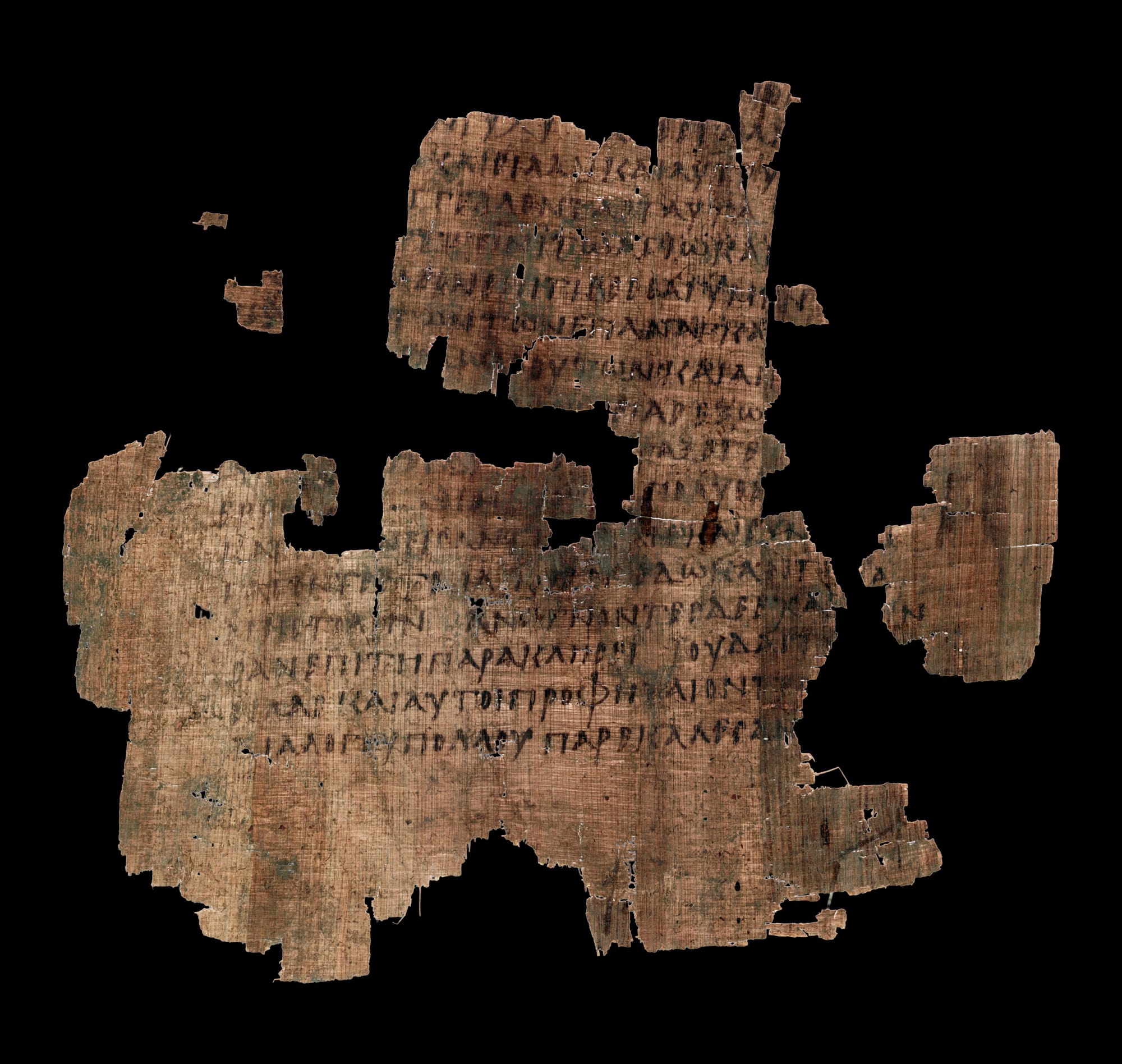
A small Greek papyrus held in Vienna may preserve part of a Christian text that was previously unknown, according to researchers at the University of Athens. Amphilochios Papathomas and Marianna Thoma think the passage is about Jesus and may come from a Christian work that is otherwise lost. Their findings were published in the journal Tyche on 19 January 2026.
What the fragment is
The papyrus, catalogued as P.Vindob. G 29289, is a Late Antique Greek papyrus from the Austrian National Library's collection, and the Tyche article offers its first edition with translation and commentary. The fragment, approximately two by three inches, was hitherto unpublished. On the researchers' tentative reading, its damaged writing speaks of a death and of a figure who went down and apparently came up again. According to the article's abstract, the text does not appear to be known to the medieval tradition.

Working from the original in Vienna, the pair transcribed what survives of the Greek and set its script and language against other ancient manuscripts and Christian texts. On the front, the abstract says, the text refers to the proper conduct of life for a Christian, while on the back the death and resurrection of Christ are discussed.
The reading on the back
The key passage is a damaged phrase on the reverse. In the Daily Mail's English rendering, the researchers' tentative reading is: '… alone (?) he who descended (into Hades) ascended again (?) …'. The researchers added the words 'into Hades' to explain their interpretation, and the last word, rendered 'ascended', is only partly preserved. The researchers wrote, in a passage translated from German, that the sense of the passage is probably that only Jesus and no one else went into Hades and returned through his resurrection. Christian tradition has long held that before his resurrection Jesus went down into the realm of the dead and set free the righteous who had died before him.
To support the reading, the researchers examined parallels including passages attributed to Eusebius of Caesarea, an early Christian historian and theologian, describing the Saviour's descent into the regions of the dead. One Eusebius passage has the Saviour descending alone, echoing the lone figure who went down in the researchers' reading of the fragment. Another word that survives seems to mean 'swallowed'. The researchers think death may be what does the swallowing, and point to early Christian texts in which death swallows people but cannot overcome Christ.
Gaps and alternative readings
Several words are incomplete or reconstructed, so the interpretation cannot be considered definitive. Towards the end of the passage, the start of the word read as 'ascended' is crammed against the edge of the sheet, and the rest of it has been lost. The researchers acknowledged other possible restorations, including a word meaning 'was raised'. The authors also weighed a less likely reading in which the descent is Jesus coming down from heaven to live as a human, not going into the realm of the dead.
The fragment is not a complete account of the Resurrection, and it gives no full narrative of an empty tomb or of Christ appearing to his disciples. Significant sections are missing. The sheet has three horizontal folds and seems to have split along the top two. A blank stretch after the last surviving line suggests the passage may have ended a section of the original work.
The other side of the sheet
The front seems to give moral advice: it calls the reader a 'wanderer' and warns against hoping for life while following the 'broad road'. A sermon by Saint John Chrysostom, the fourth-century Archbishop of Constantinople, contains a comparable warning, the researchers note. But one damaged verb might be a past-tense description of someone walking rather than an order to 'walk', in which case the passage could be about Jesus' own life. According to the team, one scribe wrote both sides, in a careful literary hand.
Date and origin
Comparing the handwriting and language with other ancient manuscripts, the researchers lean towards the fourth or fifth century AD, while accepting that it could be as early as the late third century. The handwriting comparisons drew on examples from several centuries, among them the Egerton Gospel and other Christian papyri. That date applies to this copy, not necessarily to when the work was first written, and the study reports no radiocarbon dating.
Where the papyrus was found is unknown: the library's inventories give no precise origin, though the researchers think it may be from the Fayum region of Egypt or Hermopolis, both sources of material in the collection.
What kind of text it might be
The abstract says the text is most likely a homily of a church father or a local priest, bishop or patriarch. It adds that other early Christian genres, including exegetical texts and commentaries, encomia, hymns and paraphrases of New Testament passages, cannot be ruled out. Double slashes that divide the text are a further clue: similar marks are found in early Christian manuscripts and hymns, which supports the idea that the text may be poetic. The researchers hope that publishing the fragment will help others work out what the original text was, or turn up more pieces of the same papyrus.
Sources
Giannopoulos, B. (2026) '1,600-Year-Old Papyrus May Reveal Lost Account of Christ', Greek City Times, 5 November 2026, available at: https://greekcitytimes.com/2026/11/05/ancient-greek-papyrus-jesus-descent-hades/ (Accessed: 5 November 2026).
Liberatore, S. (2026) 'Lost account of Jesus's descent to hell and resurrection uncovered in 1,600-year-old papyrus, researchers suggest', Daily Mail, 4 November 2026, available at: https://www.dailymail.com/sciencetech/article-16266101/jesus-descent-hell-resurrection-papyrus.html (Accessed: 5 November 2026).
Papathomas, A. and Thoma, M. (2026) 'Erstedition eines christlich-literarischen Fragments aus der Sammlung der Österreichischen Nationalbibliothek', TYCHE – Beiträge zur Alten Geschichte, Papyrologie und Epigraphik, 19 January 2026, available at: https://tyche.univie.ac.at/index.php/tyche/article/view/10116 (Accessed: 5 November 2026).
Picture credits
- Top picture: A different papyrus, not the fragment in this story: a Greek fragment containing Acts 7:13–18. Image: Greek papyrus fragment, Austrian National Library, Vienna (public domain) (source)
- The Austrian National Library in Vienna holds the papyrus. Image: Herbert Frank, CC BY 2.0, via Wikimedia Commons
- Map: drawn from Natural Earth (public domain) and Wikidata.

