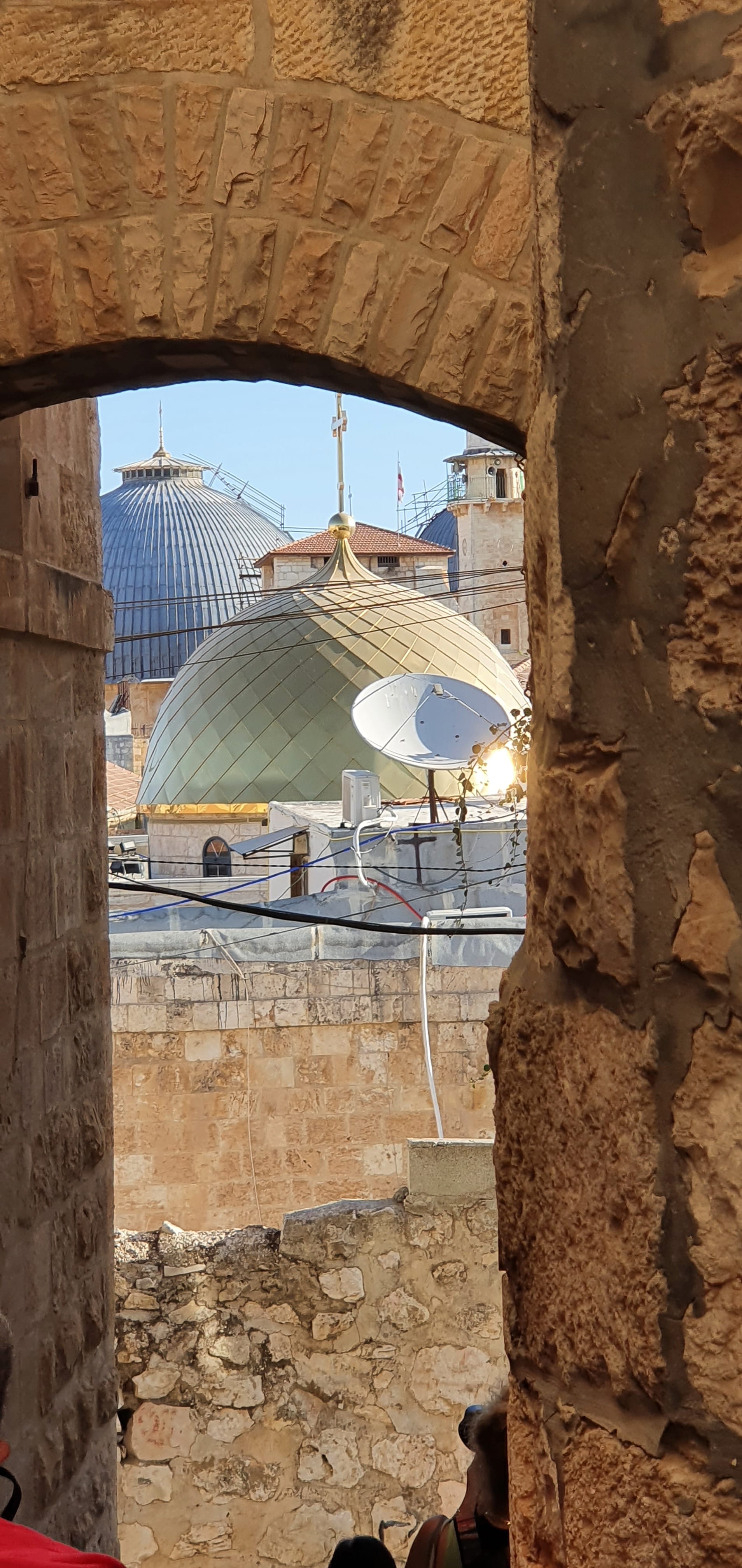
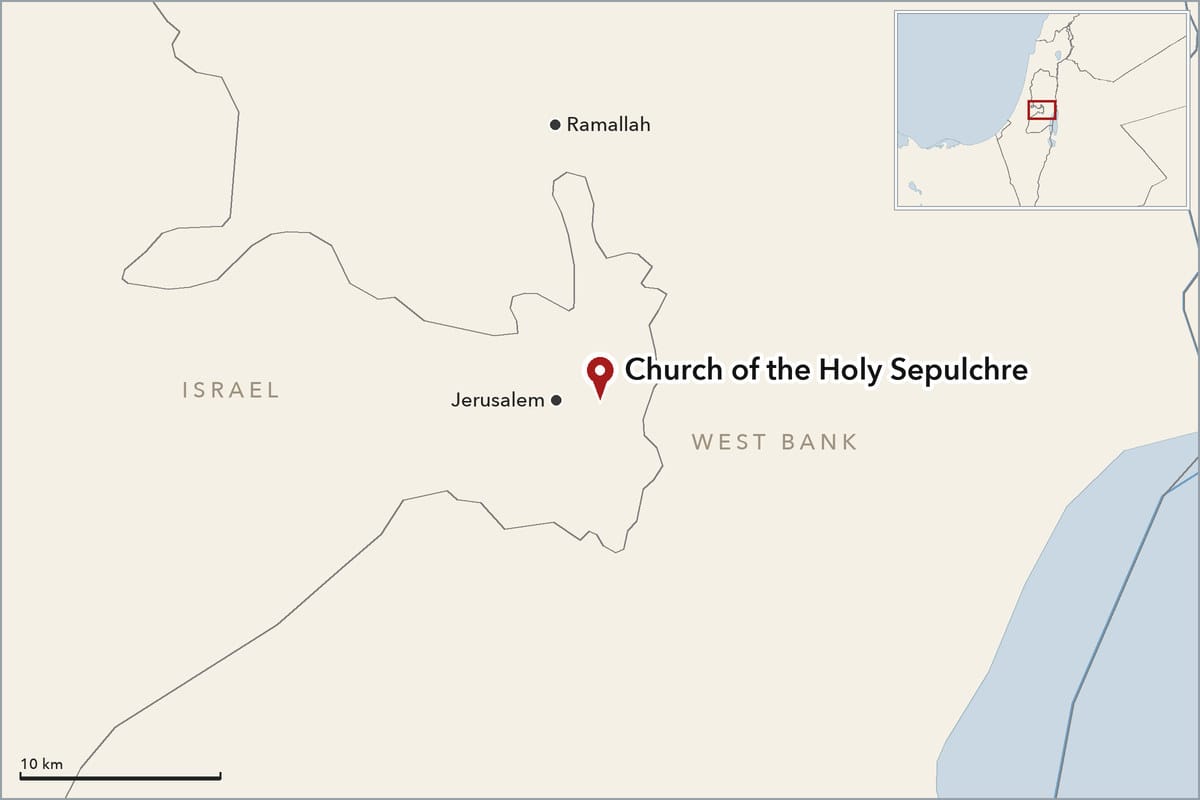
On 17 October 2026, IBTimes UK and Internewscast both reported that archaeologists working under the Church of the Holy Sepulchre in Jerusalem have identified the remains of a circular marble monument. Internewscast puts it at about 20 feet (roughly 6 metres) across, and it once surrounded the rock-cut chamber that many Christians venerate as the tomb of Jesus. The excavation is led by Francesca Romana Stasolla of Sapienza University of Rome.
The size is the headline figure. The more interesting part is what the excavators leave open.
What was found
Internewscast says the surviving structure was built from recycled marble slabs, shaped and joined with mortar into a circular platform centred on the burial chamber. IBTimes UK likewise describes reused marble pieces joined with mortar around the chamber. IBTimes UK adds that much of the structure's original appearance, layout and decoration remains uncertain.
Two of the slabs carry faint traces of decoration. According to Internewscast, the patterns appear to date from after Constantine's reign. IBTimes UK cautions that decoration alone cannot give a firm construction date.
What it does not settle
IBTimes UK is explicit that the newly identified structure does not resolve who was originally buried in the chamber. It treats the question of the tomb's identity as separate from what the marble can show.
Internewscast reports that the rock around the chamber had been deliberately cut away, and quotes Stasolla describing it as "the chamber in which tradition recalled the deposition of Christ." Internewscast says she wrote in the excavation report: "It is nonetheless possible that the memory of this tomb had crystallized within the early community and had been transmitted across generations." That is a stated possibility about how a tradition was handed down. It is not a claim that the occupant has been identified.
Internewscast also quotes Stasolla on the monument's restraint: "The monumentalization was kept to a minimum, in an effort to preserve as far as possible the original appearance of the venerated Tomb."
The date is the open question
Internewscast says researchers called the remains "the earliest archaeologically documented monument built around the venerated tomb", while noting that the surviving marble could belong to a later construction phase. IBTimes UK reports that Stasolla has suggested some of the surviving marble could be associated with repairs after the Persian attack on Jerusalem in 614; Internewscast puts it more broadly, saying she raised the possibility that the surviving marble belonged to restoration work after that attack. IBTimes UK calls this a proposed interpretation rather than a settled conclusion, still being evaluated. Internewscast says researchers are examining the mortar to establish when different parts of the structure were assembled.
Internewscast reports that the circular shape closely matches early depictions of the shrine, while IBTimes UK says researchers believe it may correspond to them. Internewscast says archaeologists therefore believe the original fourth-century structure may have followed the same design. IBTimes UK adds that a resemblance to historical representations does not show that every feature of the original monument has been recovered.
On the reporting so far, the dating of the surviving marble is still being evaluated.
The wider picture
Internewscast says the first church on the site was dedicated in AD 335, and that Constantine's builders excavated around a single tomb already being venerated, separating it from surrounding graves. It dates the church standing today to building and restoration beginning around 614 to 626, after the Persian Sassanid invasion. That compresses a longer history: Christianity Daily notes further damage under the Fatimid caliph al-Hakim in the 11th century, and says the Crusaders later gave the church the layout and style it has today. According to IBTimes UK, the church suffered damage in the Persian conquest of 614 and further destruction, rebuilding and restoration in later centuries.
The identification of the site is disputed. Internewscast reports that many scholars support the Church of the Holy Sepulchre's identification, pointing to the first-century rock-cut tombs found there, while other researchers argue that the Garden Tomb, another ancient burial site in Jerusalem, fits the biblical descriptions more closely.
An earlier report described a similar find. Christianity Daily reported on 27 March 2025 that Stasolla's team had uncovered a circular marble base beneath the aedicule, the shrine encasing the tomb. It described the base as believed to be part of Constantine's original structure and said tests to determine the marble's origin were under way.
The project behind it
The work is part of the Hagia Polis Project. IBTimes UK links the investigations to a wider programme tied to restoration of the church's floor, and says preliminary reports for 2022 to 2025 are published through Liber Annuus and the University of Rome's research repository.
Internewscast says the latest findings are presented in a 605-page report based on excavations between May 2022 and October 2025. Separately, Custodia di Terra Santa reported on 19 September 2026 that the first volume of the project's book series, Hagia Polis Project. Excavations at the Holy Sepulchre in Jerusalem. Vol. 1 Project and methodology, edited by Stasolla, was presented at a conference at Sapienza on 17 September 2026. Custodia said seven more volumes would follow in the coming years, with the second already in preparation.
Sources
Christianity Daily (2025) 'Ancient Garden Found Beneath Church of the Holy Sepulchre, Supporting Gospel of John', Christianity Daily, 27 March 2025, available at: https://www.christianitydaily.com/news/ancient-garden-found-beneath-church-of-the-holy-sepulchre.html (Accessed: 19 October 2026).
Florentino, J.R.J. (2026) 'Archaeologists Unearth 20FT Marble Monument Beneath Jerusalem Church at Centre of Jesus Tomb Mystery', International Business Times UK, 17 October 2026, available at: https://www.ibtimes.co.uk/circular-marble-monument-jerusalem-holy-sepulchre-1826181 (Accessed: 19 October 2026).
Internewscast (2026) 'Search for Jesus' Tomb Reveals Ancient Structure Marking Traditional Burial Site', Internewscast, 17 October 2026, available at: https://internewscast.com/news/search-for-jesus-tomb-reveals-ancient-structure-marking-traditional-burial-site/ (Accessed: 19 October 2026).
Sandionigi, G. (2026) 'Excavations at the Holy Sepulchre: first volume of the Hagia Polis Project presented at Sapienza', Custodia di Terra Santa, 19 September 2026, available at: https://www.custodia.org/en/news/excavations-at-the-holy-sepulcher-the-first-volume-of-the-hagia-polis-project-at-sapienza-university/ (Accessed: 19 October 2026).
Picture credits
- Top picture: The Church of the Holy Sepulchre, Jerusalem. Photo: Yair Haklai (CC BY-SA 4.0), via Wikimedia Commons
- Map: drawn from Natural Earth (public domain) and Wikidata.
