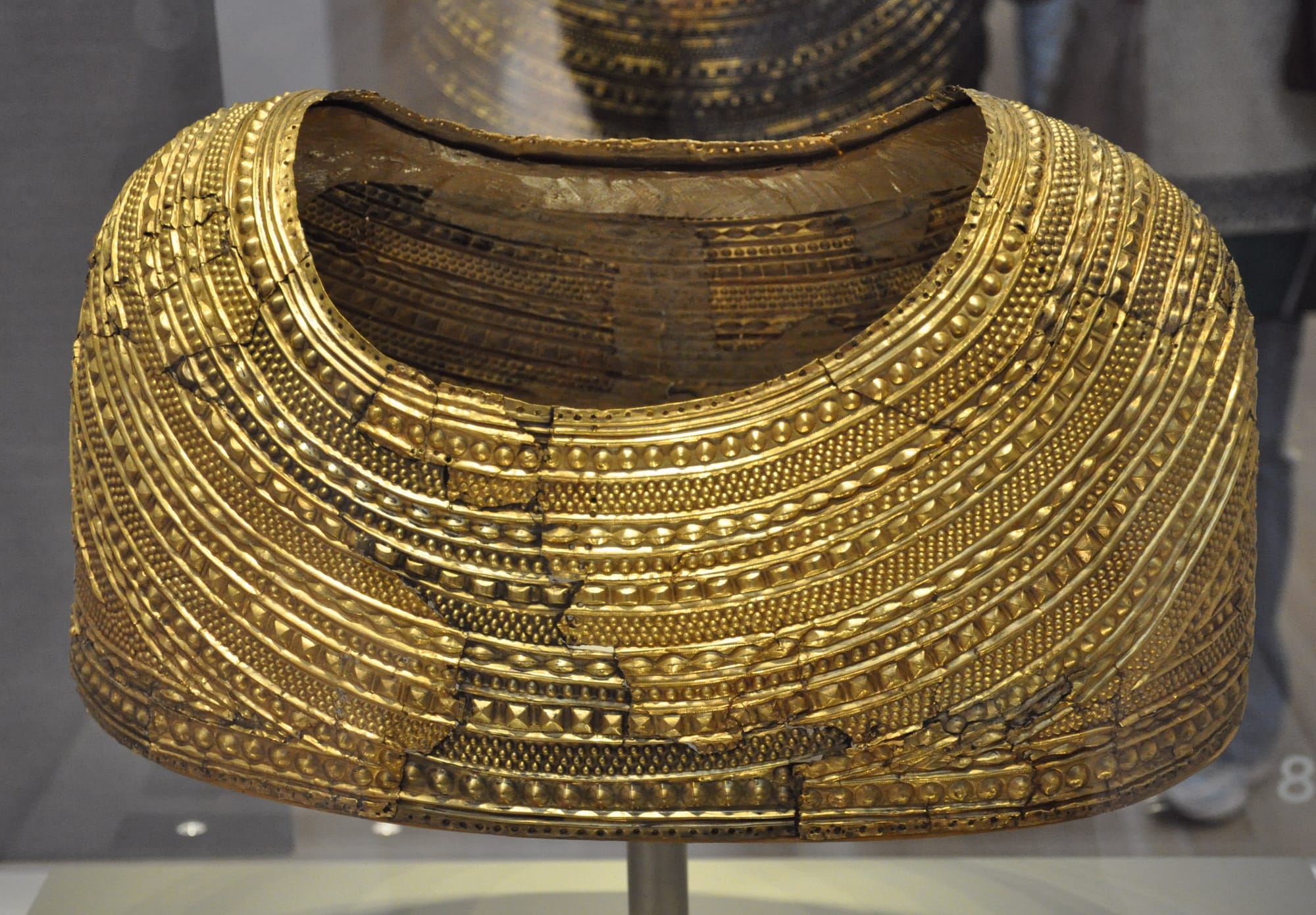
On 11 October 1833, workmen taking apart a mound near the town of Mold in Flintshire, north Wales, broke into a stone-lined grave. Inside was a skeleton with a mass of crushed gold wrapped around it. The British Museum says the object dates to about 1900–1600 BC, and describes it as a ceremonial garment of beaten sheet gold. It has taken well over a century of piecing together to understand what it was.
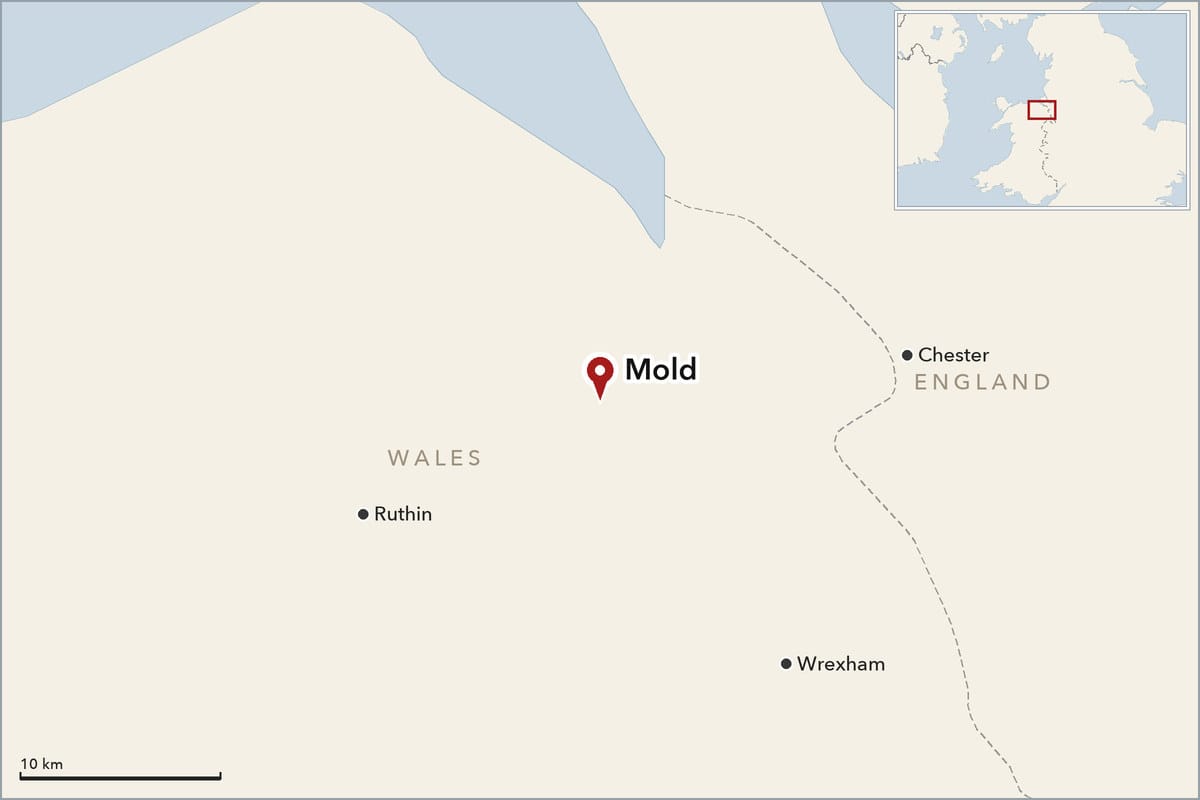
A mound called Goblins' Hill
The British Museum's learning guide says the mound was known locally as Bryn yr Ellyllon, which it translates as Hill of the Goblins. The workmen wanted the stone inside it for road building. Wikipedia notes that accounts of the exact circumstances vary: the gold was found either while a gravel pit was being filled or while the men were quarrying for stone.
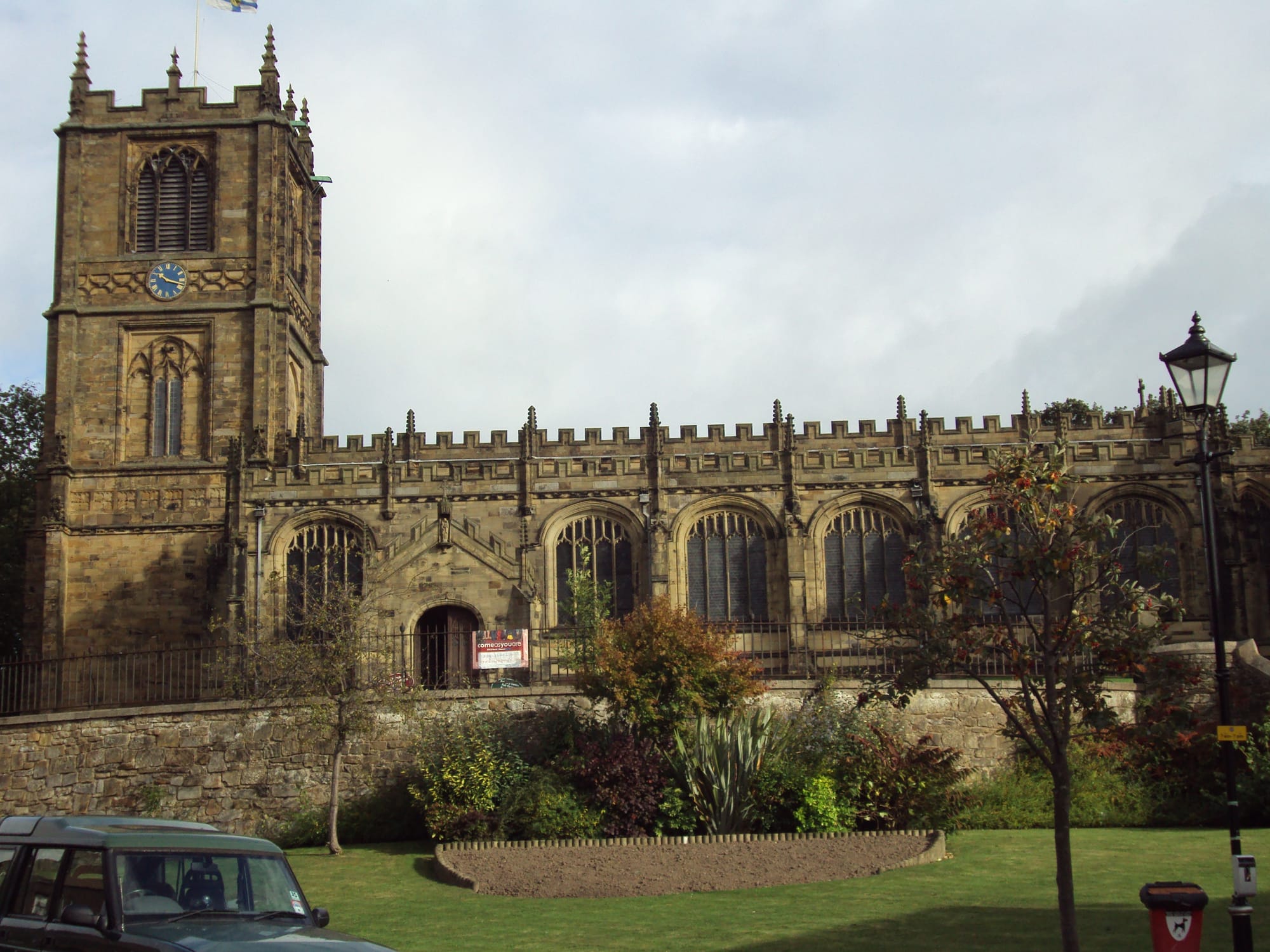
At the centre of the mound, the museum's object record says, the crushed cape lay around the fragmentary remains of a skeleton. Strips of bronze and a number of amber beads came out of the mound as well. The museum's learning guide says the vicar of Mold, Charles Butler Gough, recorded everything found.
The cape did not survive the dig in one piece. According to the museum, it broke up during recovery and the pieces were dispersed among various people. Some of the gold and some of the beads were shared out among the workers and a Mr Langford, who rented the field. He sold his three large pieces to the British Museum in 1836. The museum says it acquired the greater proportion that year, and that small fragments have come to light since and been reunited with it.
The beads fared worse. The Mystery of the Mold Cape, an online exhibit by Google Arts & Culture drawing on the British Museum's collection, says several hundred amber beads were found with the cape but were given to the workmen, and that the museum holds only a single original bead today.
What it is made of
The British Museum says the cape was beaten out of a single ingot of gold. Its learning guide says the cape is made from 700g of gold, and Google Arts & Culture's online exhibit says that gold was hammered into a sheet barely 1mm thick; the museum's own object record lists a measured sample of the sheet at just 0.11mm. The finished cape, as recorded in the museum's object record, weighs 560g. Live Science gives its size as roughly 23.5 centimetres tall and 46.5 centimetres (18.3 in) wide, matching the 465mm length in the museum's object record.
The surface is covered in ribs and bosses. The museum says they appear to imitate multiple strings of beads set among folds of cloth, and its guide says the pattern was made by pressing the gold out from behind with a punching tool. According to the museum's object record, small holes along the upper and lower edges indicate the cape was once fixed to a lining, perhaps of leather, that has since rotted away. Wikipedia adds that 16 fragments of sheet bronze were found, likely to have backed the gold.
The British Museum calls it one of the finest examples of prehistoric sheet-gold working. Live Science, in an article published on 26 October 2026, puts it as "one of the finest examples of prehistoric goldwork ever found", crediting the museum. Live Science quotes Benjamin Roberts, whom it describes as then curator for the European Bronze Age collections at the British Museum, telling the BBC in 2010: "The cape is unique — there is really nothing to compare it to in the whole of Europe." He added: "This makes it more difficult to understand why it was made and what significance it had."
Working out what it was
For a long time nobody knew what the crushed gold had been. The museum's guide says experts first thought it was a corselet worn by a warrior, and the museum's object record says it was at one time interpreted as a peytrel, a chest ornament for a horse. Live Science, citing Roberts' 2010 comments to the BBC, says experts assumed it had belonged to a warrior, chief or religious leader, given the spectacular design.
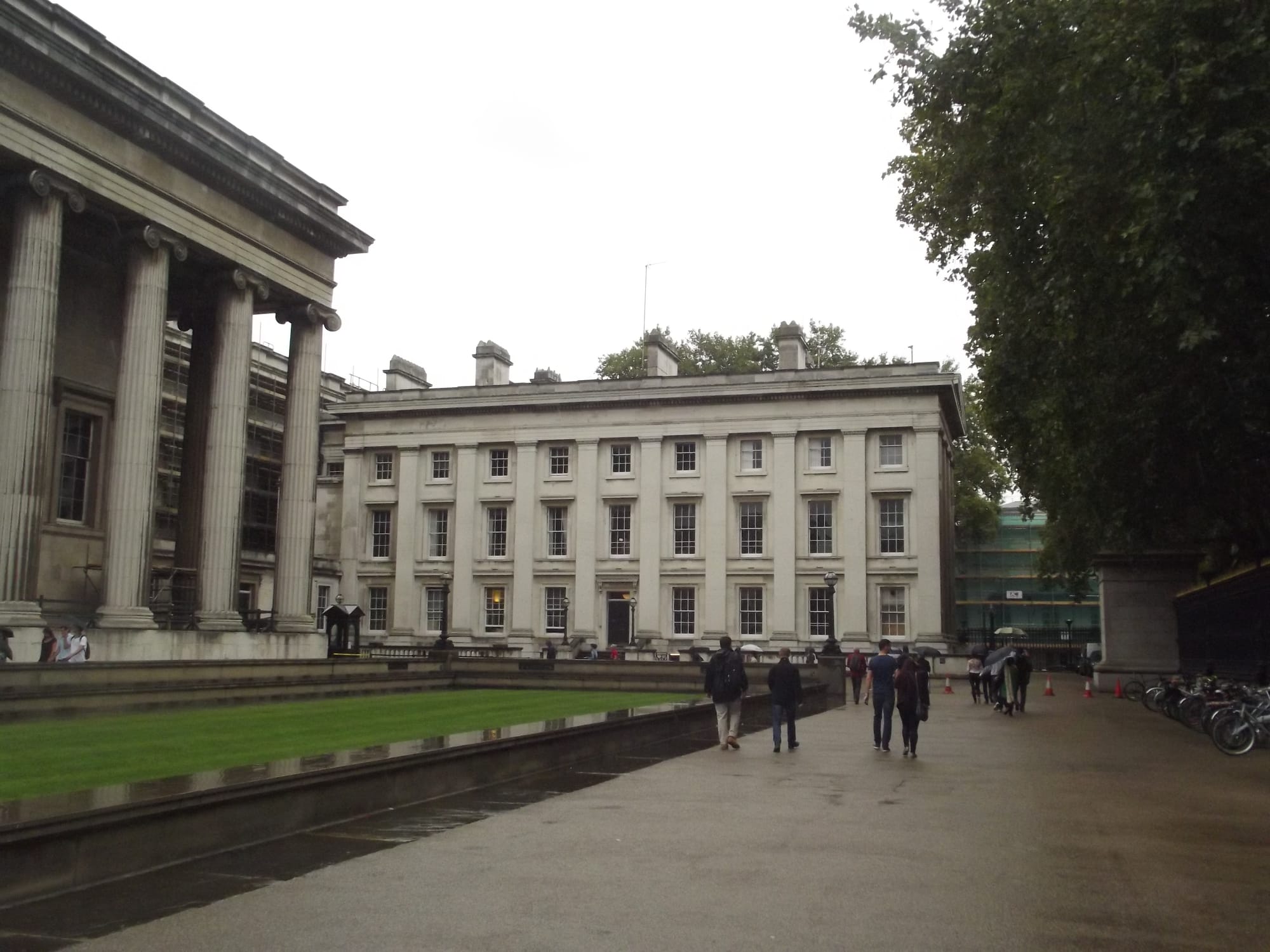
The British Museum says the cape was restored there in the 1960s, and its guide says this revealed that it was a cape; Google Arts & Culture's exhibit says the work revealed its unique oval form. The museum's guide says further work in 2002 filled in missing parts to create a complete shoulder cape. The museum's record adds that a second, smaller object in a matching embossed style was also in the grave.
Who wore it?
The British Museum cannot say for certain. Google Arts & Culture's online exhibit says the finds associated with the burial suggest a woman, but that "we can't be sure". The museum's guide says the cape would fit a slender man or woman, and that few bones from the mound survived. Current Archaeology, in a piece published by The Past on 28 September 2025, said conservation and reconstruction have revealed the cape's diminutive size and that it seems more likely to have been made for a petite woman or a young teenager.
The cape itself limits what its wearer could do. The British Museum says it would have severely restricted upper arm movement, making it unsuitable for everyday wear, and that it would instead have served ceremonial roles and may have denoted religious authority. A garment that pins the arms to the sides is not a practical one, which makes the ceremonial reading a reasonable one.
Beyond that, the possibilities are wide. Google Arts & Culture's online exhibit says the person may have been a religious leader, a social ruler or even a human sacrifice, and that they may have been associated with powerful copper-mining societies in northern Wales. Wikipedia says scholars speculate the cape's makers and owners were linked to the mine on the Great Orme, which it describes as the largest copper mine in north-west Europe at that time. The exhibit also notes that some have linked the shining cape to sun worship and to monuments such as Stonehenge that appear to be aligned with the solstices.
Where it is now
The Past reported on 28 September 2025 that the cape had been on display at the British Museum since its acquisition but was then on loan to the Museum of Liverpool, in an exhibition running until 29 March 2026. Live Science, on 26 October 2026, describes it as on display at the British Museum.
Wikipedia lists repeated calls from local politicians and others for the cape to be returned to a museum in Wales, in 2002, 2011, 2018 and 2022. It notes that the cape was lent to Wales in 2013, and that in 2011 it was stated that repatriating artefacts was not part of the Welsh Government's strategy. It also says small fragments of the cape are on permanent display in the Daniel Owen Centre's museum in Mold.
Sources
British Museum (n.d.) 'Mold Cape' (object record, reg. no. 1836,0902.1), Google Arts & Culture, available at: https://artsandculture.google.com/asset/the-mold-gold-cape/NQGcImW_1KmRVQ?hl=en (Accessed: 26 October 2026).
British Museum (n.d.) 'The Mold Cape: Prehistoric Britain: a Key Stage 2 guide to the Mold Cape', Google Arts & Culture, available at: https://artsandculture.google.com/story/the-mold-cape/VgVRiXmzf05eLw (Accessed: 26 October 2026).
Google Arts & Culture (n.d.) 'The Mystery of the Mold Cape', Google Arts & Culture (content from the British Museum), available at: https://artsandculture.google.com/story/the-mystery-of-the-mold-cape/9wWBTPgoiZ9HAw?hl=en (Accessed: 26 October 2026).
Krakowka, K. (2025) 'Curating the Mold Cape: Museum of Liverpool', The Past (from Current Archaeology issue 428), 28 September 2025, available at: https://the-past.com/shorts/the-picture-desk/curating-the-mold-cape-museum-of-liverpool/ (Accessed: 26 October 2026).
Killgrove, K. (2026) 'Mold gold cape: A 3,900-year-old accessory that's one of the finest examples of prehistoric goldwork ever found', Live Science, 26 October 2026, available at: https://www.livescience.com/archaeology/mold-gold-cape-a-3-900-year-old-accessory-thats-one-of-the-finest-examples-of-prehistoric-goldwork-ever-found (Accessed: 26 October 2026).
Wikipedia (n.d.) 'Mold gold cape', Wikipedia, available at: https://en.wikipedia.org/wiki/Mold_gold_cape (Accessed: 26 October 2026).
Picture credits
- Top picture: The Mold gold cape. Mold gold cape, British Museum (1836,0902.1) — photo: Andreas Praefcke (public domain), via Wikimedia Commons
- The town of Mold, Flintshire. Image: St Mary's Church, High Street, Mold — Rept0n1x, CC BY-SA 3.0, via Wikimedia Commons
- The British Museum, London. Image: British Museum, Great Russell Street — Elliott Brown, CC BY-SA 2.0, via Wikimedia Commons
- Map: drawn from Natural Earth (public domain) and Wikidata.


