A man buried in an oak boat on the North Sea coast of what is now Germany has had his DNA read, and the result is two stories at once. A team from Kiel University and the Lower Saxony Institute for Historical Coastal Research (NIhK) reports that he carried a strain of the leprosy bacterium Mycobacterium leprae, and that his genome groups with people from the Roman Danubian frontier; a model of genetic similarity put the highest-probability location more than 1,400 km south-east of his grave. The study appeared in the journal iScience on 15 October 2026, and Kiel University has issued a press release about it.
The grave
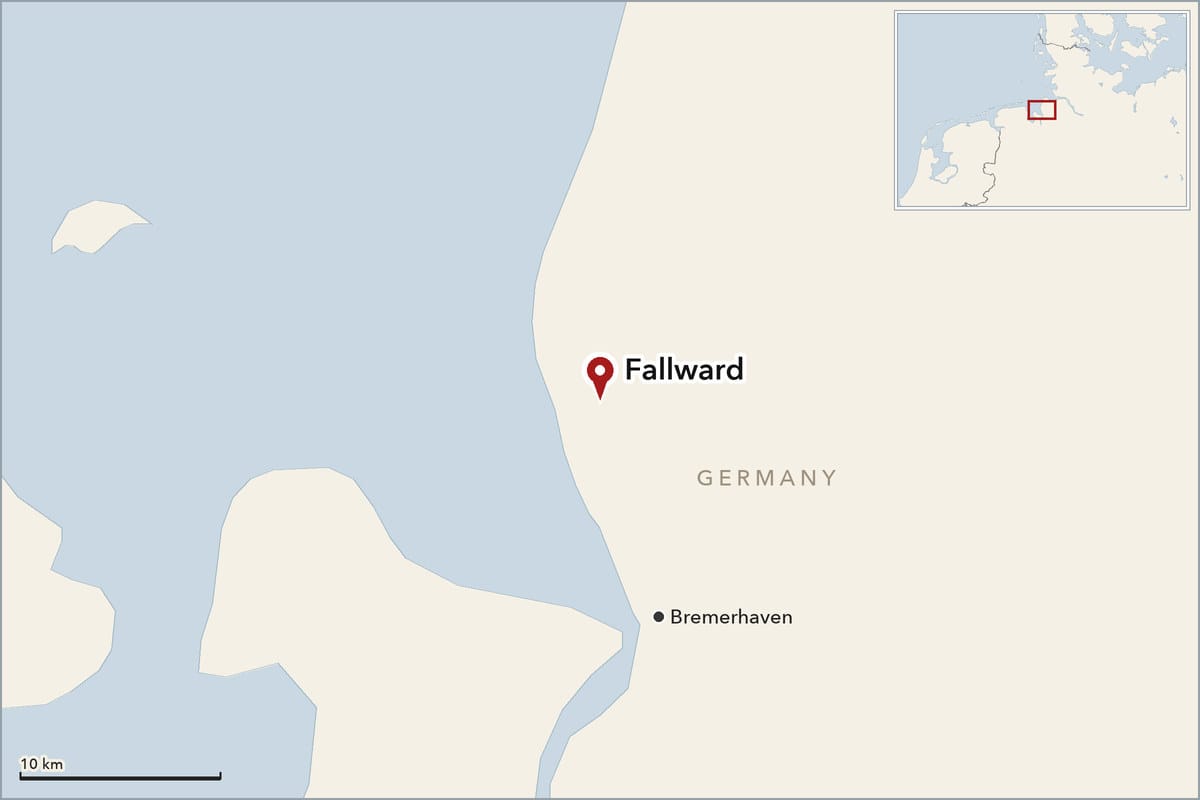
Fallward lies in the Elbe–Weser river triangle in north-western Germany. The study's authors describe a settlement built on an artificial dwelling mound, with a cemetery excavated in the 1990s that was in use from the end of the 3rd to the late 5th century CE. It held around 200 cremation burials and 60 inhumation graves. In the constantly damp ground of the marsh clay, wooden and textile grave goods survived remarkably well.
The man in grave 265 is the focus. The paper estimates that he was about 50 years old and died in the second quarter of the 5th century CE. He was laid in an oak boat more than four metres long, covered with wooden panels forming a roof-like structure. A reed mat lay under the body, and the boat held several fish bones and a small box shaped like a water bird.
Outside the boat stood a block chair made of alder, carved with notches and presumably painted. The paper notes that the chair is often interpreted as a "throne". At the man's feet was a maple stool with a hunting scene on its underside and a runic inscription. The grave also held a game table, a bronze basin, a ceramic vessel and a Roman military belt. According to the paper, the objects show signs of use and repair, so none seems to have been made only for the burial.
What the DNA says
The team took 12 skeletal samples from 11 individuals buried at Fallward. Only three gave data good enough for population genetic analysis. Two of them, G14 and G250, clustered with north-western Europeans, and most closely with Iron Age and early medieval groups, including Anglo-Saxons. The man from grave 265, labelled G265, did not. His genome clustered with Roman Iron Age and Migration Period individuals from the central and southern Danubian frontier, in what is now Croatia, Slovenia, Hungary and Serbia.
A model of genetic similarity around 500 CE put the highest-probability location for G265 more than 1,400 km south-east of Fallward, near the Roman frontier. The authors are careful about how much that proves. Their other analyses could not separate G265 from the other Fallward individuals, and they say the interpretation should be treated cautiously. In their limitations section they add that the findings rest on only three individuals, with relatively low genomic coverage, and should be regarded as individual case studies. Arkeonews, reporting the study on 4 November, likewise notes that the researchers stress the DNA is not enough to fix a precise place of origin.
The leprosy strain
M. leprae DNA turned up in two samples from G265, a tooth and a heel bone (calcaneus). Reconstructing the bacterial genome, the authors placed it in phylogenetic branch 4. In their family tree, the Fallward genome sits ancestral to the known diversity of that branch, predated only by a strain from an Egyptian mummy. The paper gives the earliest known branch-4 representative as coming from Egypt, between the 4th and 2nd centuries BCE.
Kiel University's release goes further than the paper's wording. It describes a pathogen "previously undetected in Europe", and it quotes lead author Daniel Myburgh of Kiel's Institute of Clinical Molecular Biology: "He is the first individual from this group to have been identified in Europe." The release also says the group has not yet been detected in Central or Northern Europe. Arkeonews adds a caution of its own: the find adds data on the bacterium's diversity in the ancient world but does not prove the disease travelled directly from Egypt to northern Germany.
G265's skeleton showed no leprosy-specific lesions. The paper suggests he may have had an asymptomatic form of the disease, or symptoms confined to soft tissue, and that he probably died of an unrelated cause. Almut Nebel, a co-author at Kiel, said in the release: "He may have travelled long distances whilst carrying the disease."
A boatman, a mercenary or a trader?
The authors read the boat, the fish bones, the reed mat, the water-bird box and the man's well-developed upper-arm muscles as clues that he may have worked as a boatman or fisherman. The chair, in their account, is considered a symbol of authority, and the quantity and quality of the objects are seen as reflecting privileged status and wealth in the local community.
On the Roman belt, the paper offers a hypothesis: he might have been a foederatus, a mercenary who served in the Roman army and later sought a new home in the north-west. The same passage cautions that the belt does not necessarily mean Roman military service, since such objects could also arrive through trade, inheritance or as spoils of war. Lead researcher Ben Krause-Kyora put two possibilities to the press: "He could, for example, have been a mercenary in the Roman army who later settled between the Elbe and the Weser. Or he might have undertaken long journeys as a trader."
In my view, that is as far as the evidence goes. A rich grave, Roman-influenced objects and a genome that leans towards the Danube frontier fit a man with long-distance connections. The authors themselves say his precise origin remains unresolved.
Where the work stands
The genetic work was funded by the ROOTS Cluster of Excellence. The Fallward finds are being analysed in full for the first time in a German Research Foundation (DFG)-funded project at the NIhK in Wilhelmshaven, according to Kiel University's release.
Sources
Altuntaş, L. (2026) '1,500-Year-Old Boat Grave in Germany Reveals a Wooden Throne and Roman Links', Arkeonews, 4 November 2026, available at: https://arkeonews.net/1500-year-old-boat-grave-in-germany-reveals-a-wooden-throne-and-roman-links/ (Accessed: 4 November 2026).
Kiel University (2026) 'Human and Disease Mobility in Late Antiquity', Uni Kiel, 4 November 2026, available at: https://www.uni-kiel.de/en/details/news/195-fallward-lepra (Accessed: 4 November 2026).
Myburgh, D.A., da Silva, N.A., Romeyer-Dherbey, J.H., Grefen-Peters, S., Jöns, H., Peek, C., Nebel, A. and Krause-Kyora, B. (2026) 'Paleogenomics reveals leprosy at the late antique burial site of Fallward in northern Germany', iScience, 29(11), 117877, 15 October 2026, doi: 10.1016/j.isci.2026.117877, available at: https://pmc.ncbi.nlm.nih.gov/articles/PMC13691272/ (Accessed: 4 November 2026).
Picture credits
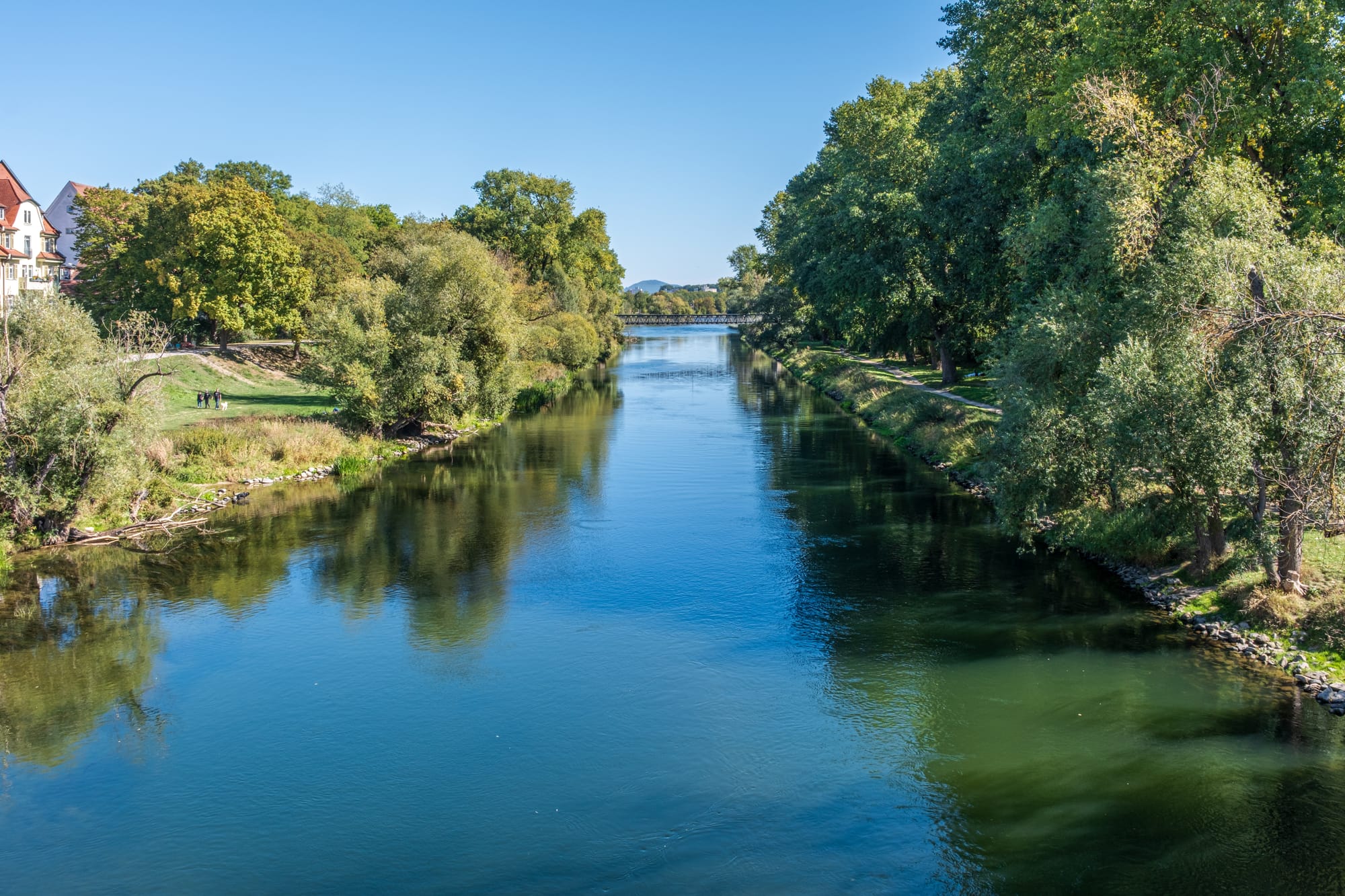
- Top picture: The Danube at Regensburg. G265's genome most resembles people from the central and southern Danubian frontier, in what is now Croatia, Slovenia, Hungary and Serbia. Image: Dietmar Rabich / Wikimedia Commons / "Regensburg, Donau -- 2026 -- 4425" / CC BY-SA 4.0
- Map: drawn from Natural Earth (public domain) and Wikidata.
