
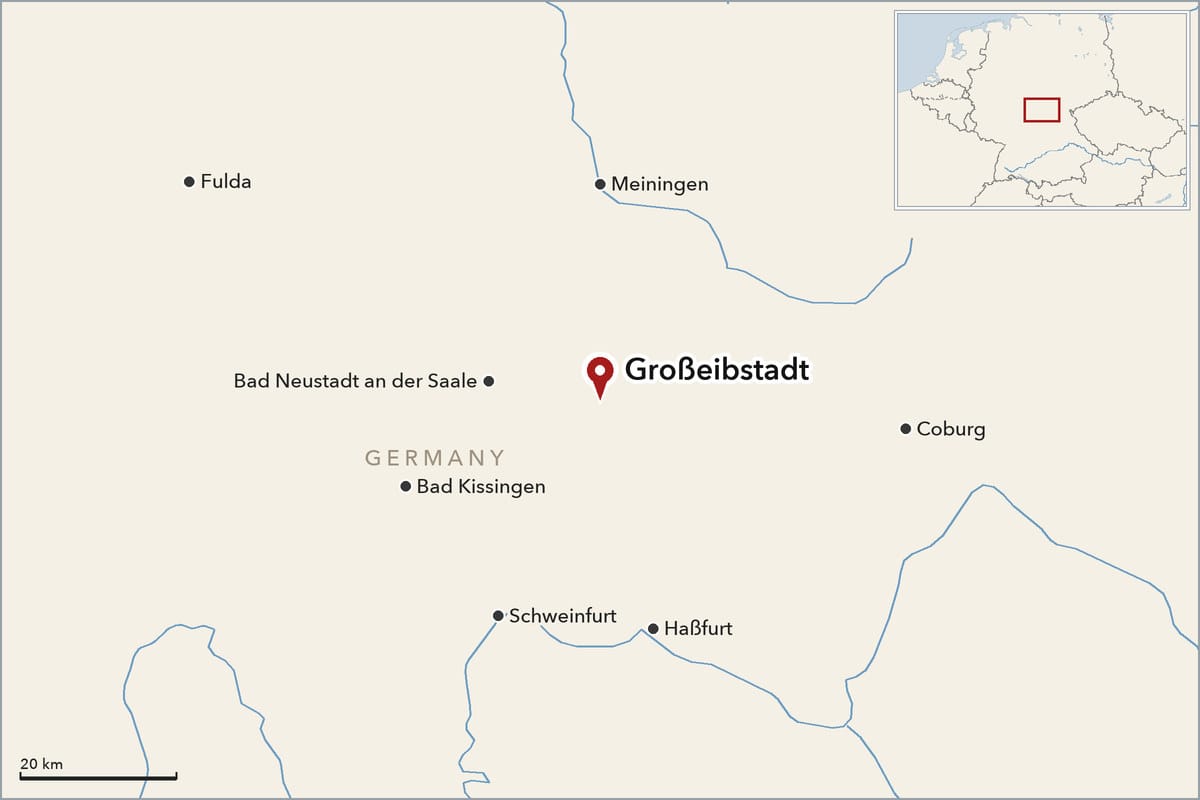
Archaeologists in Bavaria have discovered a sandstone casting mould used to produce bronze swords about 3,000 years ago. It turned up in summer 2025 during excavations at a lowland settlement near Großeibstadt in Lower Franconia, dating from the Urnfield period (1300–800 BC). The Bavarian State Office for Monument Protection (BLfD) and the Bavarian State Archaeological Collections (ASM) presented the find to the public at a meeting in Munich on 11 November 2026.
A sword mould and a pendant mould
What survives is one complete half of a sandstone mould for casting a tanged bronze sword. It is the first of its kind found in Bavaria and gives direct evidence of how Bronze Age craftsmen produced weapons.
Researchers also identified a second stone mould, for casting a decorative pendant, and other traces of metalwork at the same settlement. The BLfD's press release says its experts are certain that a bronze smith worked there about 3,000 years ago.
A second case: the Grabenstätt hoard
The second find presented that day came from near Grabenstätt in the Chiemgau region of Southern Bavaria. In October 2024, a person searching with a metal detector came across numerous bronze objects in a field. Researchers dated them to the Late Urnfield period, about 880–800 BC. The BLfD's press release says the objects are parts of a hoard that must have been shifted unnoticed during earlier earthworks and spread over a large area.
Through 2025 and 2026 the finder kept searching the field systematically in close coordination with the BLfD. In all, 52 solid arm and leg rings, two winged axes, fragments of a sheet-metal arm ring, parts of at least one bronze cup and a plate-sized cake of casting metal were recovered. That makes it one of the largest hoards of its date and composition in southern Bavaria. Why the objects were brought together, and how they first came to be in the ground, is still not known.
What the law changed
The two finds were presented together to show the effect of Bavaria's new rules on archaeological finds. On 1 July 2023 an amendment to the Bavarian monument protection law ended the earlier division of finds, and archaeological finds now belong to the state alone rather than half to the finder and half to the landowner. Landowners and finders receive a compensation or reward payment if a find is worth more than 1,000 euros and was recovered lawfully.
The ASM valued the two Großeibstadt moulds at a four-digit sum in euros, which the state is paying to the landowner as compensation. The finder of the Grabenstätt hoard and the landowners will also be paid once the ASM has valued the find.
Dr. Stefanie Berg, head of the BLfD's archaeological heritage department, said on 11 November that 24 regional institutions already meet the criteria for having finds transferred to them and that 25 applications were pending. Prof. Dr. Rupert Gebhard of the ASM said that, with its branch museums and municipal loan partners, about 9,000 archaeological objects are currently on display at 130 locations across Bavaria.
Sources
Altuntaş, L. (2026) 'Rare 3,000-Year-Old Bronze Age Sword Mold Discovered in Germany', Arkeonews, 13 November 2026, available at: https://arkeonews.net/rare-3000-year-old-bronze-age-sword-mold-discovered-in-germany/ (Accessed: 13 November 2026).
blfd.bayern.de (n.d.) 'blfd.bayern.de', blfd.bayern.de, available at: https://www.blfd.bayern.de/mam/blfd/presse/pressemitteilung_++_das_schatzregal_in_der_praxis__wie_bayern_sein_arch%C3%A4ologisches_erbe_sichert_++_blfd_asm.pdf (Accessed: 13 November 2026).
blfd.bayern.de (n.d.) 'Herzlich willkommen!', blfd.bayern.de, available at: https://www.blfd.bayern.de/blfd/presse/ (Accessed: 13 November 2026).
Picture credits
- Top picture: Munich, where the finds were presented on 11 November 2026. Munich Cityscape, photo by John-Morgan (CC BY 2.0) (source)
- Map: drawn from Natural Earth (public domain) and Wikidata.