Archaeologists digging a Roman-era cemetery near Wrocław, in south-west Poland, were close to packing up for the season when they found something far older nearby. It was a mound burial holding a nearly complete male skeleton, a necklace of 42 drilled teeth, a used stone battle axe and fragments of two more human skulls. Wrocław Medical University announced it on 2 September 2026.
A cemetery with a far older burial nearby
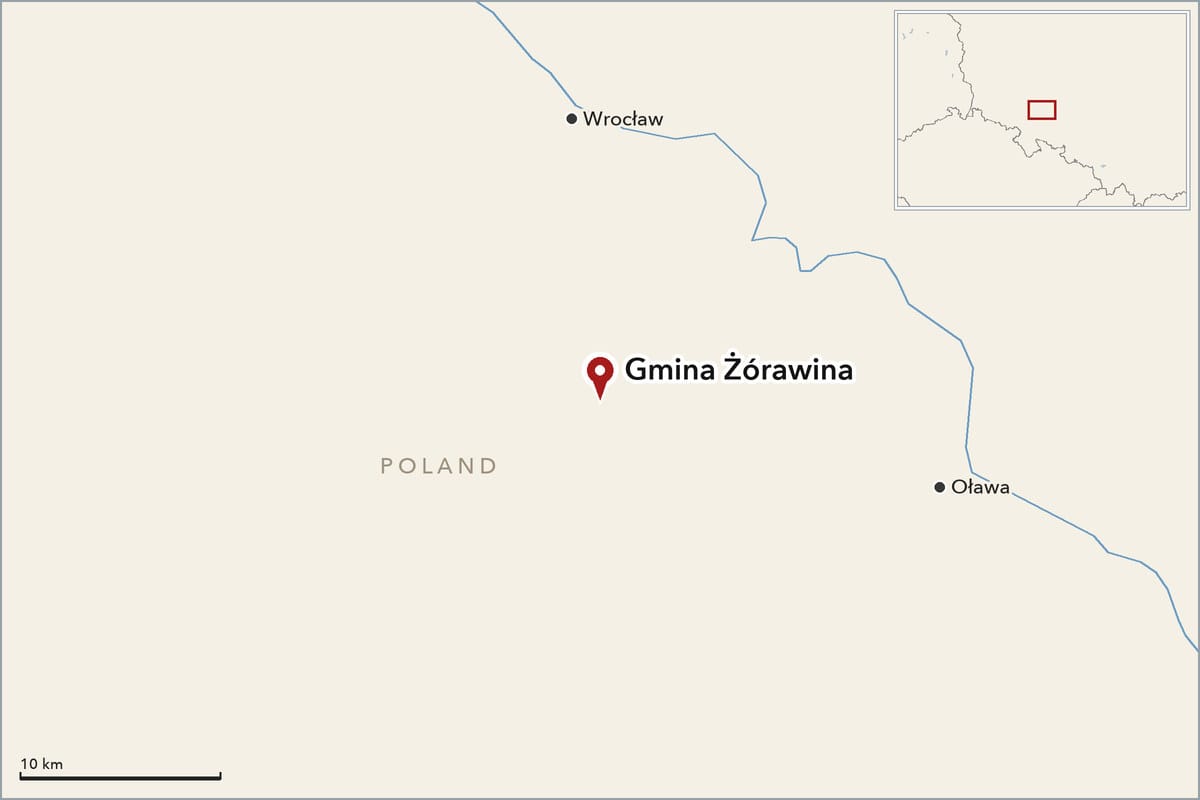
The site is at Żórawina, a village next to Wrocław. A PAP interview republished by the University of Wrocław on 4 September says researchers spent the summer there on a cemetery from the end of the Roman-influence period and the start of the Migration Period, between about 350 and 430 AD. The dig was led by Professor Tomasz Gralak of the University of Wrocław. Dr Paweł Dąbrowski, an anthropologist and anatomist at Wrocław Medical University, led the anthropological team.
The older grave turned up at the very end. Live Science's translation of Wrocław Medical University's 2 September statement has Dąbrowski saying: "We were practically packing up, and then we discovered a circular shape in the ground and began digging." Wrocław Medical University's account gives the circle a diameter of about four metres, like the outline of a burial mound.
What was in the grave
In the central chamber the team found animal teeth laid out in the shape of a necklace. Wrocław Medical University says there were 42 and that all had holes drilled through their roots. The PAP interview describes them as single-cusped incisors and canines. The cord that once joined them has not survived.
Deeper in the chamber lay the nearly complete skeleton of an adult man. Wrocław Medical University lists the other finds as:
- fragments of two adult skulls
- bone discs
- amber beads
- a flint blade
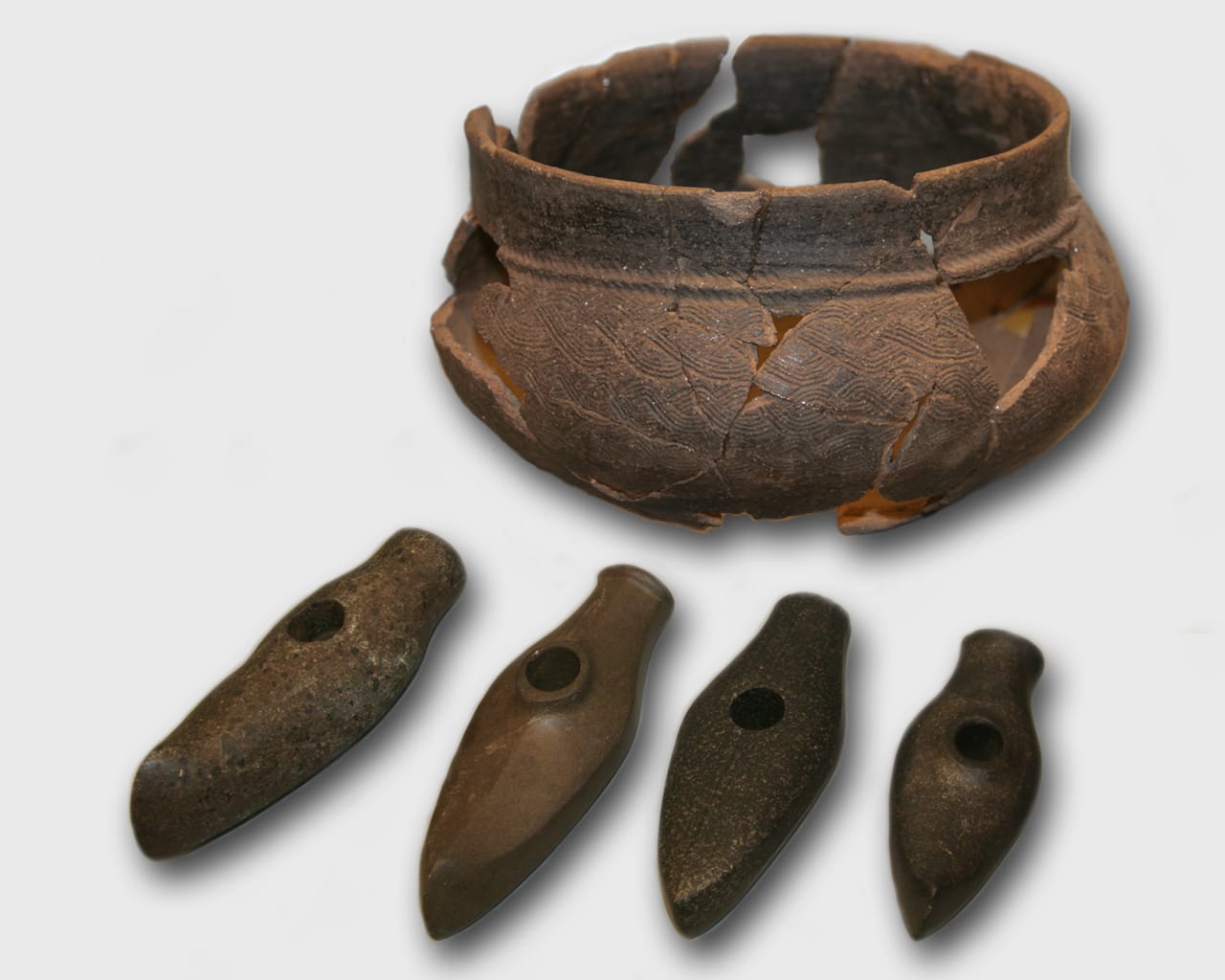
- a stone battle axe made of serpentinite
A Wrocław Medical University photo caption places the axe under the skeleton's right elbow.
Which animals?
Dąbrowski's preliminary view, from the teeth's appearance, is that they came from canids, bears and hoofed mammals. In that PAP interview he names wolves, deer and a young bear as examples. He does not rule out human teeth. Genetic analysis is planned, and Wrocław Medical University says DNA analysis should settle the species.
How the date was reached
The axe gave the first date. Its form points to about 2900 BC, which Wrocław Medical University places in the middle phase of the Neolithic in Poland. That would make the burial several thousand years older than the graves previously excavated at the site.
The date is provisional. In that PAP interview, Dąbrowski said first bone samples for radiocarbon dating had already been prepared and that results were due in the autumn. He said he was sure the figure would not differ by more than 200 years either way.
Two skulls and a hypothesis
The two skulls are described as incomplete and quite badly damaged. Wrocław Medical University says that under one preliminary hypothesis put forward by both researchers, they may have been severed heads buried with the man as gifts or votive offerings. The same statement says detailed analysis of the skull remains is meant to confirm or rule that out. Dąbrowski will look for injuries made by a sharp-edged tool. Decapitation is a hypothesis at this stage, not a finding.
A warrior, a hunter or a leader?
The axe shows signs of use and has a slightly chipped blade, so Dąbrowski thinks it was probably used for fighting or hunting; Wrocław Medical University notes that stone axes used in households were smaller. Live Science quotes him: "It's possible we've discovered the grave of a warrior or hunter, but because of this necklace, we can assume it was someone important, for example, the leader of a family clan." Wrocław Medical University adds that Gralak has often suggested the man may have been a patriarch of his kin group.
The university also says the man's identity probably cannot be established with certainty. I think that is the right note of caution: a large necklace and a used axe point to a person of standing, but they do not say who he was.
A second mound at Iwiny
According to Dąbrowski, a similar mound was found at about the same time at Iwiny, a village a few kilometres away, during rescue excavations by an archaeological firm on a building site. That PAP interview says it held a skeleton, two axes, flints and amber ornaments. A second mound found there in the days before that interview contained the bones of a calf, and Dąbrowski suggested a sacrificial animal may have been placed there.
He described them as the first mounds from a period reaching back 5,000 years found near Wrocław, though he noted that several similar ones have been found in this part of Europe. The team plans to study the two sites together.
The Corded Ware question
Wrocław Medical University's statement and that PAP interview both link the finds to the Corded Ware cultural circle. The statement says the research could provide new information about the presence of such communities in what is now Lower Silesia and the directions of their migration. Dąbrowski suggests that groups connected with the Corded Ware culture may have come from eastern Europe or even from around the Caspian Sea. Wrocław Medical University adds that if results from the two sites agree, they could shed light on where the buried people came from.
What happens next
Analysis is to be staged. After radiocarbon dating come physico-chemical, isotopic and genetic tests, including strontium isotope ratios, which can point to the conditions and place in which a person or animal lived during stages of its development. Detailed anatomical, anthropological and odontological study follows. Some bones were so fragile that they were lifted with surrounding soil. They will be X-rayed before cleaning so the team can plan how to expose them.
Dąbrowski told Wrocław Medical University he expected the first results to be known in the autumn.
Sources
Killgrove, K. (2026) 'Excavation in Poland reveals Stone Age man buried with decapitated heads and a tooth necklace', Live Science, 5 September 2026, available at: https://www.livescience.com/archaeology/excavation-in-poland-reveals-stone-age-man-buried-with-decapitated-heads-and-a-tooth-necklace (Accessed: 18 October 2026).
Nauka w Polsce / PAP (2026) 'Antropolog: znaleziony pod Wrocławiem naszyjnik z zębów pochodzi sprzed około 5 tys. lat', uwr.edu.pl, 4 September 2026, available at: https://uwr.edu.pl/antropolog-znaleziony-pod-wroclawiem-naszyjnik-z-zebow-pochodzi-sprzed-okolo-5-tys-lat (Accessed: 18 October 2026).
Giedroyć-Skiba, A. (2026) 'Niezwykły grób sprzed 5 tysięcy lat', Uniwersytet Medyczny im. Piastów Śląskich we Wrocławiu, 2 September 2026, available at: https://www.umw.edu.pl/pl/aktualnosci/niezwykly-grob-sprzed-5-tysiecy-lat (Accessed: 18 October 2026).
Picture credits
- Top picture: File photo of a Corded Ware (Boat Axe culture) stone axe, shown as an example of the type. It is not one of the finds from Żórawina. Corded Ware / Boat Axe culture stone axe, photo by Terker, CC BY 3.0, via Wikimedia Commons
- Wrocław, the city beside which the burial was found. Old houses on Rynek Główny (Market Square), Wrocław, photo by Denis Karlowski, CC BY-SA 4.0, via Wikimedia Commons
- Map: drawn from Natural Earth (public domain) and Wikidata.

