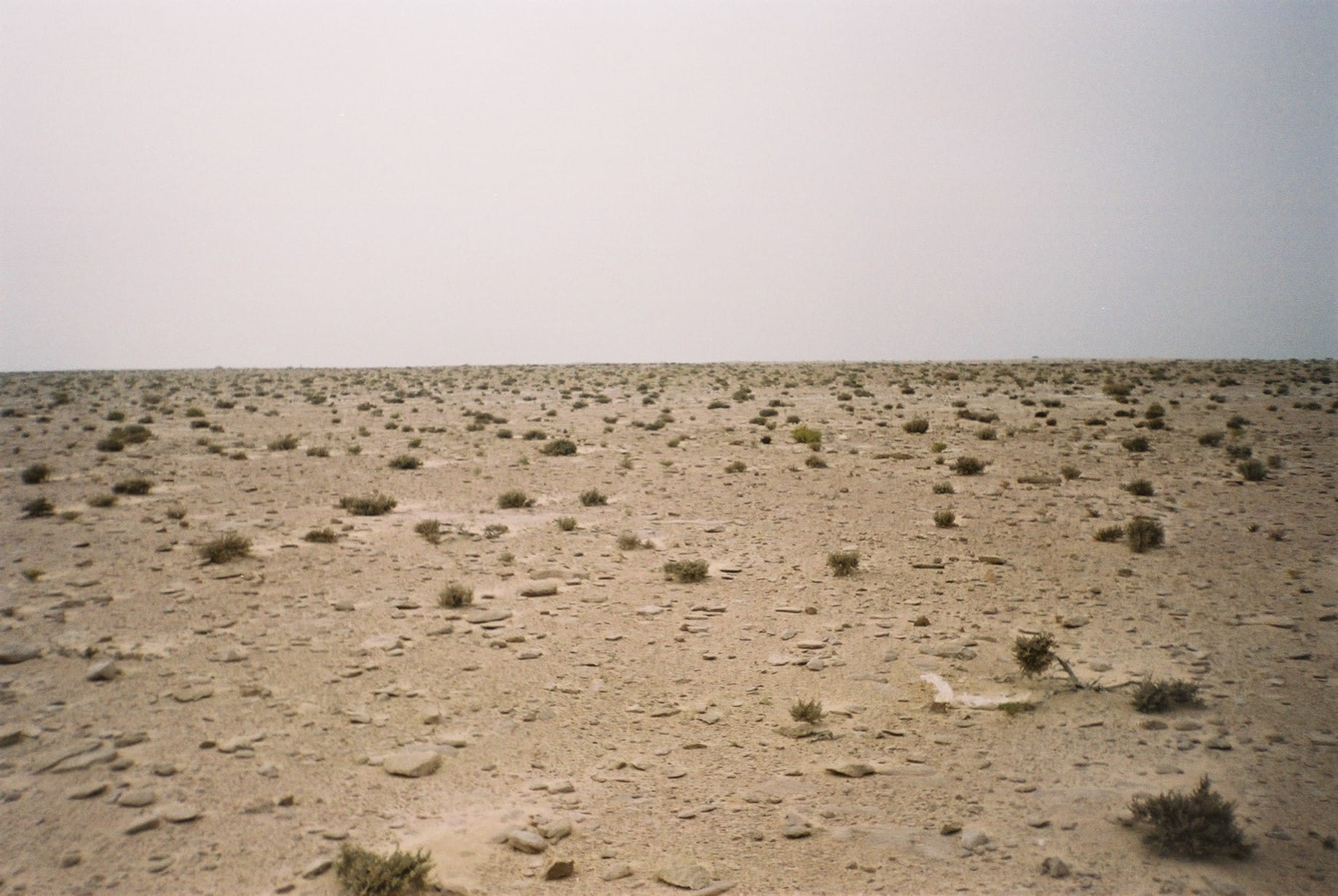
A stone monument 54.5 metres long, on a gravel plain in one of the driest parts of Western Sahara, has now been dated. A team led by Joaquim Soler reports that the single person buried beneath it died between 4417 and 4100 cal BP, a range in calibrated years before present. The authors write that this is the first absolute chronology for this type of monument in the Atlantic Sahara. The paper appeared in African Archaeological Review on 20 October 2026.
A common monument that almost nobody had dug
The monument is an antennae tumulus: a mound of piled stone slabs with two linear appendages of stones, the "antennae", running out from it. According to the paper, the type is common in Western Sahara and beyond, yet it has rarely been investigated. The authors say that although a funerary purpose could be inferred, it had never been conclusively demonstrated, and no chronology had been established.
The tomb stands on the right bank of Wadi Lawash el Telli, at the eastern edge of the Sluguilla Lawash rock art site in the north of the country. The paper puts it 910 metres from the westernmost engravings, at an altitude of about 600 metres. It describes the area as one of the most arid and inhospitable in Western Sahara.
What the monument is
The paper gives these measurements:
- Mound: oval, 12.5 metres north to south and 10 metres west to east. It is the highest part of the monument, which does not exceed 3 metres.
- Antennae: two lines of slabs extending eastward from the northern and southern ends of the mound. They begin slightly divergent, then turn convergent past the midpoint without touching.
- Orientation: the antennae point towards 102° from geographic north. The authors note that this fits the typical pattern for the type, which Rodríguez-Antón and colleagues (2023) have interpreted as possibly reflecting astronomical considerations.
It is built of local Devonian limestone slabs with no mortar or other binding. The antennae are slabs and blocks laid directly on the ground, often not touching. Apart from the slabs covering the burial, no stone reached a metre in any dimension. The authors conclude that a limited workforce could have built it within a relatively short time and without specialised infrastructure for quarrying and hauling stone.
The burial
Excavation ran from 5 to 8 April 2018, by a team from the University of Girona and the Sahrawi Ministry of Culture. The team dug only half the tumulus. That was enough to record the stratigraphy and reach the burial chamber, and it left the other half intact.
Beneath a loose outer layer of slabs lay a convex structure of large limestone slabs, each over a metre long. Under it were the remains of one individual, laid on the natural ground with no sign of a burial pit. The authors found no evidence that the grave had been disturbed or reused. The body lay on its back along a north–south axis, head to the south, with the legs folded to the west. That is the side opposite the direction the antennae point. The bones showed no sign of cremation, selection or deliberate alteration, which the authors take as primary inhumation.
The skeleton was in very poor condition. Dental wear suggests an age at death of about 25 to 35. Sex could not be determined, because well-preserved pelvic remains were absent. The authors describe the biometric data as suggesting a relatively gracile individual but say that attributing female sex would be speculative. They also report an osteophyte on a phalanx, which they say suggests possible repetitive manual activity.
The only artefacts were four ring-shaped beads made from ostrich eggshell, found where they touched the remains. The authors think they most likely formed part of ornaments worn by the dead person. Beads of this kind, they note, are widely distributed in the recent prehistory of the Atlantic Sahara, so they say little about who the person was. That is why a radiocarbon date mattered.
Getting a date out of difficult bone
Dating took seven years and a change of method. In 2018 the bone lacked enough collagen for radiocarbon results, and two attempts, on samples of 1.9 g and 19.1 g, both failed. In 2025 the team dated the mineral fraction of the bone (bioapatite) instead, sending two samples to the CIRAM laboratory. The authors say the carbon-to-nitrogen ratios of both samples fell outside the optimal range, confirming that bioapatite was the only option.
Both samples, from a humerus fragment and a femur fragment of the same individual, gave results the authors call consistent, which they say gives a high degree of confidence in the age. Calibrated, the burial falls between 4417 and 4100 cal BP. The authors date the construction of the monument to the second half of the 5th millennium cal BP.
Two other lines of evidence came to nothing. A pollen sample yielded just two grains, both pine, far below what meaningful interpretation requires, so the authors say it mostly shows very poor pollen preservation. The team also planned a 3D photogrammetric model of the monument and so did not draw plans and sections on site. The photographs later proved to overlap too little to build the model. The authors say that in hindsight the decision was inappropriate.
What the date changes
The authors place antennae tumuli at the end of the Late Neolithic sequence of stone funerary monuments, overlapping in time with crescent-shaped tumuli. They tie the result to a sequence worked out for the Tiris region in the south, where, they note, no antennae tumulus had been excavated.
The paper also records that the only other antennae tumulus excavated in Western Sahara, at Tasua wadi, yielded no archaeological material. Lawash el Telli is therefore the first to confirm a funerary use in the country. On that point the authors write that the excavation confirmed the funerary use of antennae tumuli in Western Sahara.
They are careful about the neighbouring rock art. Sluguilla Lawash has 2,068 recorded figures along a 27-kilometre stretch of the wadi, and the paper gives a provisional date range of about 6500 to 3500 BP. Antennae tumuli and some northern rock art styles overlap in territory, but the authors say they do not consider that overlap enough to affirm a shared chronological and cultural identity. They add that antennae tumuli are distributed far more widely than the northern pictorial styles.
A field shaped by war
The paper is plain about why work on these monuments has been thin. It cites the war since 1975 between Morocco and the Sahrawi Republic, and says European teams did fieldwork during the ceasefire of 1991 to 2020. The remains from this excavation are kept at the protocol services building of the Smara camp in the Tindouf region of Algeria, with plans to transfer them to the National Museum of the Sahrawi People.
Arkeonews covered the paper, calling the burial 4,400 years old.
My view: one tomb is a single data point. The authors write that they know of no other examples to compare it with. But a monument type that is common across the region now has a firm date and a confirmed purpose. The dating also shows that bioapatite can succeed where collagen failed.
Sources
Buyukyildirim, O. (2026) 'Mysterious 54-Meter-Long Stone Monument Discovered in Western Sahara Reveals 4,400-Year-Old Burial', Arkeonews, 20 October 2026. Available at: https://arkeonews.net/mysterious-54-meter-long-stone-monument-discovered-in-western-sahara-reveals-4400-year-old-burial/ (Accessed: 21 October 2026).
Soler, J., Ventura, H., Rufí, I., Coromina, N., Revelles, J., Saña, M., Moll, L. and Soler, N. (2026) 'Chronology and Funerary Practices Associated with Antennae Tumuli in Western Sahara', African Archaeological Review, 20 October 2026, available at: https://link.springer.com/article/10.1007/s10437-026-09666-8 (Accessed: 21 October 2026).
Picture credits
- Top picture: Desert landscape in Western Sahara. Photo: Radosław Botev (source)
