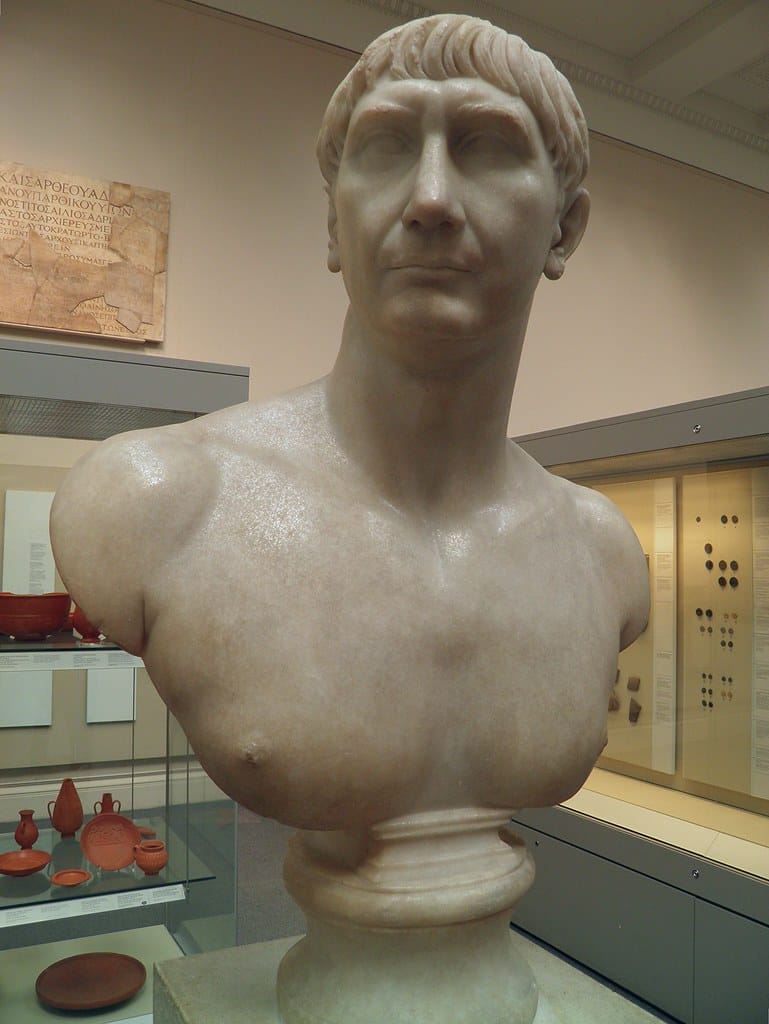
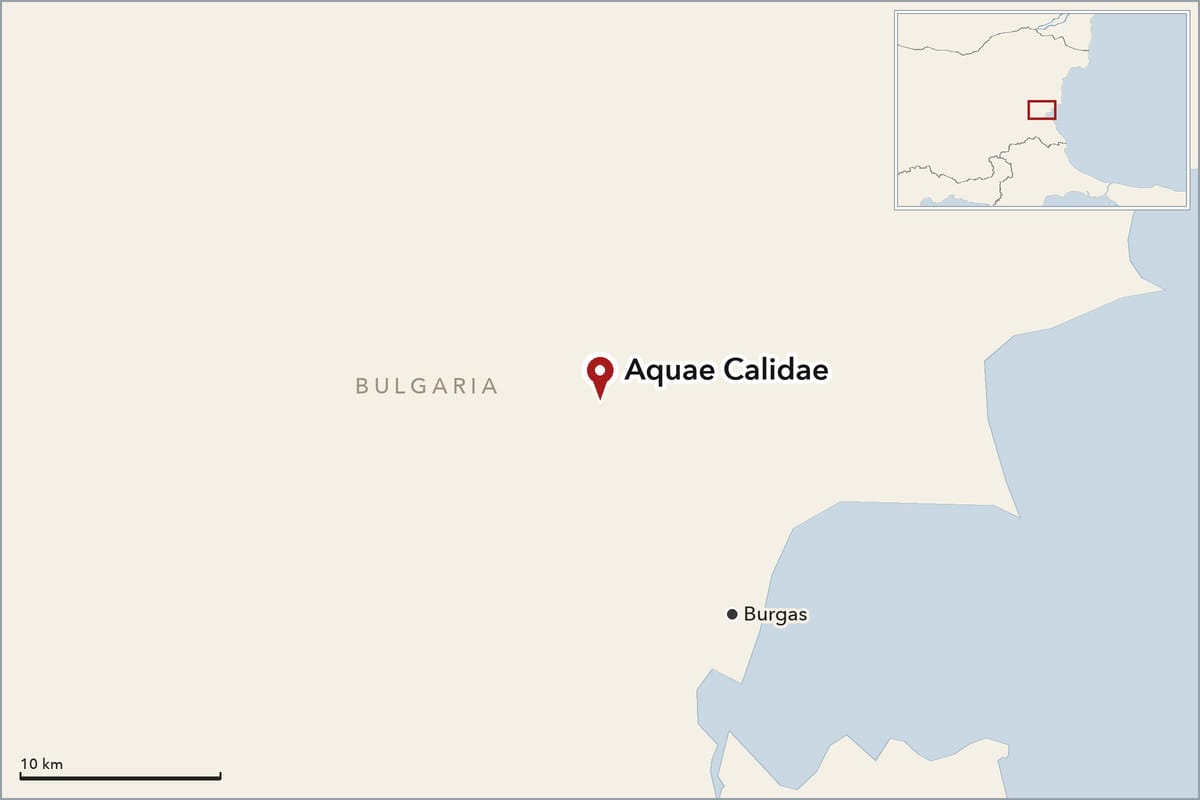
On 26 October 2026, Burgas municipality announced that an inscription found this year at the ancient thermal complex of Aquae Calidae in Burgas has been read and scientifically interpreted, according to the Bulgarian Telegraph Agency (BTA). The Latin text runs along the base of a statue of the Roman emperor Trajan. It is dated precisely to AD 100 and records that the statue was put up by decision of the city council of the Roman colony of Deultum, whose remains lie near the present-day village of Debelt in Sredets municipality.
What the inscription says
Research at the site is led by Assoc. Prof. Dr Dimcho Momchilov.
According to the municipality's account, as carried by BurgasInfo and DarikNews, the text opens with Trajan's full titles, as was the custom in Roman times. It presents him as the son of the divine Nerva, his predecessor, who adopted him. The titles that follow are emperor, Caesar, Augustus and Germanicus (given, the account says, for his victories over the German tribes), together with chief priest, holder of tribunician power and Father of the Fatherland.
On who ordered the statue, BurgasInfo says the text makes it clear: the decision was taken by the city council of the colony of Deultum, which was modelled on the Roman Senate. BTA adds that the initiative for the statue came from the council, according to Momchilov's conclusion.
A Latin text in a Greek-speaking region
The inscription is in Latin. BurgasMedia and BurgasInfo both note that in this part of Thrace people mostly spoke Greek, and that most inscriptions at Aquae Calidae are in Greek. Latin, they say, was the language of Roman rule and administration; BurgasMedia reads the choice of language as showing the colony's link with Rome, while BTA calls it evidence of the complex's link with Roman authority and administration.
Why Aquae Calidae?
The municipality's account says the choice of Aquae Calidae for the statue was no accident. The large Roman baths, whose construction in the 1st century is attested by a Nero-era inscription found in 2015, were among the most visited in Thrace. They drew visitors from across the empire, including senior officials and Roman officers.
The account adds a point about timing. Trajan began his war against the Dacians, beyond the Danube, in AD 101, only a year after the statue went up, and it says the roads leading there were very busy. In its telling, Deultum chose to show its respect for the emperor at Aquae Calidae because the statue could be seen by the most people.
My own view is that the inscription and the explanation should be weighed separately. The reports say the text itself identifies who commissioned the statue and fixes its year. BurgasMedia attributes the reasoning about why the council chose this spot to the researchers, though the municipality's text states it as fact.
One more Latin inscription in a growing series
BurgasMedia calls this the latest Latin inscription from the site. Two earlier finds are named in the reports:
- 2015: an inscription from the time of Nero. The Aquae Calidae site's 14 September post says it attests to the construction of the baths in the 1st century.
- 2022: a votive altar dedicated to the nymphs.
The find was announced on 14 September 2026. That day the Burgas Regional History Museum announced a new inscription from the early years of Trajan's reign (AD 98–117), according to the Sofia Globe, and said the epigraphist Dr Nikolay Sharankov of Sofia University "St Kliment Ohridski" was working on its reading and interpretation. The Aquae Calidae site's own post of the same date describes the inscription as found during archaeological excavations led by Momchilov. The municipality's 26 October account says it came to light during conservation and restoration work.
BTA also recalls earlier seasons. In August 2024, archaeologists found part of a nymphaeum in the area of the early Roman bath. Momchilov told BTA that it resembled a fountain with figures and was linked to the cult of the nymphs and the healing properties of the mineral water. Work in 2025 uncovered parts of a Roman marble basin and structures of a medieval church. Finds included coins, lead seals and Byzantine decorated ceramics. BTA says the results confirmed that the complex was used over a long period in antiquity and the Middle Ages.
Sources
Aquae Calidae (2026) 'A new Roman inscription dating from the time of Emperor Trajan has been discovered at Aquae Calidae', Aquae Calidae, 14 September 2026, available at: https://www.aquae-calidae.com/en/news/a-new-roman-inscription-dating-from-the-time-of-emperor-trajan-has-been-discovered-at-aquae-calidae (Accessed: 26 October 2026).
BurgasInfo.com (2026) 'Новооткрит императорски надпис свидетелства за престижа на Акве калиде в древността', BurgasInfo.com, 26 October 2026, available at: https://www.burgasinfo.com/news/view/5/155507 (Accessed: 26 October 2026).
DarikNews.bg (2026) 'Императорска тайна на 1900 години: Разчетоха надписа на Траян в Акве калиде', DarikNews.bg, 26 October 2026, available at: https://dariknews.bg/regioni/burgas/imperatorska-tajna-na-1900-godini-razchetoha-nadpisa-na-traian-v-akve-kalide-2470240 (Accessed: 26 October 2026).
Ilieva, Y. (2026) 'Inscription from statue of Emperor Trajan found at Aquae Calidae deciphered (updated)', BurgasMedia, 26 October 2026, available at: https://burgasmedia.com/news/razchetoha-nadpis-ot-statuya-na-imperator-trayan-nameren-v-akve-kalide?lang=en (Accessed: 26 October 2026).
The Sofia Globe staff (2026) 'New Roman inscription from time of Emperor Trajan discovered in Aquae Calidae in Bulgaria's Bourgas', The Sofia Globe, 14 September 2026, available at: https://sofiaglobe.com/2026/09/14/new-roman-inscription-from-time-of-emperor-trajan-discovered-in-aquae-calidae-in-bulgarias-bourgas/ (Accessed: 26 October 2026).
Stefanova, M. (2026) 'Надпис върху постамент на статуя на император Траян в Акве калиде разкрива връзката на термите с Деултум', БТА, 26 October 2026, available at: https://www.bta.bg/bg/news/lik/1233101-nadpis-varhu-postament-na-statuya-na-imperator-trayan-v-akve-kalide-razkriva-vra (Accessed: 26 October 2026).
Picture credits
- Top picture: Marble portrait of Emperor Trajan, who ruled AD 98–117. Marble bust of Trajan, British Museum — photo: Following Hadrian, CC BY-SA 2.0 (source)
- Modern bath at Aquae Calidae, Burgas. Bath at Aquae Calidae, Burgas — photo: Galileo01, CC BY 4.0 (source)
- Map: drawn from Natural Earth (public domain) and Wikidata.
