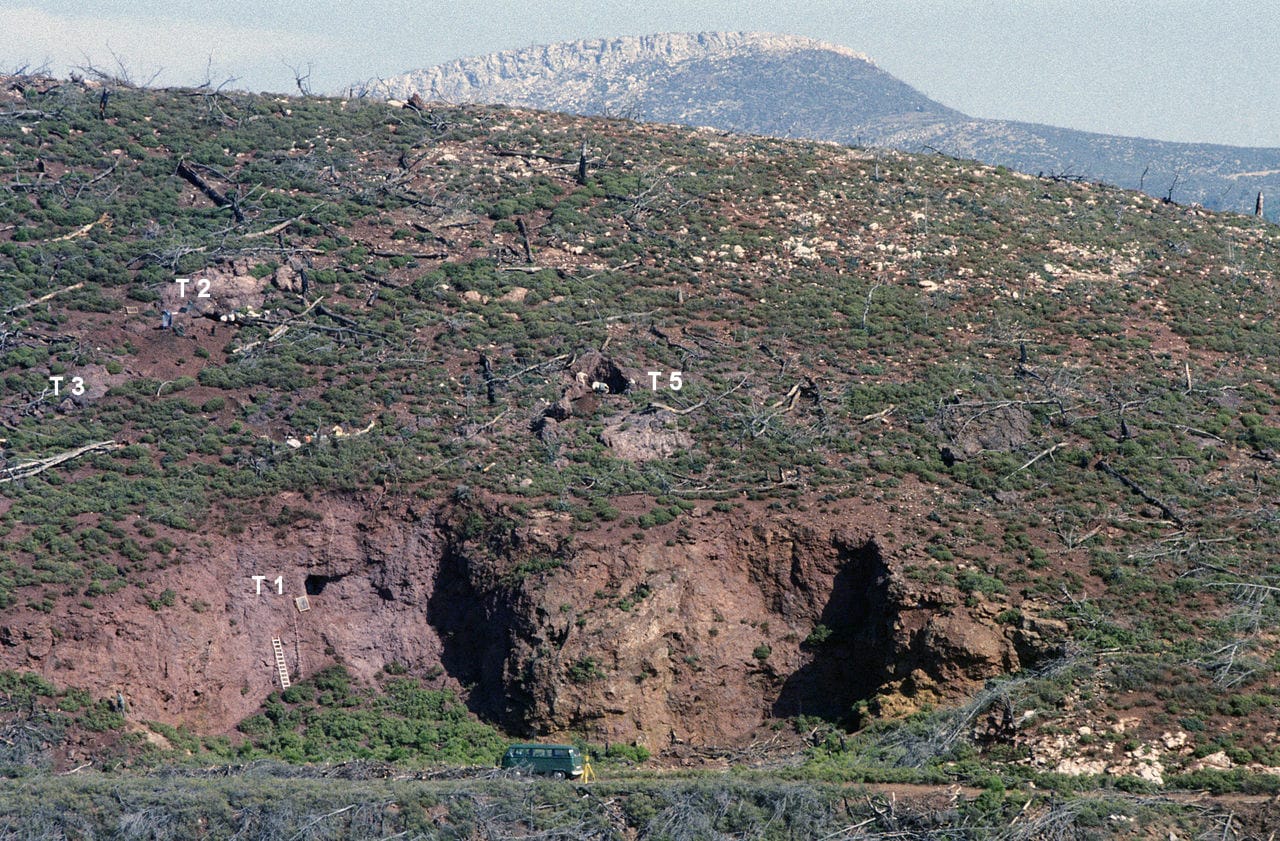
A paper published on 29 April 2026 in Archaeological and Anthropological Sciences (volume 18, article number 113) reassesses the radiocarbon dating of the prehistoric hematite mines on the Hill of Tzines on Thasos, Greece. The site was discovered in the 1950s during modern open-cast exploitation, and it was investigated archaeologically in the 1980s and at the beginning of the 1990s.
The new date
The authors report a radiocarbon date, MAMS-53686, of 28431–27804 years cal BP (calibrated years before AD 1950), which they say places the exploitation in a middle phase of the Upper Palaeolithic, corresponding to the Gravettian. They also write that, notwithstanding the extremely restricted number of AMS (accelerator mass spectrometry) dates, the mines on the Hill of Tzines provide the oldest European radiocarbon dating related to an underground and to a hematite mining context.
The dates that came before
Two earlier radiocarbon dates, both for a different mine on the hill, T1, were published in the 1990s, both from bone or antler. One was run in 1994 by accelerator mass spectrometry on a single Bos primigenius bone and gave 24976–24021 years cal BP (ETH-11573). The other, from deer antlers, gave 8985–8822 (16.2%) and 8816–8402 (79.3%) years cal BP (HD-8528-8509). The new paper says the antler date, probably obtained from the bioapatite fraction of the antlers, must be treated with caution.
What the bone is, and why the authors trust it
According to the past zoological analysis the paper cites, the bone behind the new date is a long bone from an unidentified large-size mammal. It was recovered near the mine's entrance, in trench SA1 at -110 cm, under the superficial layer and within the layer of mining debris. The authors give three arguments for linking it to the mining.
- First, the superficial layer sealed the deposit, so anything embedded in the mining debris beneath it was already there before that layer formed.
- Second, the sample lay in spatial association with several percussion tools and with seven flakes from the use of such tools, found in trench SA1 at depths between -110 and -138 cm; the authors say this assemblage documents direct percussion activity at the findspot, consistent with in situ ore extraction.
- Third, the collagen preserved in the sample was of good quality (1.3%, C:N ratio 3.3), which they say supports its association with the mining context.
They add that conditions in the mine, which they call T2, were generally unfavourable to collagen, as shown by the poor or absent collagen in the other bone samples from it. Their conclusion is that the date plausibly defines the terminus ante quem for the inception of mining in T2. They also state that the possibility that the bone entered the mine independently of human activities cannot be entirely excluded, though all available stratigraphic and taphonomic evidence supports its association with mining.
A date the authors do not rely on
A second T2 date, MAMS-53688, came out at 6398–6302 years cal BP, a Holocene result. The authors do not consider it reliable because of the sample's low collagen content, which the paper puts at 0.4%.
Tools, targeting and a rare kind of site
The paper says the number of prehistoric iron oxide mines investigated or dated in Europe remains extremely low, naming Tzines in Greece, Rydno in Poland, Lovas in Hungary, Bad Sulzburg in Germany and Grotta della Monaca in Italy. It adds that their chronology ranges from the Upper Palaeolithic until the end of the Neolithic.
In T2, the deposit yielded 163 macrolithic finds, made mostly of gneiss or gneiss schist, lacking hafting traces and bearing percussive traces on one or both ends. Chipped finds were rare and undiagnostic, numbering three. The authors say the mine was mainly exploited by direct percussion, using macrolithic tools. They also write that it is self-evident that the people who mined there did not gather ochre pieces randomly but targeted a specific geological formation.
On context, the authors write that the start of exploitation at Tzines could fall in a time span when ochre use was already well consolidated. They say this is further confirmed by early ochre evidence in the Aegean, from sites including Grava in the Ionian Islands, Klithi and Kastritsa in Epirus, and Klisoura (Cave 1), Franchthi, Kolominitsa, Melitzia and Skin 4 in the Peloponnese. The differences between the mines may, they say, preliminarily indicate that the deposits were identified in successive phases, perhaps within a system of knowledge transmission about the hill's location, its mineral content and the extraction techniques. The authors say the question of where, and in what state, hematite was transported from Tzines remains unresolved, and that a geochemical tracing project is required to gain insight into the connection between the ore deposit and the prehistoric settlements of Thasos and the opposite North Aegean coasts.
Sources
Levato, C., Koukouli-Chrysanthaki, C., Malamidou, D., Vaxevanopoulos, M., Lindauer, S. and Stöllner, T. (2026) 'Reassessing the radiocarbon dating of the prehistoric hematite mines on the Hill of Tzines (Thasos, Greece)', Archaeological and Anthropological Sciences, 29 April 2026, available at: https://link.springer.com/article/10.1007/s12520-026-02486-6?error=cookies_not_supported&code=4068a895-c7a7-4457-a688-9b252a078da3 (Accessed: 16 November 2026).
Picture credits
- Top picture: The Hill of Tzines on Thasos, site of the prehistoric hematite mines. Image: Red ochre mines, Tzines, Thasos — Deutsches Bergbau-Museum Bochum (CC BY-SA 3.0) (source)
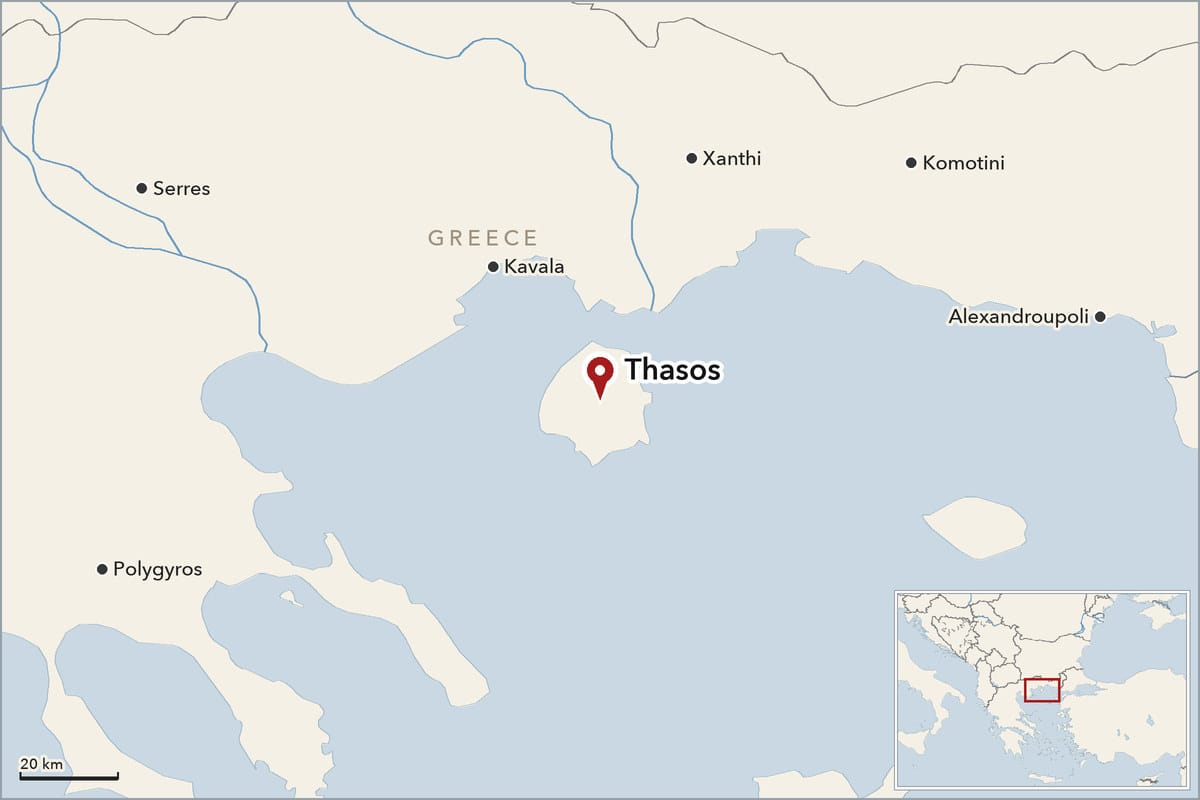
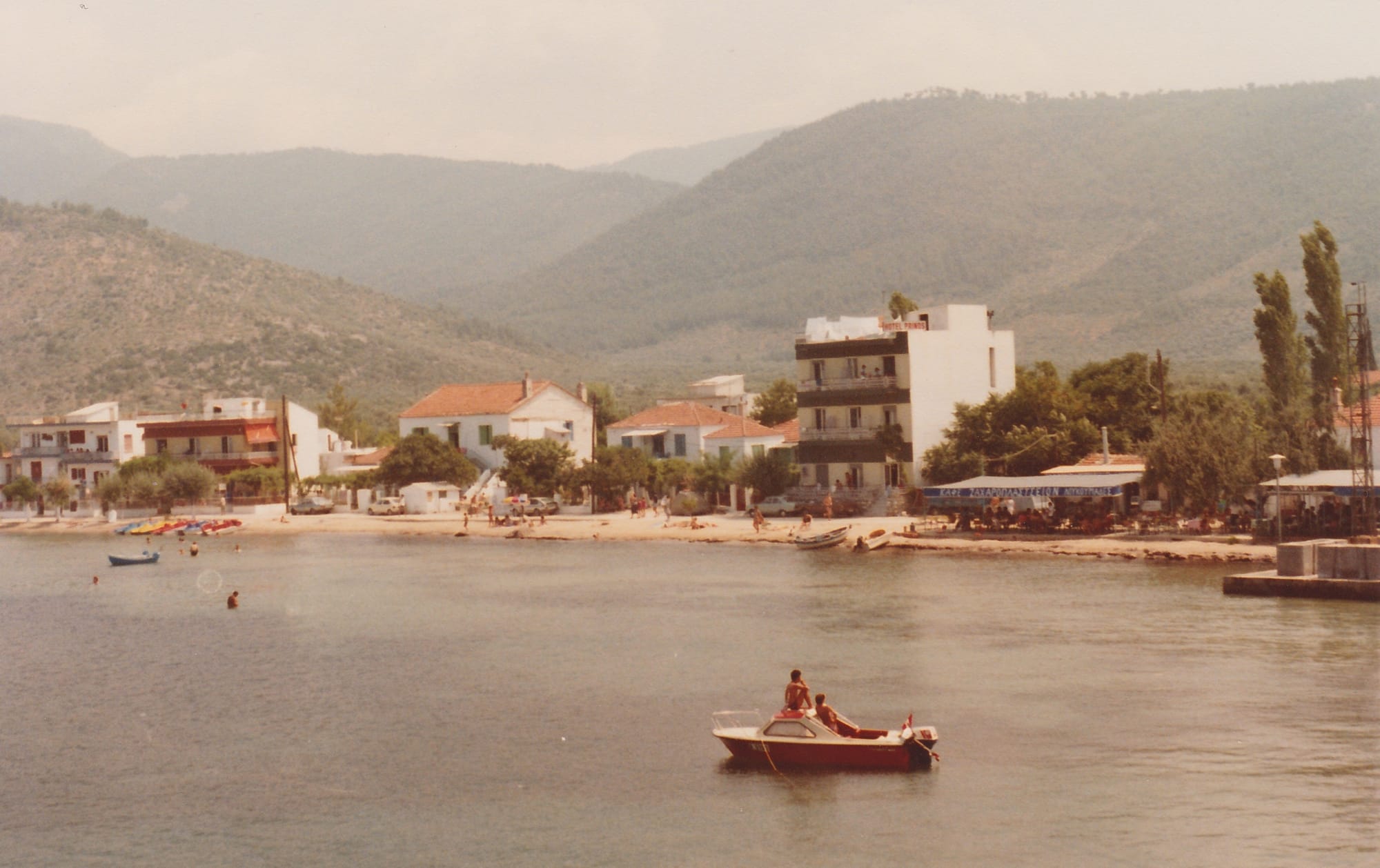
- Thasos, the island where the Hill of Tzines lies. Image: Thasos Island — thintruman (CC BY-SA 2.0) (source)
- Map: drawn from Natural Earth (public domain) and Wikidata.

