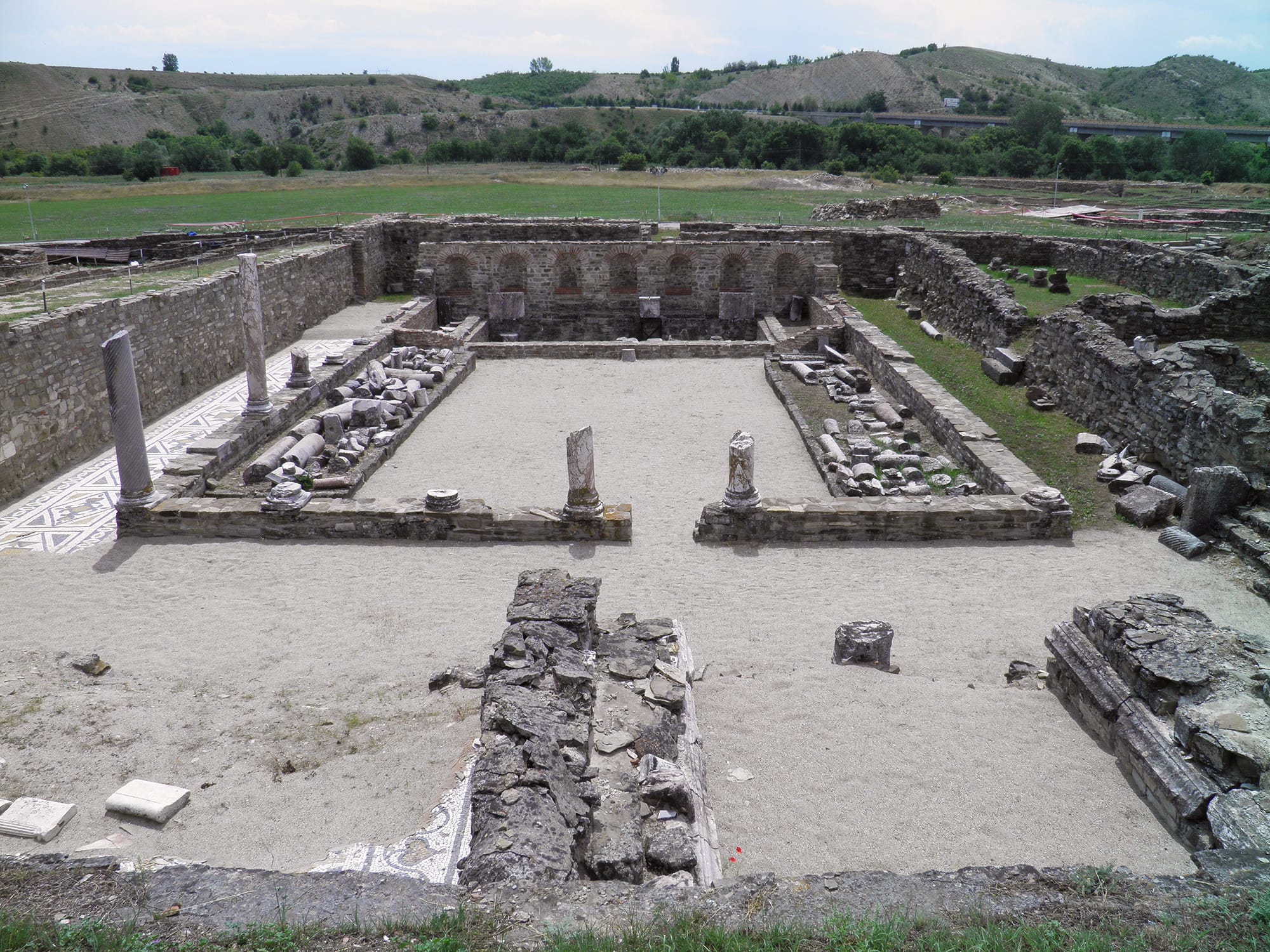
On 30 October 2026 the excavation season at the Theodosian Palace in Stobi came to an end. The National Institution Stobi (NI Stobi), which carried out the excavations, published its account of the work on its own website. It is a modest report of re-opened rooms and what was found in them, and its most useful finding concerns what stood on the spot before the palace.
What NI Stobi says it found
According to NI Stobi, the team worked between 3 September and 30 October 2026 and focused on five rooms. Much of the work was re-excavation and documentation of areas explored in earlier campaigns. The institution says the investigations gave new insights into the complex's architectural development and its different phases of occupation.
It lists three specific results:
- A floor foundation. In one room the team found "the preserved foundation for a mosaic or cocciopesto floor", in NI Stobi's words. The page describes a foundation, not a surviving decorated surface, and does not say which of the two floor types it supported.
- Earlier buildings and drains. In two other rooms, remains of earlier buildings and associated drainage channels were identified. NI Stobi calls this "valuable evidence of architectural phases preceding the construction of the Theodosian Palace".
- The southwestern entrance. The excavations also allowed the complex's southwestern entrance to be defined more clearly.
NI Stobi says the results will help explain the building's architectural history and provide documentation for the ongoing conservation works.
An excavation inside a conservation project
NI Stobi presents the dig as part of a larger project to conserve and present the building's architectural remains. It says the work was carried out with the Balkan Heritage Foundation, with financial support from the J. M. Kaplan Fund and Ancient Rome Live.
That context shapes what the season was for. In my view, documenting the rooms while conservation continues is sound practice: a floor foundation and the traces of earlier structures are the kind of evidence that can change how a building's history is read, and recording them now means conservation decisions can take them into account.
The palace and the wider project
NI Stobi describes the Theodosian Palace as one of the most representative Late Antique residential complexes at Stobi. Other organisations give more detail, and their accounts differ slightly on dates.
Ancient Rome Live, in an article dated 1 May 2026, says the palace sits on a middle terrace and is among the largest Late Antique residential complexes at the site. It says the building went up in the late 4th century, was rebuilt in the 5th and stayed in use until the early 7th. The Balkan Heritage Foundation, describing the conservation project, dates the residence to the 4th to 6th centuries CE.
Ancient Rome Live also describes the layout. It says a peristyle courtyard with a nymphaeum is the centre of a residence with eleven rooms, including a large triclinium and apsidal chambers, and floors in opus tessellatum, opus segmentatum and opus sectile. It adds that the palace was first excavated in the 1930s and has only been partially conserved. It also reports that a mosaic depicting Dionysus was uncovered in 2023 in a room south of the peristyle.
The conservation effort has its own history. The Balkan Heritage Foundation says it has been funded by the J. M. Kaplan Fund and the American Institute for Roman Culture from 2022 to 2026. It covers conservation and re-conservation of stone walls, floor mosaics and marble elements, and it includes training for local teams in architectural conservation. The Foundation names the UK firm Skillington Workshop as leading the conservation work and the training.
The Foundation reports that on 17 April 2026 the conservation was celebrated with a visit from the Macedonian Minister of Culture, representatives of the American Institute for Roman Culture and the Kaplan Fund's programme director. During the visit, the Foundation says, the American Institute for Roman Culture representatives discussed plans for future projects in Stobi, such as developing a training centre for archaeological conservation and completing the conservation of the insula housing the Theodosian Palace.
Where Stobi fits
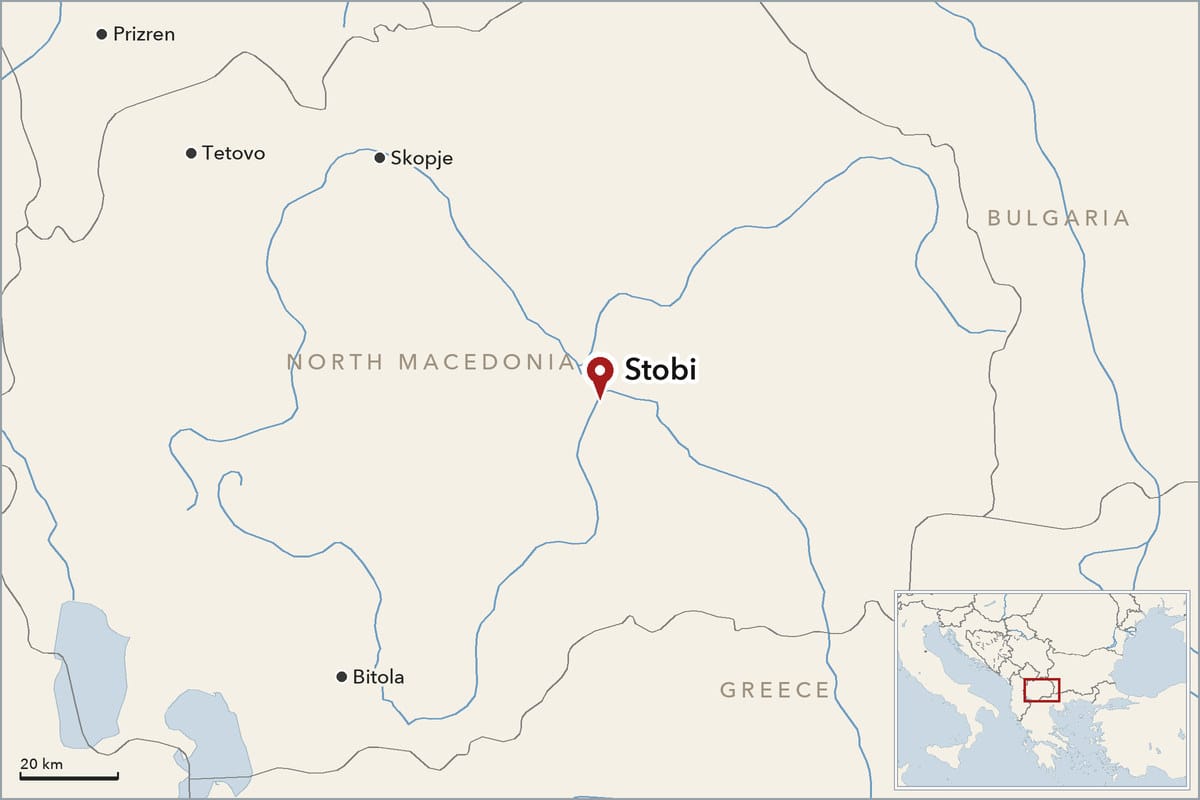
Stobi lies near Gradsko in North Macedonia. Wikipedia describes it as an ancient town of Paeonia, later conquered by Macedon, which finally became the capital of the Roman province of Macedonia Salutaris. The Theodosian Palace is one of the Late Antique buildings the Balkan Heritage Foundation lists among the city's prosperous 5th- and 6th-century monuments.
What to take from it
NI Stobi's report is short. What it does establish is that, by the institution's own account, work in two rooms found structures from before the palace was built, in a building otherwise known for its Late Antique decoration.
Sources
Ancient Rome Live (2026) 'Conservation Efforts Bring a Late Roman Palace Back to Life', Ancient Rome Live, 1 May 2026, available at: https://ancientromelive.org/news/at-stobi-conservation-efforts-bring-a-late-roman-palace-back-to-life/ (Accessed: 31 October 2026).
Balkan Heritage Foundation (2026) 'Stobi Celebrates Theodosian Palace Conservation with Ministerial Visit and International Partners', Balkan Heritage Foundation, 17 April 2026, available at: https://balkanheritage.org/stobi-celebrates-theodosian-palace-conservation/ (Accessed: 31 October 2026).
Balkan Heritage Foundation (2010) 'Stobi Excavation Project', Balkan Heritage Foundation, 10 July 2010, available at: https://balkanheritage.org/stobi-the-capital-city-of-macedonia-secunda-excavation/ (Accessed: 31 October 2026).
National Institution Stobi (2026) 'Archaeological Excavations at the Theodosian Palace 2026 Are Completed', NI Stobi, 29 October 2026, available at: https://stobi.mk/en/archaeological-excavations-at-the-theodosian-palace-2026-are-completed/ (Accessed: 31 October 2026).
Wikipedia (n.d.) 'Stobi', Wikipedia, The Free Encyclopedia, available at: https://en.wikipedia.org/wiki/Stobi (Accessed: 31 October 2026).
Picture credits
- Top picture. Image: The Theodosian Palace, Stobi — Carole Raddato, CC BY-SA 2.0 (via Wikimedia Commons)
- Image: Roman Theatre, Stobi — d_proffer, CC BY 2.0 (via Wikimedia Commons)
- Map: drawn from Natural Earth (public domain) and Wikidata.

