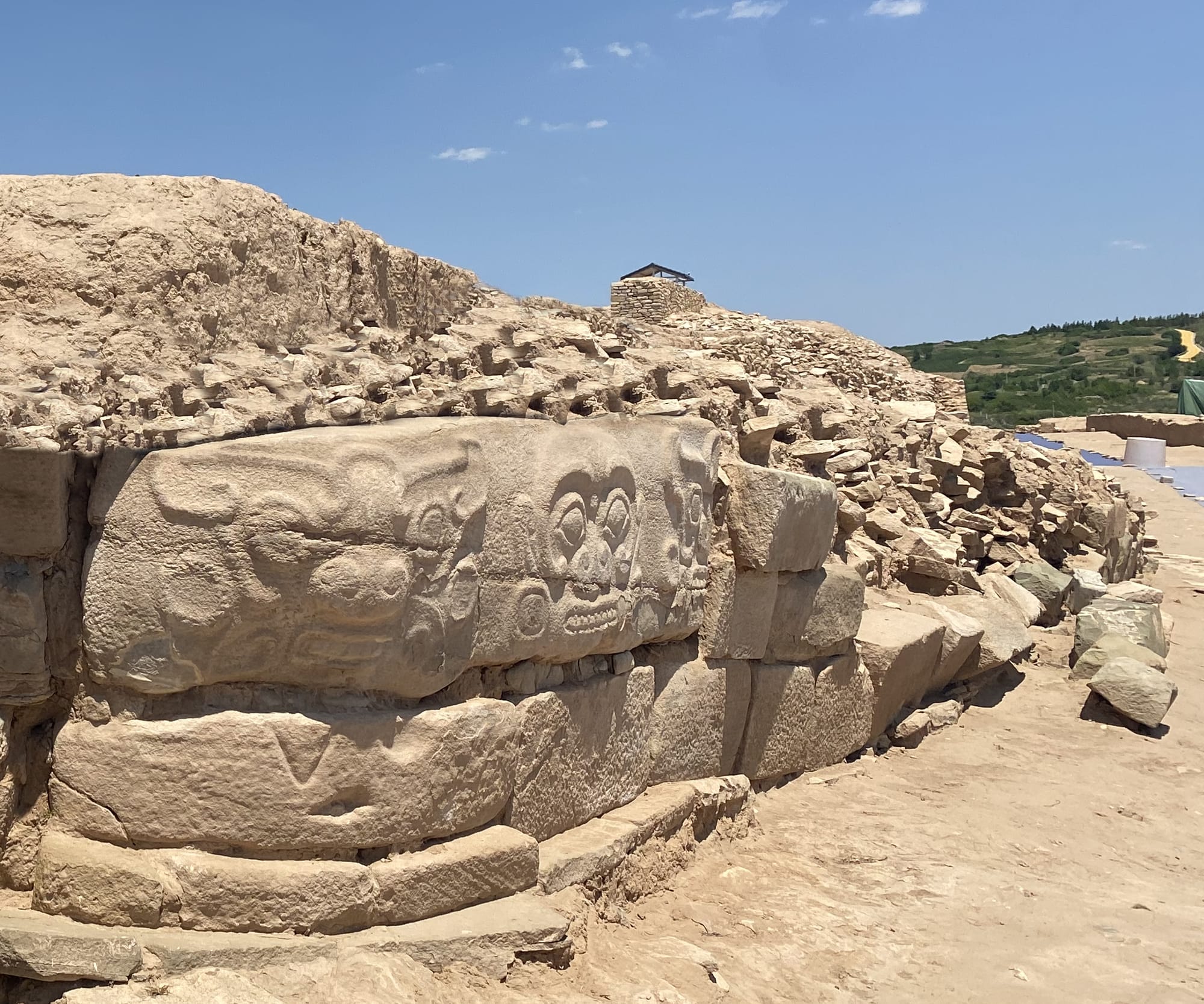
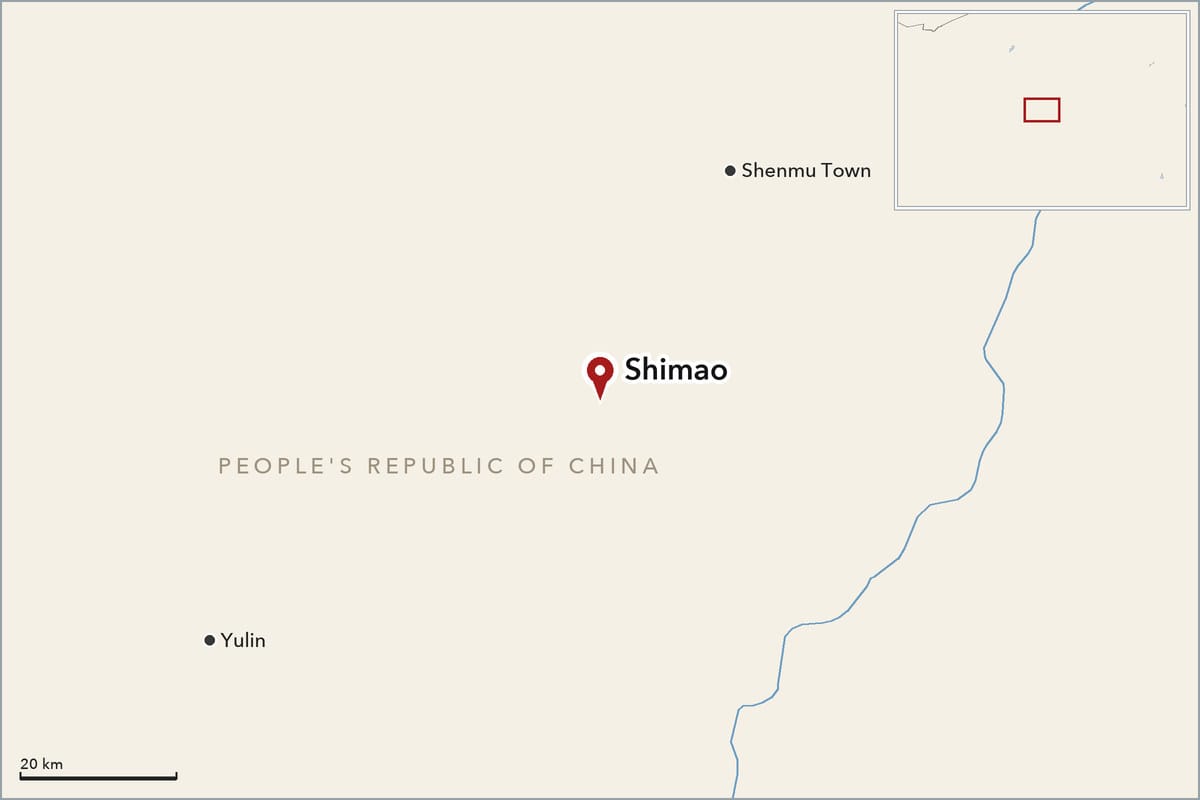
Shimao was a walled city on the far northern Loess Plateau in Shaanxi Province, in use between about 2300 and 1800 BC. On 21 October 2026, Antiquity published a review by Jessica Rawson, of the School of Archaeology and Merton College, University of Oxford, of the three-volume Shimao excavation report. Its second volume concentrates on a single structure, the East Gate of the Outer City. Under that gate lay a grim find: human skulls. What the gate's excavators have recorded, and what DNA has since said about who was buried there, makes a story that has already changed once.
The report
Rawson reviews the three volumes, published in Beijing in 2026 and edited by Zhouyong Sun as general editor. Volume II is the excavation report on the East Gate of the Outer City; Antiquity's books-received listing, which records it as received on 20 July 2026, places it in the Archaeological China Major Research Project Series A.
According to Rawson, the project ran from 2012 to 2024 under Zhouyong Sun. She describes volume II as a full account of the East Gate, including its later changes after Shimao's decline. Volume III, she writes, collects research essays by as many as 20 specialists on topics including the analyses of DNA derived from bones in tombs.
The gate
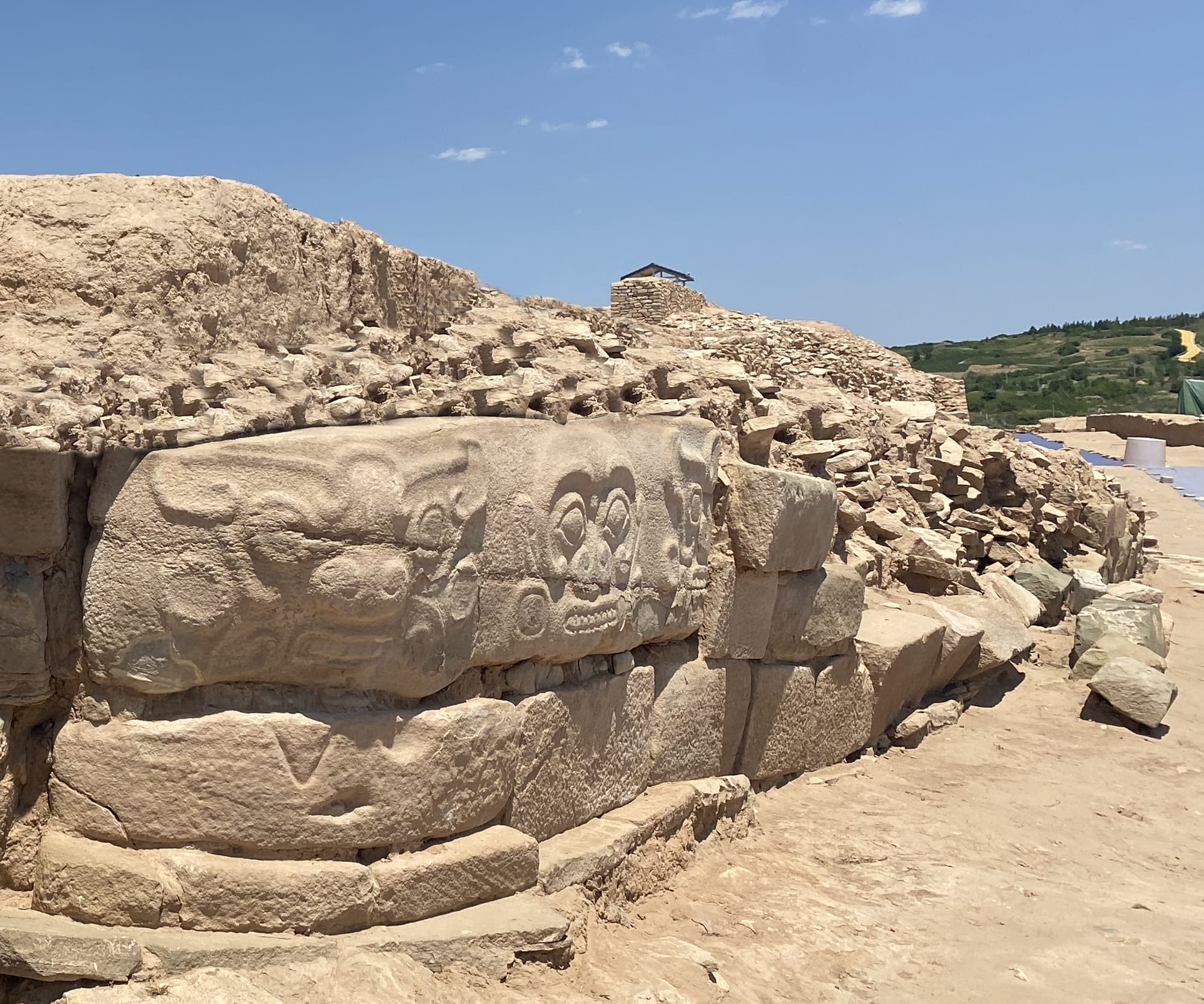
Rawson writes that the East Gate is one of four such monuments, three of which remain unexcavated. She writes that it was built at the highest point of the city around 2000 BC, and that its four-part design was unknown in China before then. Two large towers of rammed loess with thick stone facings stand opposite each other and form a narrow passage. Two further walls, which the archaeologists identify as barbicans, control who approaches. Rawson writes that the authors of volume III compared the gate with gate structures in Western Asia and Egypt as well as China. Their conclusion, as she reports it, was that while no identical structures have so far been identified, many of the East Gate's features are likely to have been introduced from further west.
The skulls
Rawson reports six deposits of human skulls at the gate, probably buried at different times, before or during construction. Their orientation was set according to the solstice. She writes that they were placed on the original ground rather than in pits, under a foundation platform, and that most of the skulls were severely crushed. Her verdict on precedent: "There is no obvious precedent for these multiple deposits." She compares them with later sacrifices at the late Shang royal tombs at Anyang, which she suggests may make Shimao a forerunner of later practices.
On the deposits' purpose, she is willing to venture an interpretation: the careful deposits are, in her words, "likely to have been part of a ritual to ensure a benefit, almost certainly some form of protection provided by the gate". She also notes that fine jades in weapon or sceptre forms were unusually inserted into the stone walls, and that stone-flaked weapon tips for arrows and spears have been excavated at the East Gate. She asks whether there was raiding or conflict between regions.
The sex of the victims
A Chinese Academy of Sciences release, carried by ScienceDaily on 21 July 2026, puts the number of skulls near the East Gate at around 80. A Nature study led by Qiaomei Fu, published on 26 November 2025, sequenced the genomes of 169 individuals from Shimao, its satellite sites and earlier surrounding sites. Nature's press release says: "Prior research had suggested that sacrificed individuals were predominantly female". Wikipedia's entry on Shimao describes the skulls found under the city gate as "mainly of young girls". According to the CAS release, the genetic evidence shows that nine out of ten burials examined there were male.
The pattern was not the same everywhere. The press release says the elite cemeteries at Huangchengtai and Hanjiagedan showed evidence of predominantly female sacrifice. The CAS release reads this as sacrifice that was carefully organised, suggesting men and women may have been selected for different ceremonies. Archaeology Magazine, reporting the study on 17 July 2026, described the East Gate skulls as ones thought to have been sacrificed.
Our view
The older picture, that those sacrificed at the gate were predominantly female, came from research done before the genetics arrived. The DNA now points the other way for the East Gate, while the elite cemeteries tell a different story. That is a good reason to treat any one-line account of Shimao's sacrifices with caution, this one included. The gate's meaning is still argued.
Sources
Antiquity (2026) 'Shimao (volume II): excavation report on the east gate of the outer city', Books received, Antiquity, received 20 July 2026, available at: https://www.antiquity.ac.uk/open/books/6649 (Accessed: 22 October 2026).
Archaeology Magazine (2026) 'Researchers Analyze DNA from Residents of Chinese Neolithic City', Archaeology Magazine, 17 July 2026, available at: https://archaeology.org/news/2026/07/17/researchers-analyze-dna-from-residents-of-chinese-neolithic-city/ (Accessed: 22 October 2026).
Chen, Z., Gardner, J.D., Sun, Z. et al. (2025) 'Ancient DNA from Shimao city records kinship practices in Neolithic China', Nature, published 26 November 2025, available at: https://doi.org/10.1038/s41586-025-09799-x (Accessed: 22 October 2026).
Chinese Academy of Sciences Headquarters (2026) 'Ancient DNA reveals a chilling secret at China's 4,000-year-old Shimao city', ScienceDaily, 21 July 2026, available at: https://www.sciencedaily.com/releases/2026/07/260721000828.htm (Accessed: 22 October 2026).
Nature Portfolio (2025) '[Research Press Release] Genetics: New clues about a prehistoric city in China (Nature)', Nature Asia, 27 November 2025, available at: https://www.natureasia.com/en/info/press-releases/detail/9163 (Accessed: 22 October 2026).
Rawson, J. (2026) 'Excavations of the city of Shimao and its monuments', Antiquity, published online 21 October 2026, available at: https://www.cambridge.org/core/journals/antiquity/article/excavations-of-the-city-of-shimao-and-its-monuments/AD1050E0DB5579F9DE2835ED5489752A (Accessed: 22 October 2026).
Wikipedia (n.d.) 'Shimao', Wikipedia (Accessed: 22 October 2026).
Picture credits
- Top picture: Wall at the Shimao Neolithic Site in Shaanxi, China. Image: Wall at the Shimao Neolithic Site, Shaanxi, China — Bilaterian, CC BY-SA 4.0 (via Wikimedia Commons)
- Map: drawn from Natural Earth (public domain) and Wikidata.
