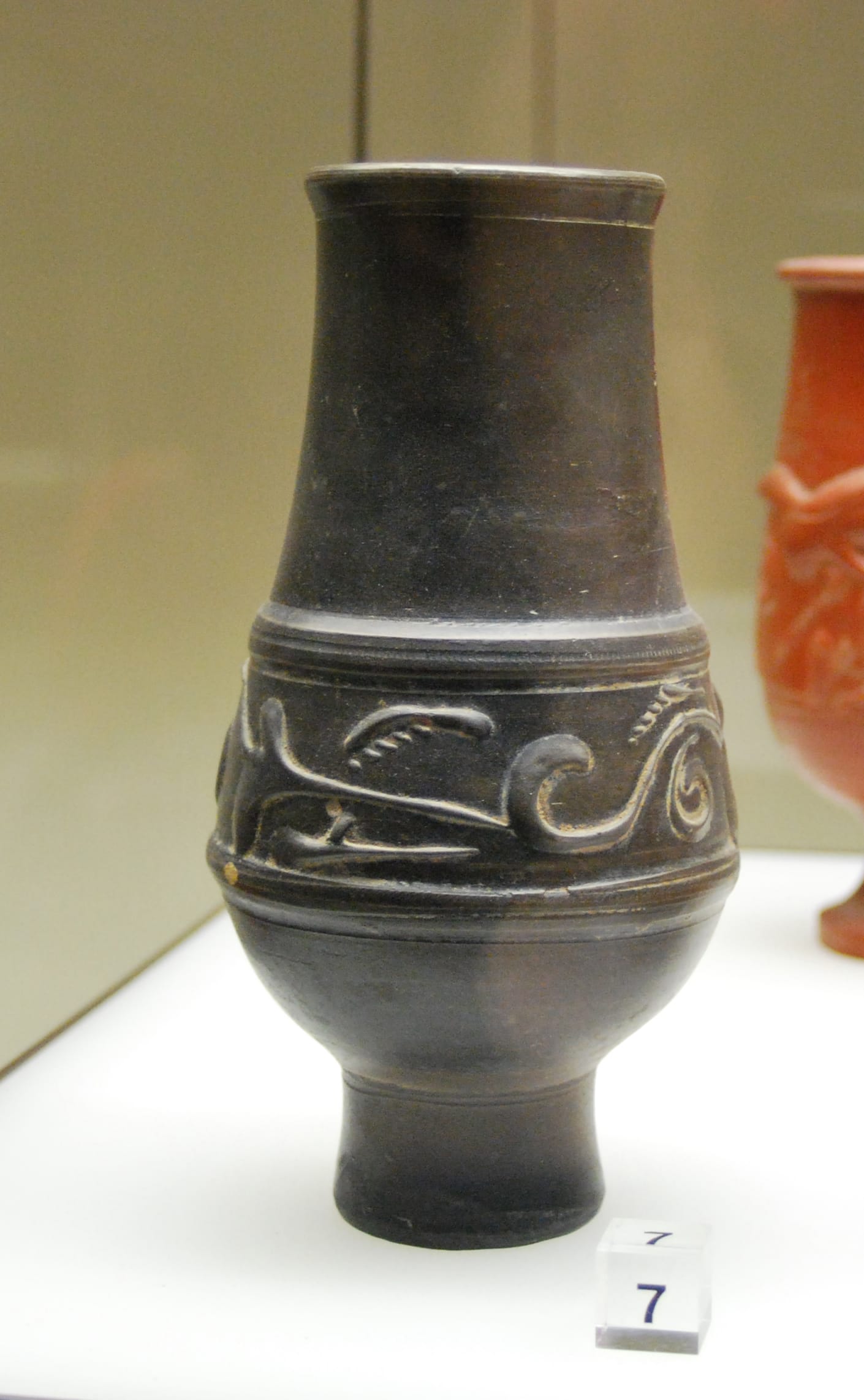
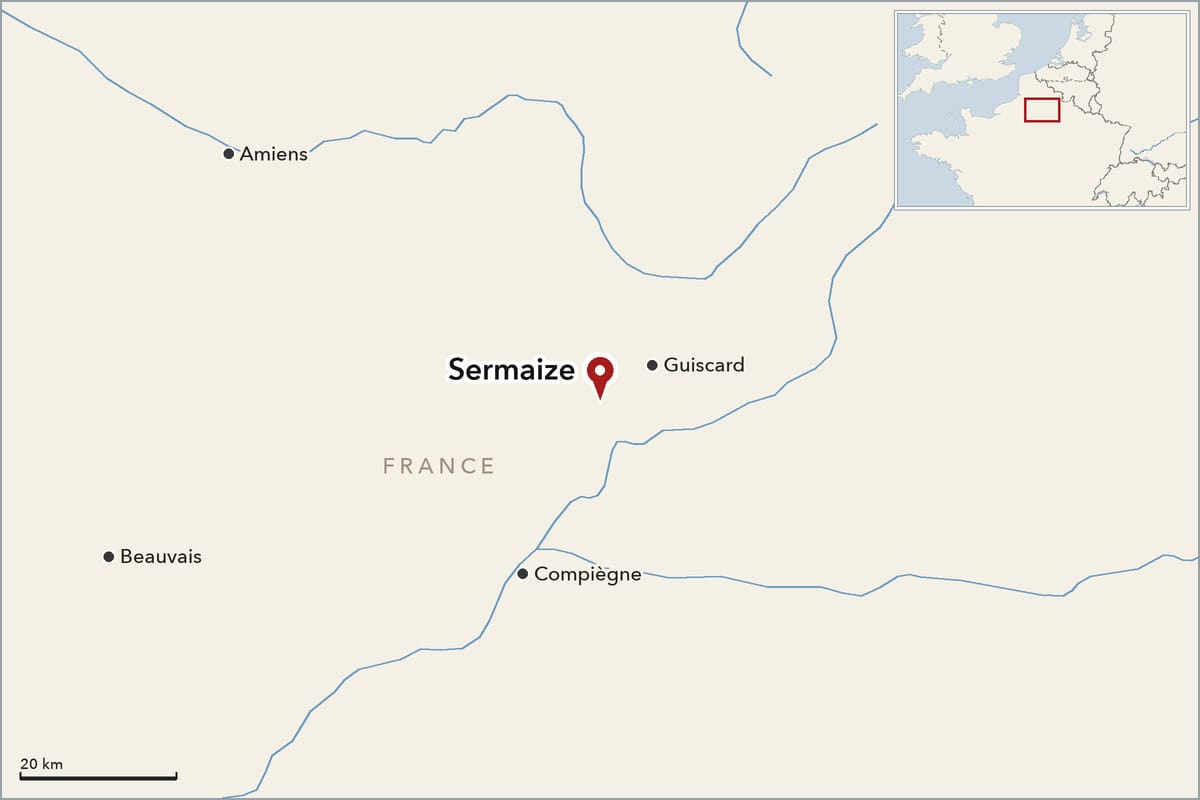
At Sermaize, in the Oise department of northern France, archaeologists have recovered one place where Roman pots were made, from clay pit to kiln, on a single site.
The workshop was excavated by INRAP, France's national institute for preventive archaeology, ahead of work on the Seine-Nord Europe Canal. Louis Florin, who directed the operations, and ceramics specialist Victor Viquesnel-Schlosser presented the results to the public at a conference on Saturday 19 September, during the Journées européennes du patrimoine. France 3 Hauts-de-France had reported on the dig on 2 July. Oise Hebdo covered the talk on 24 September. Further reports followed from La Brújula Verde, Archaeology Magazine and Archaeology Wiki.
What was found
According to the reports, the site was occupied from the first century BC to the third century AD. The excavation covered about 20,000 square metres, two hectares. La Brújula Verde says the ground was laid out as a grid of plots, each with separate zones for preparing clay, shaping pots and firing them.
Florin's own summary, given to Oise Hebdo, is that the site holds the whole chain of ceramic manufacture, from extraction to firing and on to distribution, because it sits beside a road. He said a site this complete is « très, très rare, même à l'échelle nationale » (very, very rare, even nationally). The oldest fairly similar case, he said, was Beuvraignes, in the Somme, in 1989, excavated with different methods.
The stages, as La Brújula Verde and Archaeology Wiki describe them:
- Clay. A possible extraction area of about 2,500 square metres lies to the north, with around 50 pits. Samples are being analysed to test whether the potters actually used this clay, and La Brújula Verde calls that a working hypothesis for now. Twenty flat-bottomed, clay-filled basins may have been used to prepare or settle the clay.
- Wheels. There were fourteen groups of wheel installations. Three held a single wheel, and the other eleven had room for between two and six. The team also recovered six stone pivot sockets and 13 flint potter's tools.
- Kilns. There were 21. Twelve, from the first century AD, had a single flue and a raised floor. Two double-flue kilns date to around the turn of the first and second centuries. Three more double-flue kilns date from the mid-second to mid-third century, and La Brújula Verde says they made dark pottery, with four further single-flue kilns working alongside them.
- Buildings. About ten cellars or storage spaces were excavated, along with wells, hearths, ovens, food waste and large storage jars. Archaeology Wiki reads these as showing that production was closely integrated with spaces used by the people who worked there.
Florin told Oise Hebdo, repeating a point Viquesnel-Schlosser made in the talk, that the site has more potter's wheels than the whole known regional corpus for Hauts-de-France; Oise Hebdo presents this as the researchers' estimate. France 3 reported that about fifty potter's wheels were found, and that a very large kiln has few or no known parallels. Florin said of it that the team wonders what was fired in it.
What they made
The output changed over the centuries. The earlier phase produced terra nigra, a fine dark-surfaced tableware inspired by Italian models. It also produced mica-coated drinking vessels and cooking pots with shell added to the clay. In the later phase the workshop moved to plainer dark tableware. Misfired and damaged vessels in the waste deposits are direct evidence that the pots were made on the spot.
La Brújula Verde contrasts this with the great terra sigillata centres of La Graufesenque and Tricio, noting that Sermaize, as far as is known, made plainer everyday ware instead.
Why it survived
Florin said some of the kilns survived frozen in their original state. He credited sediment that built up over time and the site's position partly in a valley bottom. Oise Hebdo says the remains lay in places under as much as 2.5 metres of earth. Florin compared the effect to a lid being put over the site.
A coin hoard, and a gap
The finds also include about a hundred fibulae, mostly bronze, along with billhooks, cutting tools, buttons and keys. In addition, more than 455 coins, mainly sesterces, were found in a vase. At the conference a numismatics specialist set out the possibilities: whether it was a collection, whether someone hid it from imminent danger, and whether they meant to come back for it. Oise Hebdo reports that the answer remains open.
Florin told Oise Hebdo that no burials or associated cemetery were found in the excavated area. He added that he thought the continuation might lie on the other side of the site.
Open questions
The reports disagree on a few points, and they leave others unanswered.
- The road. Oise Hebdo, La Brújula Verde, Archaeology Wiki and Archaeology Magazine all put the workshop beside the Via Agrippa. Archaeology Wiki and La Brújula Verde describe it as the road between Noyon and Amiens, and La Brújula Verde says archaeologists place the site there presumably; Oise Hebdo locates it between Noyon and Roye. La Brújula Verde adds that the road's date is disputed, at around 39–38 BC or about 19 BC. France 3 says the Roman road that passed the site lay where the departmental road beside the dig now runs.
- Reach of the pots. France 3 quotes Viquesnel-Schlosser saying that the site made terra nigra, a fine tableware, and that neighbouring workshops made light-bodied wares. La Brújula Verde, writing on 1 October, said that how far Sermaize's pots travelled was not known, and that INRAP's release listed selling as one of the documented stages without naming markets.
- Length of the dig. Oise Hebdo reports that fieldwork ran from August 2025 to July 2026, with eight months of active excavation interrupted by four winter months of bad weather.
What happens next
Florin told Oise Hebdo that field work has been finished since the summer and that the team is now preparing monographs and journal articles. He expects Sermaize to become a reference site. Both Oise Hebdo and France 3 report that the ground is to disappear under the canal project: Oise Hebdo says an inland port is planned for the spot, and France 3 says the site will soon be covered by the canal works.
The site cannot be left standing, so the published record has to carry the weight. The clay analyses now under way and the study of the finds will decide how much of the workshop's story is established and how much stays a working hypothesis.
Sources
Alves-Teixeira, F. (2026) 'À Sermaize, les archéologues dévoilent les secrets d'un atelier de potiers exceptionnel', Oise Hebdo, 24 September 2026, available at: https://www.oisehebdo.fr/2026/09/24/sermaize-archeologues-devoilent-secrets-un-atelier-potiers-exceptionnel/ (Accessed: 26 October 2026).
Archaeology Magazine (2026) 'Large-Scale Pottery Workshop Uncovered in France', Archaeology Magazine, 6 October 2026, available at: https://archaeology.org/news/2026/10/06/large-scale-pottery-workshop-uncovered-in-france/ (Accessed: 26 October 2026).
Archaeology Newsroom (2026) 'Roman pottery workshop with 21 kilns uncovered in France', Archaeology Wiki, 7 October 2026, available at: https://www.archaeology.wiki/blog/2026/10/07/roman-pottery-workshop-with-21-kilns-uncovered-in-france/ (Accessed: 26 October 2026).
Caillieret, L. (2026) '"C'est assez exceptionnel" : un grand atelier de poterie, vieux de 2 000 ans, mis à jour avec le chantier du canal Seine-Nord-Europe', France 3 Hauts-de-France, 2 July 2026, available at: https://france3-regions.franceinfo.fr/hauts-de-france/oise/c-est-assez-exceptionnel-un-grand-atelier-de-poterie-vieux-de-2-000-ans-mis-a-jour-avec-le-chantier-du-canal-seine-nord-europe-3379261.html (Accessed: 26 October 2026).
Carvajal, G. (2026) 'Archaeologists Uncovered a Roman Pottery Workshop With 21 Kilns in France — It Ran for About Three Centuries and Left Evidence of Every Production Step', La Brújula Verde, 1 October 2026, available at: https://www.labrujulaverde.com/en/2026/10/archaeologists-uncovered-a-roman-pottery-workshop-with-21-kilns-in-france-it-ran-for-about-three-centuries-and-left-evidence-of-every-production-step/ (Accessed: 26 October 2026).
Picture credits
- Top picture: A terra nigra beaker in the Römisch-Germanisches Museum Köln, not a find from Sermaize. Sermaize's early kilns made this kind of fine, dark-surfaced tableware. Image: Terra Nigra beaker: Hannibal21, CC BY-SA 3.0, via Wikimedia Commons (Römisch-Germanisches Museum Köln)
- Map: drawn from Natural Earth (public domain) and Wikidata.
