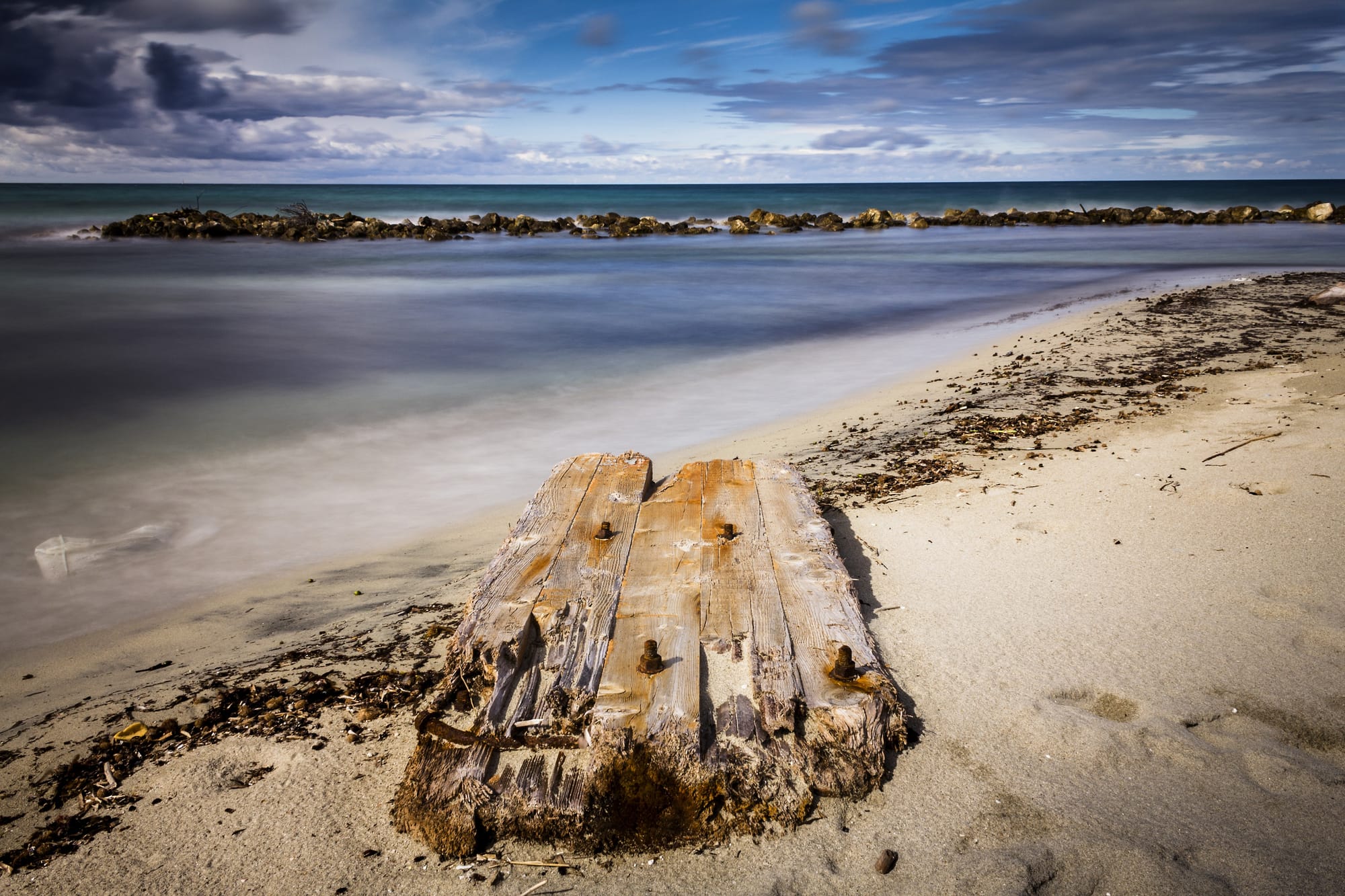
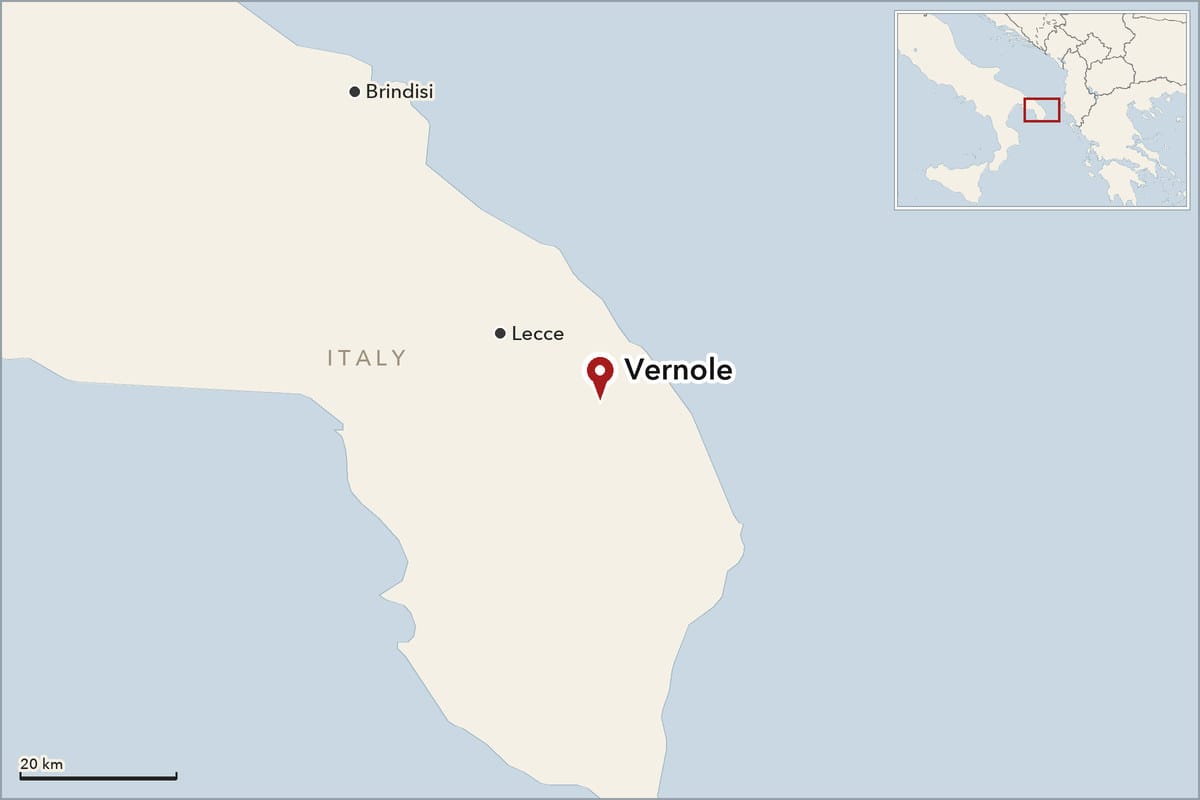
Archaeologists in southern Italy have exposed more of a sunken Roman harbour that could be older than Emperor Hadrian's well-known pier, together with a shoreline building where wine was probably produced for shipping, La Brújula Verde reported on 7 November. The results were presented on 5 November at the Lecce headquarters of the Soprintendenza for Archaeology, Fine Arts and Landscape, the local office of Italy's Ministry of Culture that oversees heritage in the provinces of Brindisi, Lecce and Taranto. The site lies in the locality of San Giovanni, inside the WWF's Le Cesine state nature reserve, in the municipality of Vernole.
A port that may predate Hadrian
According to La Brújula Verde, a stone pier still juts out of the water at San Cataldo, known as the Pier of Hadrian and considered the best-preserved Roman harbour structure in Apulia. Hadrian ruled from AD 117 to 138. La Brújula Verde reports that the pier is credited to him because of a passage by Pausanias (VI, 19, 9), a Greek writer of the second century, and that local scholars read it as a reference to harbour works by the emperor in this bay, which is why the structure is called the molo di Adriano.
La Brújula Verde notes that writers of antiquity record Octavian, the future emperor Augustus, landing at Lupiae, the Roman name of Lecce, after crossing from Apollonia in 44 BC, following the assassination of Julius Caesar. It says the Salento team reads the episode as a sign that the harbour already had some standing, and perhaps facilities able to receive a ship carrying such a passenger. If the port at San Giovanni is that same harbour, it would be more than a century older than Hadrian's reign.
On this basis, Rita Auriemma's team proposes that the San Giovanni complex dates to the Augustan period, between the 1st century BC and the 1st century AD. The university's own release calls it presumably Augustan. La Brújula Verde adds that in 2023 the researchers compared their finds with the submerged part of Hadrian's pier and said the San Giovanni structure resembles it in technique and size, but could be even older. In its words, what has been published so far still has no direct date to settle the question.
Underwater: an L-shaped pier
La Brújula Verde says the structures along this stretch of coast were first detected in 2020, and that the Politecnico di Torino joined the project in 2021, using drones and cameras to build three-dimensional models and underwater robots fitted with cameras. It reports that the pier's massive foundation lies about 15 metres off the present shore, in water no deeper than 3.5 metres, and that wave action has knocked over its largest blocks and spread them across the sea floor. The 2023 season, it says, brought the most striking result: two groups of blocks that had been studied separately turned out to belong to one structure, an L-shaped pier of almost 150 metres. It adds that the connection was difficult to spot because storm-driven sand can cover the remains with more than a metre of sediment.
According to La Brújula Verde, the builders used a technique called a cassone, named after the Italian word for a large box: huge blocks of calcarenite, a porous limestone quarried in the area, were lined up to form compartments that were filled with loose stone. The method, it says, is common in the Adriatic and is also found in the Aegean and elsewhere in the Mediterranean. JournalArta reported that earlier campaign plans described a straight structure ending in a broad platform, with foundations still underwater.
This year's underwater work focused on one sector of the complex, and the university's release says the study clarified the building technique and how the structure was put in place. With the National Research Council in Lecce, and in particular Giuseppe Scardozzi, the team took samples from the big foundation blocks, with the goal of learning which quarry supplied the stone. La Brújula Verde also reports that some blocks have one rounded side and sit at fairly regular intervals, so they may be bollards, the posts where ships were tied up. It adds that dating of some submerged timber piles confirmed that in the first half of the 15th century the Angevin queen Maria d'Enghien had a pier built that used the Roman one as its foundation, and that the old harbour, in one form or another, stayed in use for centuries.
On the shore: a probable winery
Facing the harbour was a production site where wine was probably made and then loaded onto ships. The archaeologists cautiously propose a wine-making facility or, which they consider less likely, an oil-making one. That caution is worth keeping in view: the wine reading is a proposal, and oil remains on the table. JournalArta reported that investigations also focused on a large plastered basin, which researchers had thought might belong either to a wine-making installation or to a plant for processing and salting fish, while the newly reported findings point to a probable wine-making installation.
The university's release notes that the surrounding land is known to have been given over to intensive arboriculture. The release adds that a workshop with kilns making amphorae, clay jars for local oil and wine, is known at Masseria Ramanno, north of the Lecce–San Cataldo expressway, and that stamps link it to the centres of Giancola and Marmorelle in the Brindisi area. The production site's position right beside the port meant goods could be loaded straight onto small boats bound for Brindisi, the port where the Via Appia ended, or onto larger ships on medium and long-distance routes.
La Brújula Verde adds that earlier seasons had already identified rock-cut basins in the area that probably served to produce salt, and some rooms that may date to the late Republic. Auriemma said the team is reconstructing a landscape rather than single structures, and that the port and the production site speak of an economic system tying the countryside to the sea routes.
Who is digging
The excavations, on land and underwater, were carried out by the ArcheoSub group of the University of Salento's Department of Cultural Heritage under the scientific direction of Professor Rita Auriemma. This year's season ran from 7 September to 4 October. At the 5 November presentation, superintendent Antonio Zunno welcomed the presentation of the results, and Vernole's mayor, Mauro De Carlo, called the excavations a discovery and an opportunity for the community.
Sources
Carvajal, G. (2026) 'Archaeologists Uncover a Roman Port Dating from Before Hadrian’s Time in Italy, With a Probable Winery on the Shore', La Brújula Verde, 7 November 2026, available at: https://www.labrujulaverde.com/en/2026/11/archaeologists-uncover-a-roman-port-dating-from-before-hadrians-time-in-italy-with-a-probable-winery-on-the-shore/ (Accessed: 10 November 2026).
JournalArta (2026) 'San Giovanni: Roman port predates Hadrian’s pier', JournalArta, 7 November 2026, available at: https://journalarta.com/en/2026/11/08/san-giovanni-roman-port-predates-hadrians-pier/ (Accessed: 10 November 2026).
Unisalento.it (n.d.) 'Cesine - Acaya, il resoconto della presentazione della campagna di scavo - Università del Salentoangle-left', Unisalento.it, available at: https://www.unisalento.it/comunicati/-/asset_publisher/C6YX5RjDCSpB/content/campagna-archeologica-alle-cesine-conferenza-stampa (Accessed: 10 November 2026).
Picture credits
- Top picture: Le Cesine, in the municipality of Vernole: the nature reserve where the San Giovanni site lies. Photo: Depascali.angelo, Wikimedia Commons (CC BY-SA 4.0)
- Map: drawn from Natural Earth (public domain) and Wikidata.
