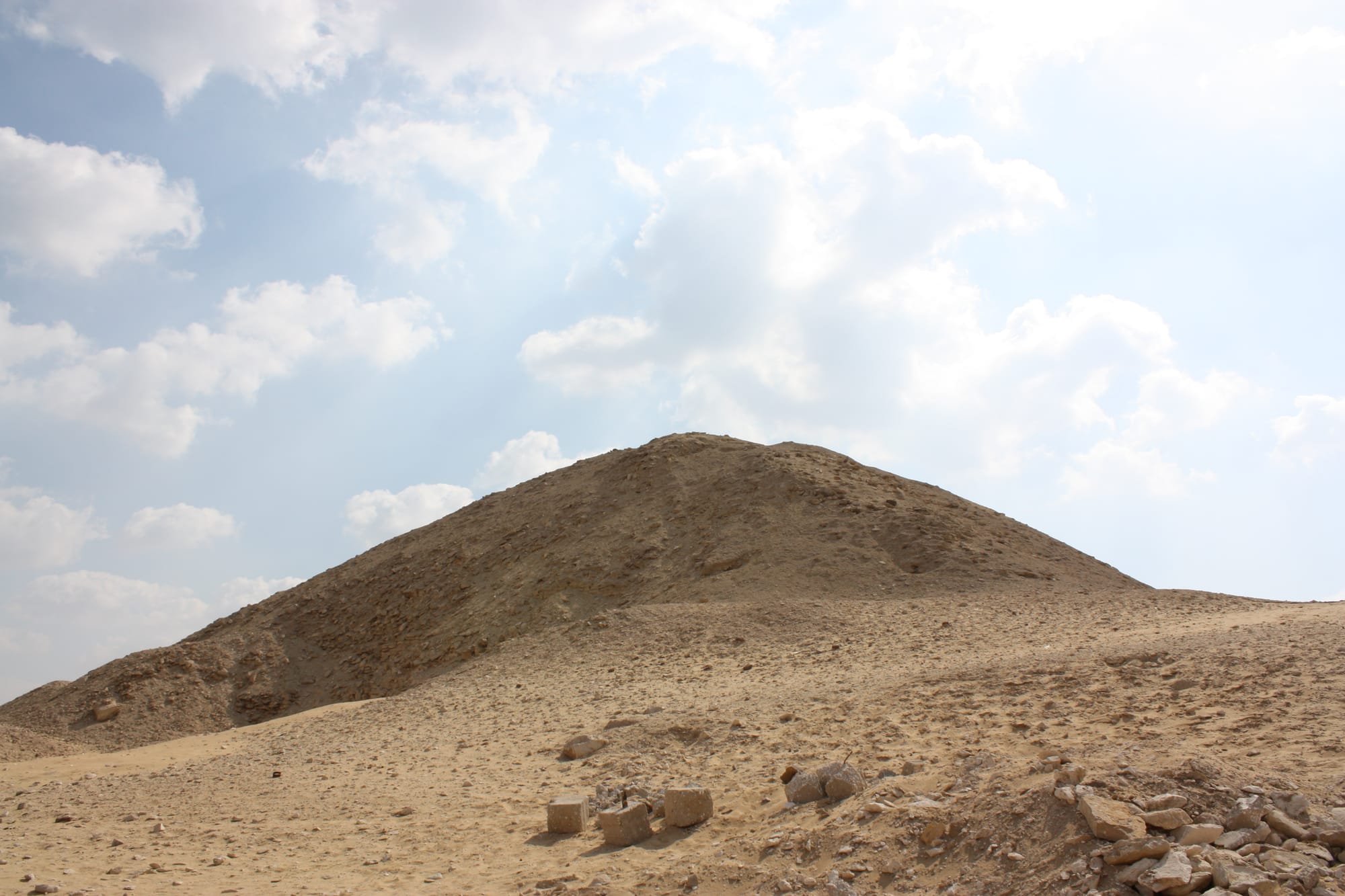
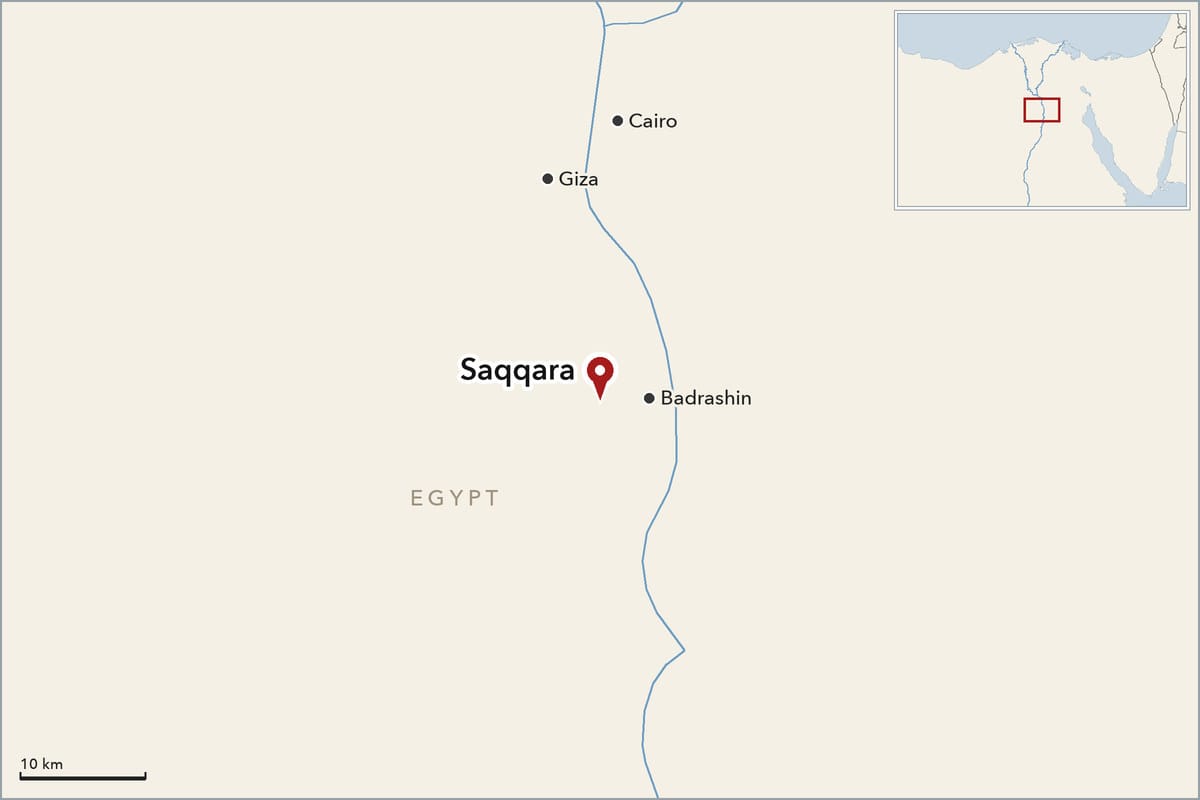
In January 2021, Egypt's Ministry of Tourism and Antiquities revealed details of the latest discoveries to emerge from the Saqqara necropolis, south of Cairo. Among the biggest rewards for Egyptologists in that round, CBS News reported, was the identity of a queen who died around 4,200 years ago. Researchers had a name for her at last: Queen Neit, the wife of King Teti.
A pyramid without a name
Her tomb lay at a site adjacent to the pyramid of King Teti, the first pharaoh of the Sixth Dynasty of Egypt's Old Kingdom. Zahi Hawass, the Egyptologist who heads the mission, told CBS News: "The excavation started in 2010, when we discovered a pyramid of a queen next to the pyramid of King Teti, but we didn't find a name inside the pyramid to tell us who the pyramid belonged to." About a month before the announcement, the team found a funerary temple, and CBS News reported that her name was carved on a wall in the temple and also written on a fallen obelisk in the entrance to her tomb.
Hawass said: "I'd never heard of this queen before. Therefore, we add an important piece to Egyptian history, about this queen." The Daily Galaxy, in a piece published on 7 November 2026, reported that Teti already had two known queens buried near his pyramid, Iput I and Khuit, each with a small pyramid roughly 100 metres away. The same outlet described the temple as built of stone, with three mud-brick storerooms along its southeastern side, used to keep offerings and equipment for the queen's funerary cult. The Ministry of Tourism and Antiquities statement, as carried by MRU.INK, called her Queen Nearit and described the three mud-brick warehouses attached to her temple.
The Daily Galaxy also noted that Neit, Naert, Nearit and Neith are all English renderings of the queen's name, which it put down to hieroglyphs recording consonants rather than vowels. That explains why the same queen appears under different spellings in the coverage.
The cemetery around Teti
The queen was only part of the announcement. CBS News reported that the team also found 52 burial shafts, each around 30 to 40 feet deep, with more than 50 wooden coffins from the New Kingdom, around 3,000 years ago. The ministry's statement, as carried by MRU.INK, gave the shafts' depth as 10 to 12 metres and said they held hundreds of wooden coffins. Al-Ahram, quoted by CNN, said it was the first time coffins dating back 3,000 years had been found in the Saqqara region.
According to the Daily Galaxy, most of the graves around Teti's pyramid belong to the New Kingdom, particularly the 18th and 19th Dynasties, dating from about 1550 to 1186 BC. The statement said the finds "will rewrite the history of this region, especially during the 18th and 19th dynasties of the New Kingdom, during which King Teti was worshiped, and the citizens at that time were buried around his pyramid," as quoted by CNN. Hawass told NBC News in November 2022 that the number of coffins could be because "Teti was worshipped as a god in the New Kingdom, and everyone wanted to be buried alongside him." He also said that, although Teti's sarcophagus is 4,300 years old, people continued to be buried near him for more than 1,000 years later because they wanted his protection.
The Daily Galaxy reported that more than 50 wooden coffins had been recovered when the discoveries were announced in 2021, and that by late 2022 Hawass reported nearly 300 from the area around Teti's pyramid, many painted with individual faces and scenes from the Book of the Dead. In that NBC interview, Hawass said most of them were in good condition.
A papyrus, a stela and games for the afterlife
CBS News reported a papyrus about 13 feet long and three feet wide, bearing Chapter 17 of the Book of the Dead in hieroglyphics, with its owner's name recorded on it. Hawass said it was the first time such a large papyrus had been discovered inside a burial shaft. The ministry statement, as carried by MRU.INK, identified the papyrus as belonging to Pw-Kha-Ef, the same name found on four shabti statues and on an anthropoid wooden coffin.
Other finds included numerous wooden funerary masks, a shrine to the god Anubis, statues of Anubis, and games buried with the dead. CBS News said one was a game called "Twenty," found with its owner's name still visibly written on it, and another, "Senet," was found in the shafts. The ministry statement, as carried by MRU.INK, also described a limestone stela belonging to a man named Kha-Ptah and his wife Mwt-em-wia. Researchers also studied mummies: per the statement, an archaeologist named Afaf determined that one woman suffered from a chronic disease known as "Mediterranean fever". The Daily Galaxy also said that, according to Hawass, one coffin contained a woman wearing a mask of solid gold.
The dig since 2021
Work at the Teti Cemetery has continued. On 2 November 2025 the Egyptian Gazette reported that Hawass had welcomed King Philippe of Belgium to the excavation site of the Zahi Hawass Foundation for Archaeology and Heritage, in collaboration with Egypt's Supreme Council of Antiquities. The paper said the visit was attended by Belgian Ambassador to Egypt Bart De Groof and a high-level delegation, and that the pyramid of Queen Neith and its funerary temple were among the discoveries presented, part of a newly revealed Old Kingdom cemetery complex.
According to the Egyptian Gazette, Hawass told the king the mission had uncovered the tomb of Prince Userkaf-Ra, son of King Userkaf, the first ruler of the Fifth Dynasty. The paper reported a statue of King Djoser, his wife and their ten daughters inside that tomb, and said preliminary studies indicate the statues were originally in a chamber beside Djoser's Step Pyramid and moved there in later eras. It also listed a red granite offering table, 92.5 cm in diameter, and a 1.17-metre-tall black granite statue of a standing man, dating to the Old Kingdom. Hawass emphasised, the paper said, that such royal and international visits are the strongest promotion for Egypt's antiquities.
In November 2022, NBC News reported Hawass saying the coffins and antiquities from the site would likely be displayed in the Grand Egyptian Museum in Giza, which was then scheduled to open the following year. The sequence runs from a pyramid with no name inside it in 2010 to a temple wall and an obelisk with a name about a decade later.
Sources
MRU.INK (2024) 'Egypt Announced New Archaeological Discoveries "that Will Rewrite History" Of Saqqara', MRU.INK, 5 November 2024, available at: https://mru.ink/funerary-temple/ (Accessed: 7 November 2026).
NBC News (2022) '100 years after Tutankhamun discovery new finds reveal more of ancient Egypt's secretsNBC News LogoSearchSearchLiveNBC News LogoToday Logo', NBC News, 5 November 2022, available at: https://www.nbcnews.com/news/world/egypt-tutankhamun-tomb-ancient-mummies-discovery-giza-king-feti-cairo-rcna55700 (Accessed: 7 November 2026).
Samir, S. (2025) 'Belgium’s King Philippe tours Saqqara discoveries with Zahi Hawass', Egyptian Gazette, 2 November 2025, available at: https://egyptian-gazette.com/entertainment/arts/belgiums-king-philippe-tours-saqqara-discoveries-with-zahi-hawass/ (Accessed: 7 November 2026).
Shawkat, A. (2021) '4,200-year-old queen's identity among remarkable new finds in Egypt', CBS News, 19 January 2021, available at: https://www.cbsnews.com/news/saqqara-tomb-egypt-4000-year-old-queen-neit-id-remarkable-archaeology-discoveries/ (Accessed: 7 November 2026).
The Daily Galaxy --Great Discoveries Channel (2026) 'Archaeologists Unearthed Over 100 Mummies and a Forgotten Queen's Pyramid at Egypt's Ancient Saqqara', The Daily Galaxy --Great Discoveries Channel, 7 November 2026, available at: https://dailygalaxy.com/2026/11/egypt-100-mummies-unknown-queen-pyramid/ (Accessed: 7 November 2026).
Woodyatt, A. (2021) 'Ancient coffins, burial sites and a funeral temple discovered in Saqqara necropolis will ‘rewrite history’', CNN, 17 January 2021, available at: https://www.cnn.com/travel/article/egypt-saqqara-coffins-intl-scli (Accessed: 7 November 2026).
Picture credits
- Top picture: The pyramid of King Teti at Saqqara, beside which the queen's tomb was found. Image: Photo of the Pyramid of Teti: Wknight94, via Wikimedia Commons (CC BY-SA 3.0)
- Map: drawn from Natural Earth (public domain) and Wikidata.
