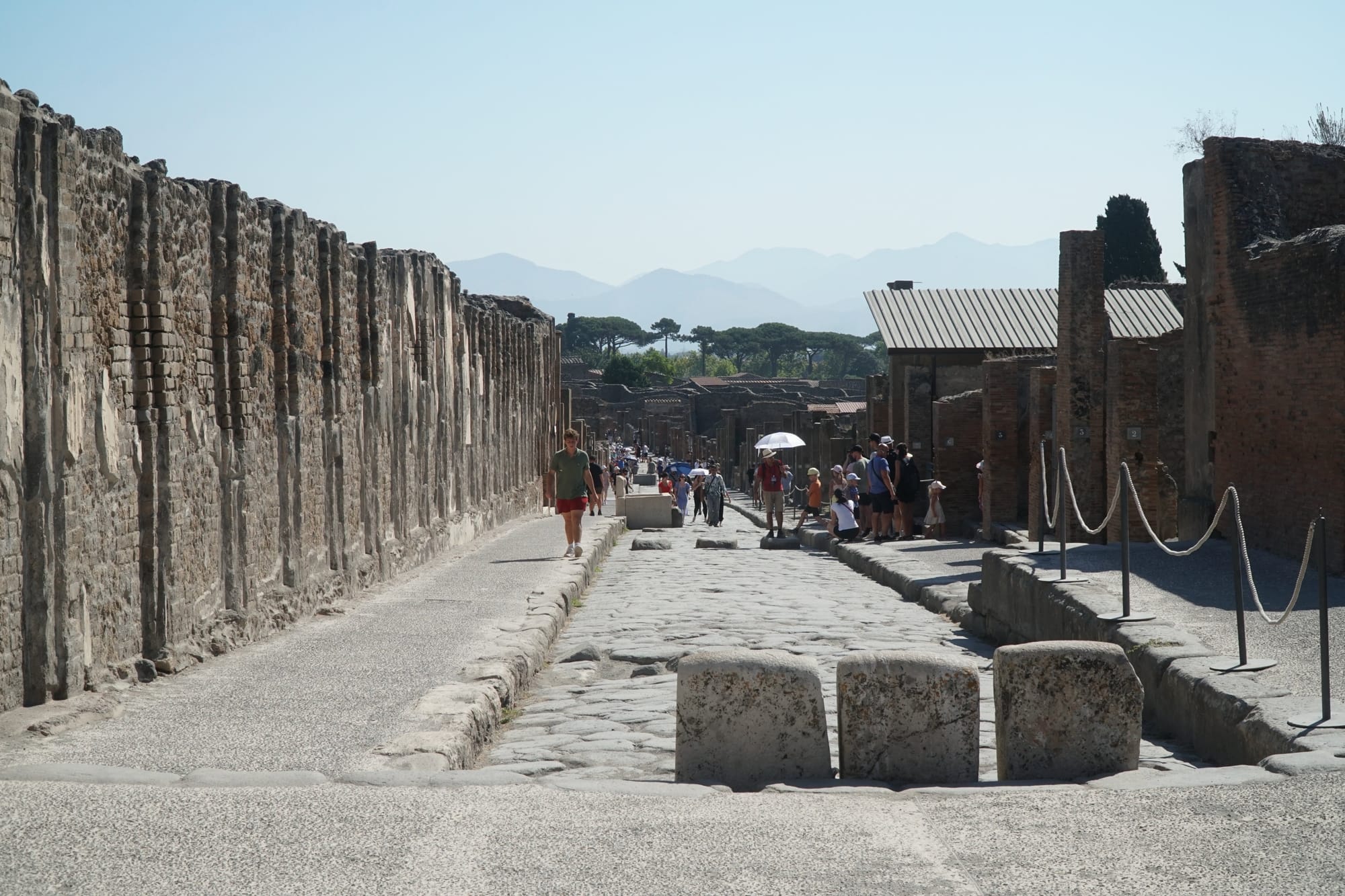
The wardrobe stood in the central area of Pompeii, in house IX 11, 7, traditionally attributed to Cornelius Maximus, on the very busy Via dell'Abbondanza. No wood survives: the wardrobe has been reconstructed from the hollow it left in the volcanic deposit, from post holes in the walls, and from the objects that came down with its upper shelves when the roof collapsed. The park's excavation report was published as number 11 of the E-Journal degli Scavi di Pompei, dated 29 October 2026, with Gabriel Zuchtriegel among seven authors.
A house dug in two stages
The façade of the house was excavated in 1912, and the attribution to a man called Cornelius Maximus is doubtful, resting on inscriptions that are no longer visible. Only now has part of the rooms behind it been investigated, within the large restoration and accessibility project for the neighbouring Insula dei Casti Amanti. The slope west of the alley dividing insulae 11 and 12 of Regio IX was cut back by about 2.50 m.
The park says the Fourth Style wall paintings in the room with the wardrobe, attributable to the workshop of Via di Castricio, point to a certain standard of living, in keeping with the house's central position. At the time of the eruption, however, various works were under way that must have affected how liveable the house was.
The wardrobe and what it held
Its two arms, each roughly 2 m long, ran along the south and east walls and met in the room's south-east corner. The roof of the room withstood the fall of lapilli but gave way when the pyroclastic flow came in from the north-west; it smashed the top of the wardrobe, and the flow filled what remained, keeping more than half of its height intact.
The park's press release lists make-up tools (tweezers and a pigment palette), a glass balsamarium, a perfume burner and a bronze lamp, alongside lead weights kept in a small wooden box of which only faint traces remain. The press release says the weights were probably used for selling goods.
A necklace of charms
The wardrobe held a necklace of at least 24 miniature objects in faience, bone, glass paste and rock crystal, all pierced for suspension and showing deities (Bes and Mercury are recognised), feet and hands, pine cones and bunches of grapes. Such objects were at times thought of as magical, for spells and potions, but the park identifies them as crepundia, literally rattles: necklaces with amulets given to children to protect them and so that they could be heard when they moved. Traces of cloth show the pendants were stored in a bag, probably on a middle shelf; when the roof came down, a post toppled inward onto the shelf, shoving the bag against the south wall, where it tore open. The authors cite comparable sets from the House of Helvius Severus (I 13, 2) and from the House of the Garden in Regio V.
Thirty-eight coins
The wardrobe also held 38 bronze coins, kept in a small plaited container, the remains of which were analysed after recovery. Thirty-six of them date from Nero's reign, from issues of 64 to 67 CE, and 21 of those are dated to 65 CE; the remaining two are older, much-worn pieces, a unit of Ebusus and a sestertius of Claudius struck in Germanicus's name. The authors take them to be a modest store of small change, perhaps kept for everyday spending.
Two mice in an amphora
Excavators also found the skeletons of at least two mice inside an amphora on a mezzanine. Analyses by the park's laboratory point to the wood mouse, Apodemus sylvaticus, and the press release says both were not fully mature, judging by their skeletons, which survive as 117 tiny fragments.
Who owned it?
Zuchtriegel, the park's director, said in the press release that the identity of whoever lived in the house cannot be reconstructed with certainty, but that these fragments bring us closer to their daily life. The press release suggests the owners may have been among those who, as Tacitus recalls, died without heirs and whose property was to be used to refound Pompeii, a refounding that never took place. The report adds that this reference needs philological and legal-historical study before it is tied to the owners of this house. Suetonius, Life of Titus 8.4, assigns the property of those who died at Vesuvius without heirs to restoring the buried towns. That caution suits the evidence: a cupboard can say a good deal about what was kept in it, and much less about who kept it.
Sources
Ancient Content (2026) 'The Wardrobe in House IX 11', Ancient Content, 29 October 2026, available at: https://www.ancientcontent.com/p/the-wardrobe-in-house-ix-11 (Accessed: 9 November 2026).
Pompeii Sites (n.d.) 'L’armadio di una donna che non tornò più', Pompeii Sites, available at: https://pompeiisites.org/comunicati/larmadio-di-una-donna-che-non-torno-piu/ (Accessed: 9 November 2026).
Picture credits
- Top picture: Via dell'Abbondanza, Pompeii, the street on which house IX 11, 7 stands. Image: Via dell'Abbondanza, Pompeii — Adam Harangozó / Wikimedia Commons (CC BY-SA 4.0)
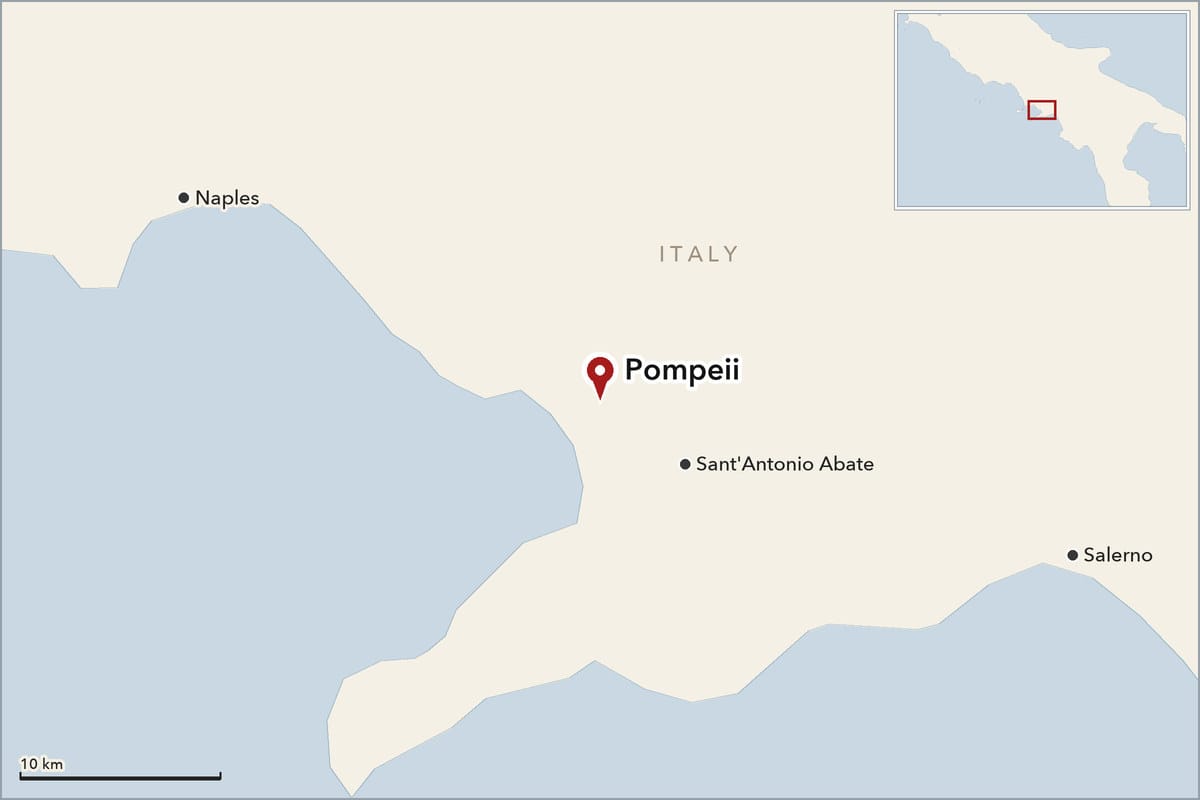
- Map: drawn from Natural Earth (public domain) and Wikidata.
