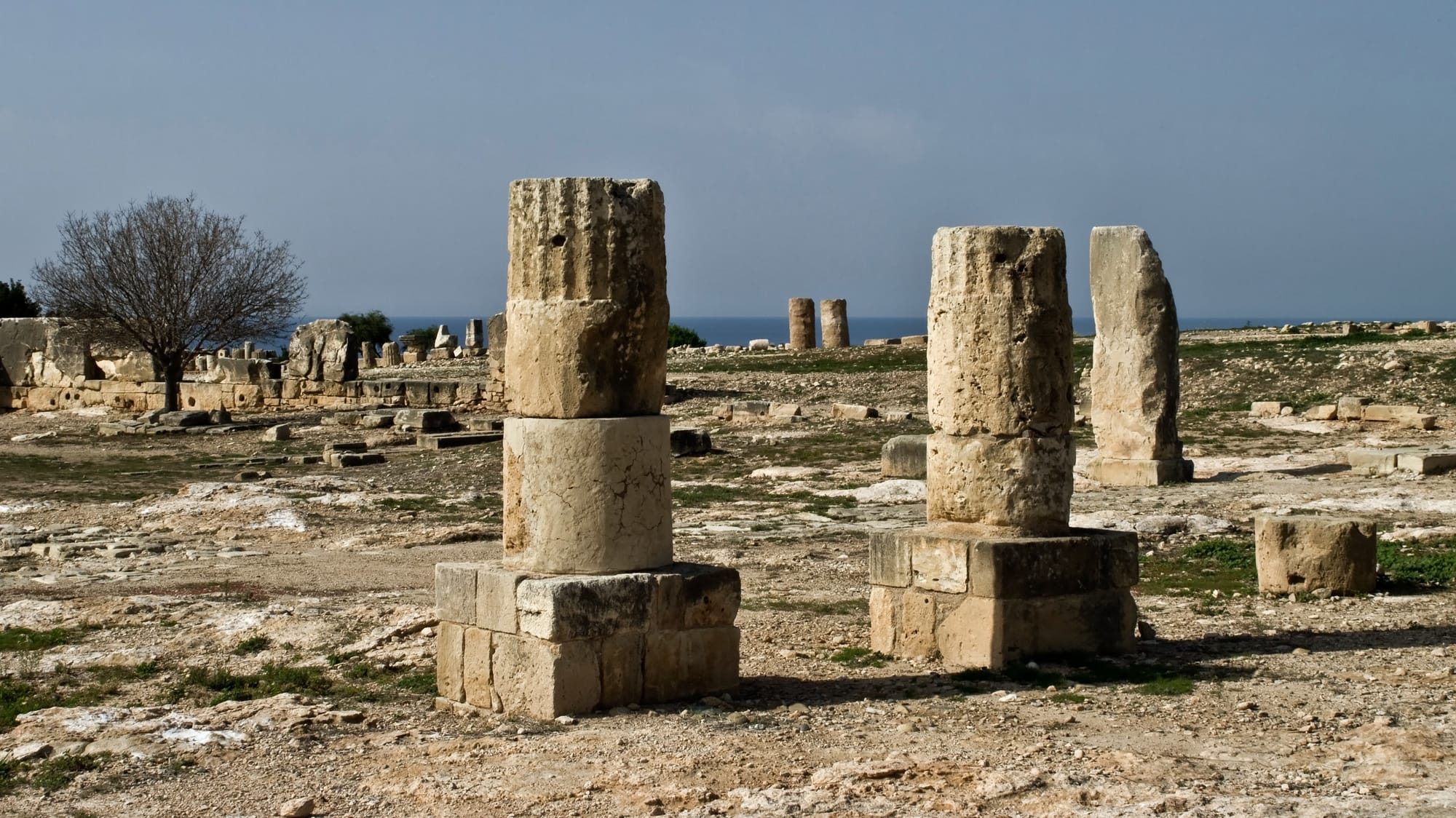
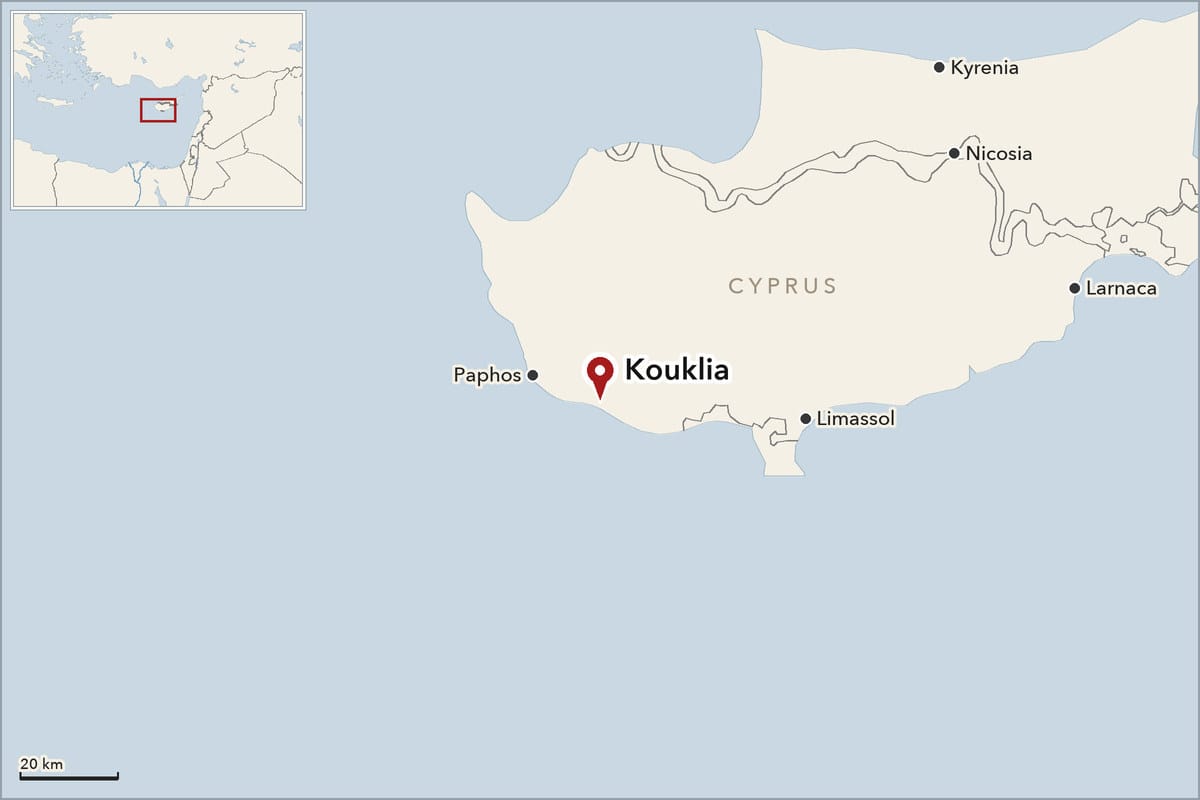
On 22 October 2026, the Department of Antiquities of the Deputy Ministry of Culture of the Republic of Cyprus announced the end of the August–September excavation season at Marchello in Kouklia, the village that sits on ancient Palaepaphos. The department's press release says the season's findings "establish the first Late Bronze Age fortification system identified at Palaepaphos." That is the department's own framing, and the details behind it are worth reading closely.
Who dug, and where
The excavation was run by the Department of History and Archaeology of the National and Kapodistrian University of Athens (NKUA), under the direction of Professor Konstantinos Kopanias, as the Department of Antiquities' press release names him. According to the press release, NKUA has been excavating at the site since 2021.
Marchello lies just under 1 km northeast of the sanctuary of Aphrodite, according to the release. The fortifications are therefore near the sanctuary, not on it.
What was already known, and what wasn't
Earlier British, German-Swiss and University of Cyprus excavations had uncovered a long rampart and a monumental gate, the release says. What remained open was when those structures were built and how they related to each other. Since 2021, NKUA has been excavating to investigate the site's history further, the release says.
A dated rampart
The department says the 2026 work gives stronger evidence that the earliest rampart dates to Late Cypriot IIC–IIIA, towards the end of the Late Bronze Age. Beside a newly exposed stretch of wall, the team found an undisturbed deposit containing pottery of that period. On top of it lay a concentration of marl, which the release says was apparently prepared there for construction. Builders appear to have spread it over the stone foundation to make a level base for the mudbrick wall above. The release says its close association with the pottery and foundations helps establish the date of the rampart's earliest phase.
From bastion to tower
The season's main architectural result, according to the department, concerns a rectangular bastion, a structure projecting from the rampart, built in Late Cypriot IIIA. A three-sided extension was later added in front of it. Together they formed a nearly square structure of about 7.4 × 7.3 metres, with thick walls around a central chamber of about 9 square metres.
The department says that plan supports identifying it as a tower that could have carried upper levels. Only the foundations survive, so its original height is unknown. The tower was strengthened again, probably still in Late Cypriot IIIA, with a wall about 2.7 metres thick added on its northwestern side. The release reads these successive additions as showing that the defensive complex was developed and reinforced during the Late Bronze Age.
Reinforced again centuries later
In the Late Cypro-Classical period, in the fourth century BCE, another reinforcing wall was added along the tower's northeastern and southeastern sides. Pottery from its foundation trench gives the evidence for that date. The rampart was also widened at a later stage, possibly in the same period, the release says.
What is still open
The department states the limits of the finding itself. No Cypro-Geometric or Cypro-Archaic construction phase has yet been securely identified in the area NKUA excavated. Whether the fortifications stayed in continuous use between their Late Bronze Age construction and the later repairs is, in its words, still under investigation. The claim of the "first Late Bronze Age fortification system identified at Palaepaphos" sits alongside a stretch of the site's history that the excavators have not yet filled in.
At the end of the season, the remains were covered with ground-cover fabric for protection, the department says.
Greek City Times, reporting the announcement on 26 October 2026, described the discovery in matching terms and credited the Department of Antiquities as its source.
Sources
Department of Antiquities, Deputy Ministry of Culture (2026) 'Completion of the August-September 2026 excavation season at Marchello archaeological site, in Kouklia by the National and Kapodistrian University of Athens', gov.cy, 22 October 2026, available at: https://www.gov.cy/en/culture/completion-of-the-august-september-2026-excavation-season-at-marchello-archaeological-site-in-kouklia-by-the-national-and-kapodistrian-university-of-athens/ (Accessed: 4 November 2026).
Giannopoulos, B. (2026) 'Archaeologists Uncover Bronze Age Defences at Ancient Cyprus Site', Greek City Times, 26 October 2026, available at: https://greekcitytimes.com/2026/10/26/archaeologists-uncover-bronze-age-defences-at-ancient-cyprus-site (Accessed: 4 November 2026).
Picture credits
- Top picture. Photo: Nikodem Nijaki (CC BY-SA 3.0), via Wikimedia Commons
- Map: drawn from Natural Earth (public domain) and Wikidata.
