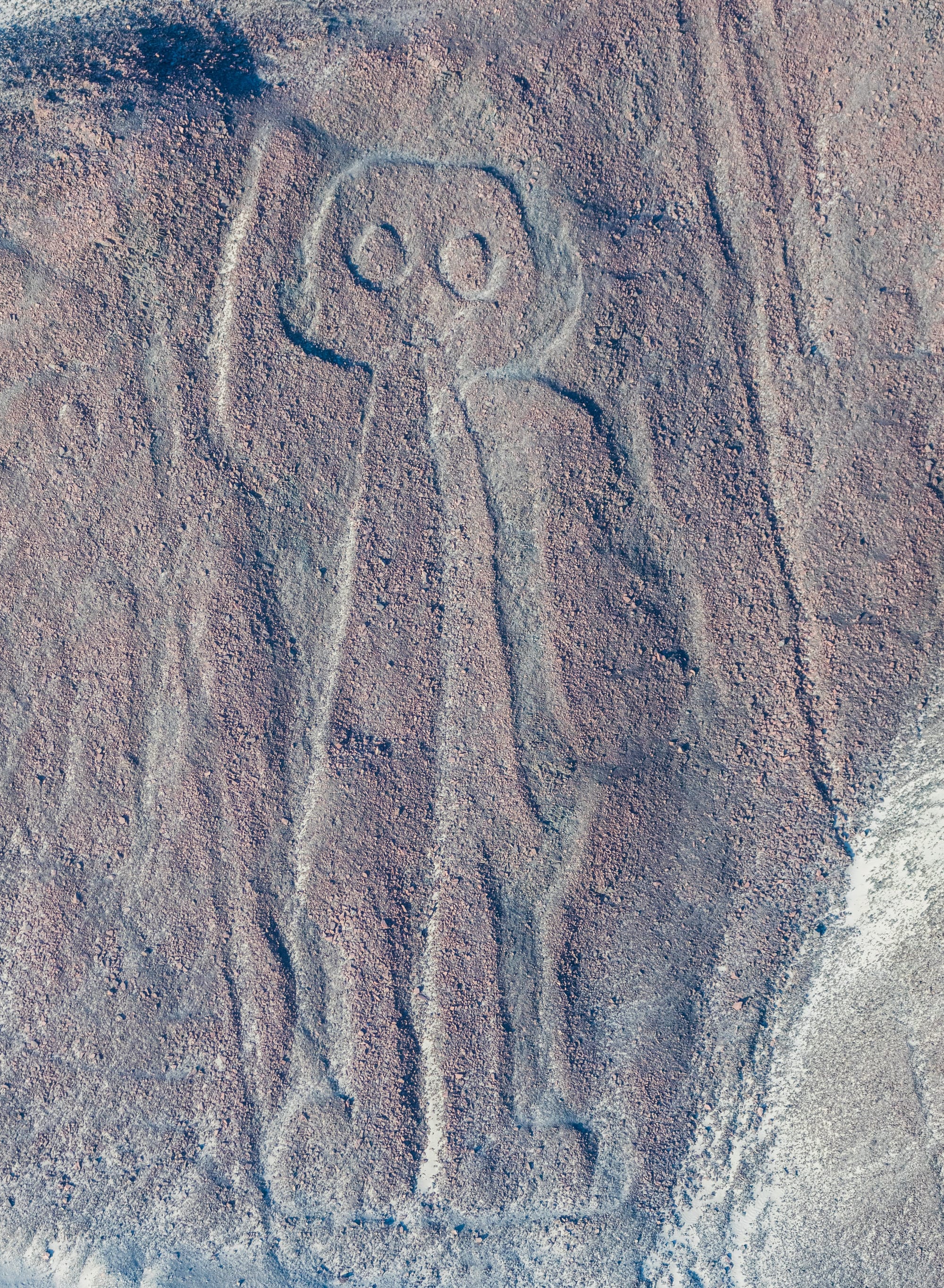
The remains of an infant girl with the physical and genetic characteristics of cyclopia were found buried in an urn with another baby girl, according to Haaretz. The researchers reported in the journal PNAS that the urn was placed in a cemetery in Jauranga somewhere between 325 and 440 C.E. The paper's authors are Elsa Tomasto-Cagigao, Markus Reindel, Johny Isla Cuadrado, Mellisa Lund Valle, Kalina Kassadjikova, Kelly Harkins and Lars Fehren-Schmitz.
What was in the urn
Live Science reported that her skeleton lay with a second infant's inside a ceramic urn at Jauranga, in Peru's Palpa Valley, an area where many of the geoglyphs known as the Nazca Lines have been found. Her skull was very small, with a single eye socket in the middle of the face and other problems in the development of the cranial bones. Haaretz describes her symptoms as the hallmark single eye socket, a small, elongated and underdeveloped skull, and an absent nasal cavity. The study's abstract labels her JA13A and says the second infant, JA13B, showed no comparable congenital variations.
According to Haaretz, the disorder stems from a malformation called alobar holoprosencephaly, in which the brain does not divide into left and right hemispheres early in the embryo's development. Live Science adds that the condition can also alter the nasal structures, resulting in a missing nose or a tube-like nose above the single eye. Haaretz lists other symptoms as the absence or misplacement of the nose, a cleft palate and abnormal genitals. "The cause of the malformation was present at fertilization, but manifestation occurs around the fourth to fifth week in utero [in the womb], when the frontal lobe of the brain has to divide," first author Elsa Tomasto-Cagigao, an archaeologist at the Pontifical Catholic University of Peru, told Live Science in an email.
Live Science puts cyclopia at about 1 out of every 100,000 births. The study's abstract calls it an extremely rare congenital condition that is typically lethal before or shortly after birth. Haaretz says that in humans the infant always dies within minutes to days, the longest survival span known being 240 days. Haaretz also notes that the malformation can affect any vertebrate, fish and frogs as well as humans, and is mostly reported in agricultural settings, where animals are watched closely. It cites a cyclopic and albino shark pup off Mexico in 2011 as one of the most famous cases, and says there are rare reports of careful nurturing leading to a few weeks of life for cyclopian animals, a recent case being a goat in India.
What the DNA showed
Live Science reported that the team detected an extra copy of chromosome 13, meaning the infant had trisomy 13, also called Patau syndrome, which is known to be a major chromosomal cause of cyclopia, although only a small percentage of trisomy 13 cases involve cyclopia. The study's abstract says ancient DNA revealed the extra copy in JA13A, identifying trisomy 13 as the likely cause. Live Science adds that the DNA suggested the infant carried two X chromosomes, typical of a female. Fehren-Schmitz said that while trisomy 13 is associated with advanced maternal age, it is not clear whether that was the case for this infant.
The genetic analysis showed that the two infants did not have the same mother. "Sadly, the DNA preservation of the second individual was not good enough to analyze relatedness beyond the mitochondrial genome," Fehren-Schmitz told Haaretz. He also told Haaretz: "The burial suggests that both infants died around the same time, which would make a scenario where they both shared the same father less likely, unless the father impregnated two women around the same time."
How long did she live?
Haaretz reports that, based on an analysis of the infants' femurs, the researchers say both babies had died after 40 weeks in the womb or fewer. "I would say that we are certain that the girl was born alive, but most likely only survived for a short time," Fehren-Schmitz told Haaretz by email. Haaretz says the evidence suggesting that she survived birth is the state of development of her mouth, but that the dimensions of her long bones are more typical of late fetal skeletal development. Fehren-Schmitz told Live Science: "We cannot really say how long this individual survived."
He told Haaretz: "Sadly, as far as we know, there are no medical case studies that would allow us to fully assess how both conditions affect long bone and dental development, which would have helped us determine the age at death more precisely." Siân Halcrow, a bioarchaeologist at the University of Otago in New Zealand who was not involved in the study, told Live Science that the researchers' estimate of the infant's age at death suggests she may have survived for several weeks or months after birth. Halcrow also said: "To my knowledge this is the first archaeological example of this developmental abnormality," adding that the condition has been documented in historic and modern anatomical collections. Those accounts differ in emphasis: one co-author says a short life is most likely, while an outside expert reads the age estimate as allowing weeks or months.
A burial in keeping with the norms
Urn burial itself was common for Nazca children. "Urn burials are a very frequent burial type for children in the Nazca region around that time," Fehren-Schmitz told Haaretz, adding that these seem to have been primary burials. The study's abstract calls interment in a ceramic vessel a mortuary treatment well documented for Nasca children. He added: "Importantly, these burials did not always include intact urns; in some cases, the bodies were only covered with sherds or broken vessels. However, in our case, we found the two infants in an intact vessel."
"The baby with cyclopia was at the bottom of the jar, while the other baby was on top. Nevertheless, it appears that they were interred in a single event," Tomasto-Cagigao told Live Science. Haaretz says the other baby buried with her was normal. Live Science reports that the researchers said a burial of two infants in one urn is unusual for this culture, but that there is not enough archaeological evidence to conclude that the infant with cyclopia was given a different type of burial. According to Haaretz, Fehren-Schmitz says the Nazca did not seem to have practised cremation, a burial form that seems atypical in the Andes.
Fehren-Schmitz told Live Science that burial "with a 'healthy' individual in a regular cemetery, without any special grave goods, suggests that, to some extent, the individual was not treated differently in death, even though it had such a rare condition." In his words: "It was neither 'excluded' because of it nor treated in a 'special' way." He said "the burial of this infant suggests that the Nasca treated this individual in death like most other infants." Haaretz reports the researchers' conclusion that the malformed infant was handled in keeping with traditional Nazca mortuary norms. Haaretz adds that we cannot know how the child may have been treated before death. As quoted by Haaretz, the researchers write: "This distinction matters because impairment, disability and care are not interchangeable categories, and similar bodily conditions may carry very different social meanings across communities."
Other Andean evidence, and its limits
Live Science notes that some people with disabilities in ancient Andean societies held special roles, for example ones tied to religious practices. "If that reflects Nasca society as a whole, we can't say based on one case," Fehren-Schmitz said, "but it does reflect the community this infant was part of, even if only briefly."
Haaretz points to separate work published in 2021 on the Moche people of ancient Peru, who it says lived from 50 to 850 C.E. Those researchers described 26 pieces of Moche pottery that appear to show people with malformations, among them what may be cleft lips and palates, abnormally spaced eyes, craniofacial clefting and extra fingers. According to Haaretz, those scientists wrote that the portraits suggest such people were given some respect, perhaps even elevated status, in their society. Haaretz also cites a 2022 paper that claims the Inca Empire recognised disabled people and cared for at least some of them, which Haaretz sets in sharp contrast with how such people were treated in late medieval and early modern Europe.
Sources
Haaretz (2026) 'Rare Malady of Cyclopia Discovered in Ancient Nazca Burial in Peru', Haaretz, 9 November 2026, available at: https://www.haaretz.com/archaeology/2026-11-09/ty-article-magazine/rare-malady-of-cyclopia-discovered-in-ancient-nazca-burial-in-peru/000001a1-c03e-d7fa-adbb-d4bf748c0000 (Accessed: 10 November 2026).
Life Science Network (n.d.) 'A Nasca-period perinatal burial reveals cyclopia associated with trisomy 13 in southern Peru.', Life Science Network, available at: https://www.lifescience.net/publications/2293315/a-nasca-period-perinatal-burial-reveals-cyclopia-a/ (Accessed: 10 November 2026).
Live Science (2026) 'Nazca infant had rare, fatal birth defect that left her with one central eye 1,600 years ago', Live Science, 9 November 2026, available at: https://www.livescience.com/archaeology/americas/nazca-infant-had-rare-fatal-birth-defect-that-left-her-with-one-central-eye-1-600-years-ago (Accessed: 10 November 2026).
Picture credits
- Top picture: A geoglyph of the Nazca Lines in Peru, seen from above. Photo: Diego Delso, CC BY-SA 4.0, via Wikimedia Commons
