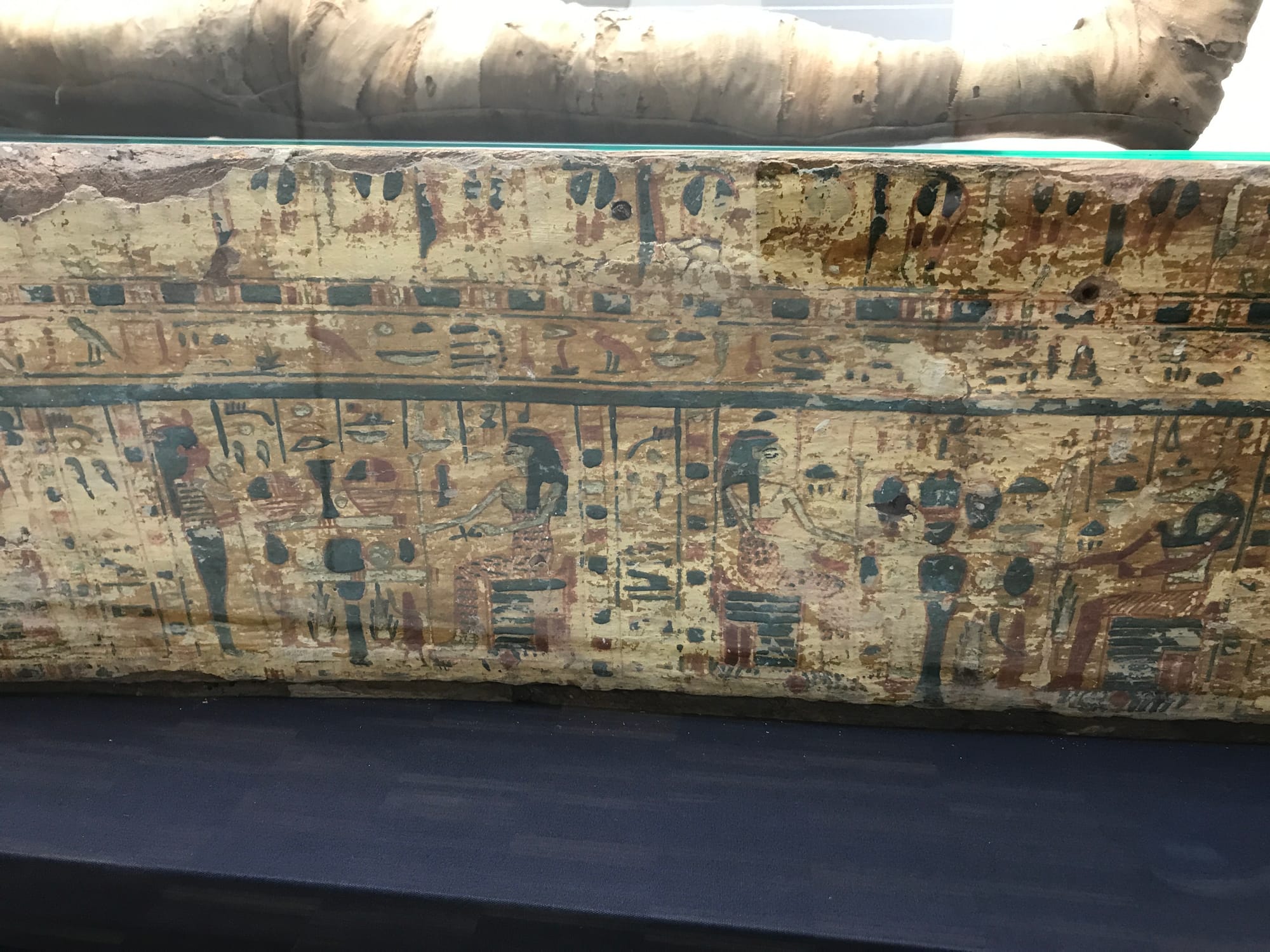
In a news item dated 22 October 2026, the Archaeological Museum of the University of Münster announced that the German Research Foundation (DFG) is funding a new project on the Egyptian mummy and coffin it keeps in its basement. The project, funded with 170,000 euros, is entitled "History(ies) in a 'dense find' – a multidisciplinary investigation of the Egyptian coffin containing a mummy in Münster".
Who he was, and what the museum admits it doesn't know
The museum opens with questions it does not expect to answer. Who was the man? Why was he buried in a coffin that is several centuries older than he was? And how did the mummy and coffin come into the possession of the merchant Wilhelm Schmitz-Scholl, whom the museum describes as a descendant of the Tengelmann founding family? "These specific questions will probably remain unanswered forever," the museum's page says.
The history of the two objects is thin. Nothing is known of the coffin's history from its manufacture to its disposal, or of where the two objects were found. The earliest confirmed mention dates only to 1903, when Schmitz-Scholl donated the mummy and coffin to his former school in Mülheim. After a series of twists and turns, they reached the Archaeological Museum in Münster in poor condition. The head was missing and has since been replaced by a replica. They have been on display since 2021, following extensive restoration.
What the project will look at
The project brings together Egyptologist Prof. Dr Angelika Lohwasser, project collaborator Dr Marc Loth and the museum's team. The museum says researchers from a wide range of disciplines are involved, investigating the materials and techniques used to build the coffin, the methods used for mummification, and the possible significance of the coffin's texts and images. The aim is a multifaceted overall picture. The museum adds that modern analytical methods promise to reveal information about the mummy's age, diet and health.
A second strand follows the 3,000-year history of the objects. The museum describes it as running from the coffin's manufacture by a joiner, through its refurbishment with stucco and paint and its use and possible reuse, to its disposal. The team hopes the work will yield new insights into everyday life in Egypt 3,000 years ago.
An ordinary collection, and why that helps
"The Münster collection is neither exceptional nor of particularly high quality," Lohwasser says. She argues that this makes it well suited to a comprehensive publication, since it is usually unusual or exquisite objects that get individual studies. "This, however, skews our understanding of Egyptian coffins, as most objects in museums are not of high quality," she says. In her view, an average collection can illustrate an ancient Egyptian standard and serve as a benchmark for other collections.
That is an unusual pitch, and an honest one. A study of the best pieces tells you what the best pieces looked like. A study of the middling ones, as Lohwasser argues, can show what was standard.
What the 2010 scan found
The mummy has been examined before. A news item on the museum's site dated 9 July 2010 reports the initial findings of a CT scan of the fully bandaged mummy, carried out at the Institute of Clinical Radiology at Münster University Hospital. The mummy was clearly male, about 30 years old and 1.65 metres tall at death, and likely died almost 3,000 years ago. His head and parts of his spine were missing. The item says the cause of death remained unknown.
Seeing it for yourself
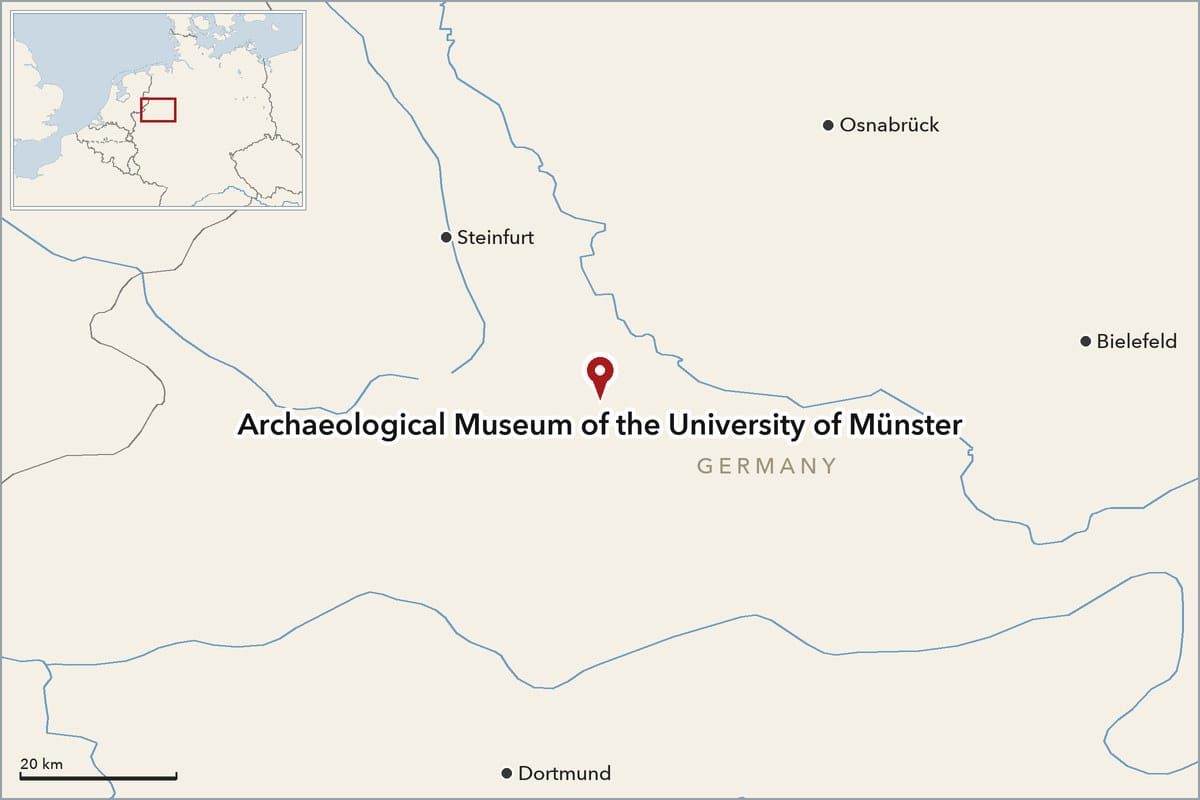
According to the museum, the mummy and coffin can be viewed free of charge, 10 am to 6 pm, Tuesday to Sunday, at the museum on Domplatz 20–22 in Münster.
Sources
University of Münster, Archaeological Museum (2026) 'DFG Funds New Research into the 'Münster Mummy'', Universität Münster, 23 October 2026, available at: https://www.uni-muenster.de/ArchaeologischesMuseum/en/ (Accessed: 31 October 2026).
University of Münster, Archaeological Museum (2026) 'DFG Funds New Research into the 'Münster Mummy': A Multifaceted Overview Using Modern Methods', Universität Münster, 23 October 2026, available at: https://www.uni-muenster.de/ArchaeologischesMuseum/en/sammlung/dfg.html (Accessed: 31 October 2026).
University of Münster, Archaeological Museum (2026) 'Latest Research News', Universität Münster, 23 October 2026 (includes the item 'UKM radiologists examine the Münster mummy'), available at: https://www.uni-muenster.de/ArchaeologischesMuseum/en/sammlung/aktuelles.html (Accessed: 31 October 2026).
Picture credits
- Top picture: The Münster mummy and its coffin. Mummy and coffin, Archaeological Museum of the University of Münster — photo: Marsupium (CC BY-SA 4.0) (source)
- Map: drawn from Natural Earth (public domain) and Wikidata.
