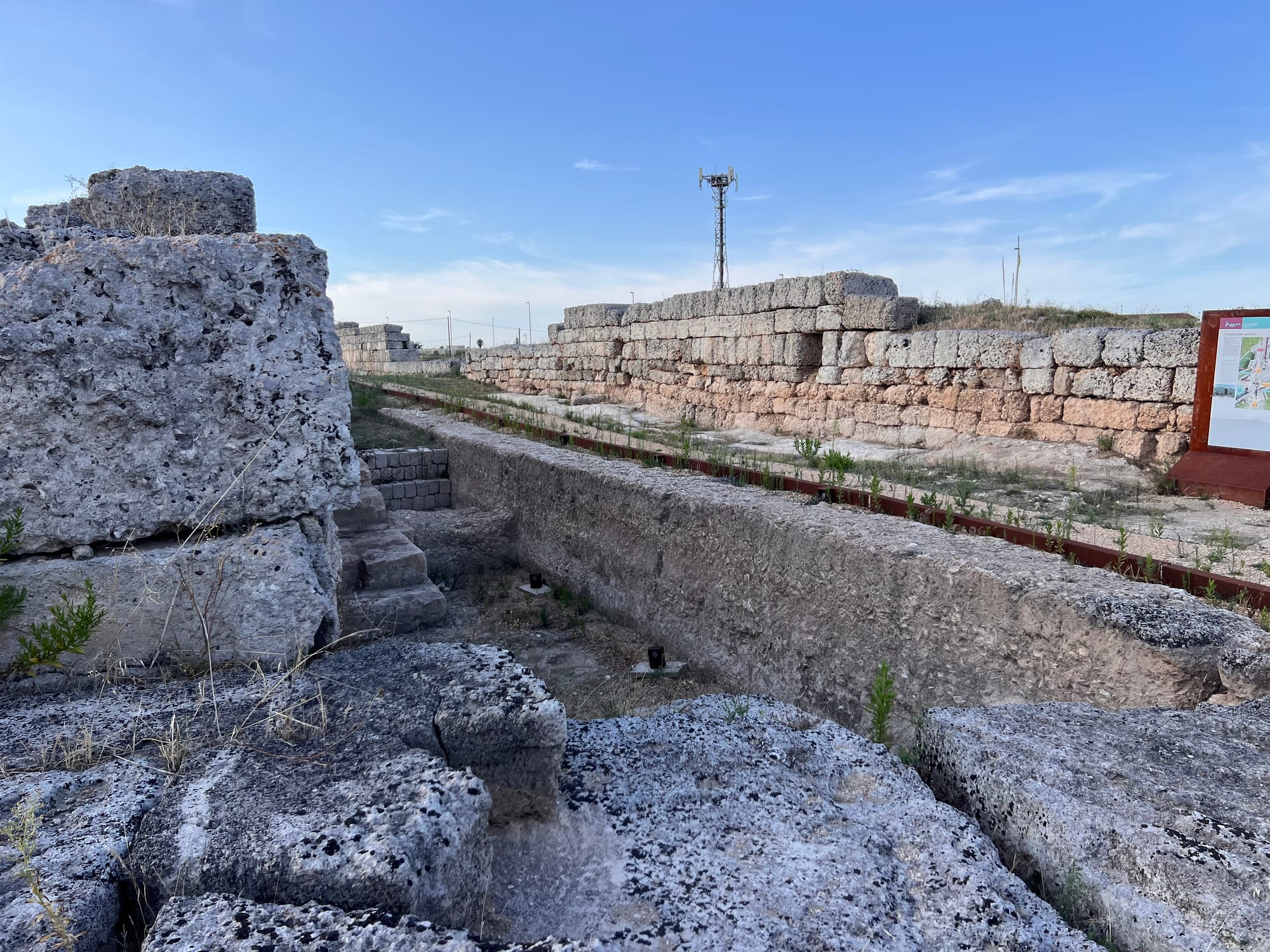
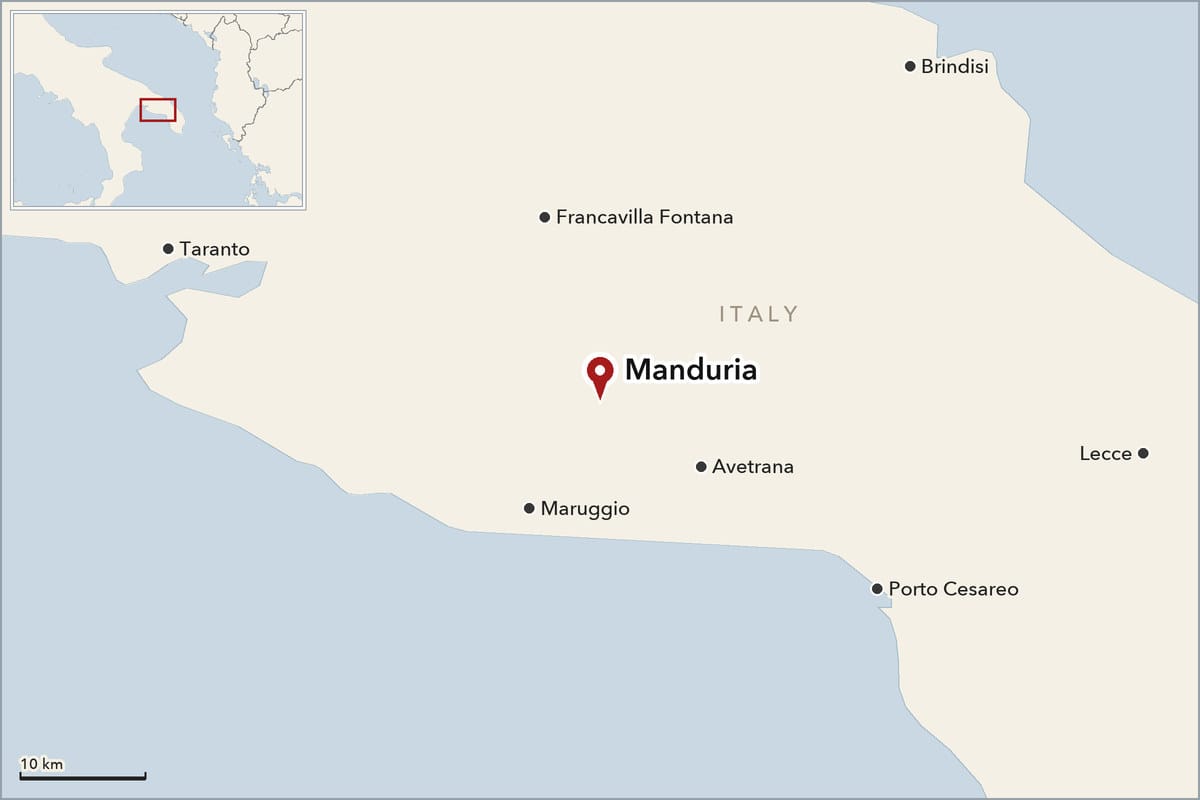
Archaeologists working at Manduria, in the province of Taranto in southern Italy, have uncovered a monumental tomb whose inscriptions and painted decoration suggest the person buried there may have been a priestess connected to the cult of Demeter. Arkeonews, which reports the tomb as 2,300 years old, describes the evidence as a pointer rather than proof, and that is the right way to read it.
What was found
The tomb, known as Tomb 17, lies in the necropolis of the ancient Messapian city, within the Mura Messapiche Archaeological Park. Arkeonews and The History Blog both describe it as cut into the bedrock and originally sealed with three large stone slabs.
The first inscription is carved across those three slabs, in the Messapic language. Arkeonews reports that initial epigraphic analysis found a woman's name, her father's name and the word thabara. Researchers read thabara, which appears in the genitive case, as a title linked to a priestly role. Arkeonews adds that the exact reading of the woman's name and the full scope of her duties remain undisclosed.
A second inscription is painted in four lines on the inner face of one of the slabs. Arkeonews says looting damaged parts of it, but researchers identified thabara again, along with a name provisionally reconstructed as Damatrioas. Researchers are examining whether that name relates to Demeter, the Greek goddess associated with agriculture and fertility. La Voce di Manduria, reporting on the day of the announcement, calls these interpretations preliminary and still under study.
The painted decoration
Traces of red and blue paint survive on the slabs, Arkeonews reports, including a meander pattern along the upper section. Other painted images appear to show a temple or sanctuary key and a thymiaterion, a vessel for burning incense. Arkeonews notes that ancient Greek priestesses sometimes carried a key as a symbol of their responsibilities at sanctuaries.
A looted tomb
Tomb 17 was disturbed by looters in the past, and The History Blog says it was looted in antiquity. Arkeonews lists what survives of the grave goods: bronze fibulae (clasps), a silver ring, a silver coin attributed to the mint of Taranto, and an iron object whose function is undetermined. The History Blog adds that the ring carries a snake motif. It also describes the human bone fragments as sparse and fragmentary, damaged by looters and acidic soil.
Arkeonews is blunt about the limits: the objects alone cannot definitively prove that the occupant was a priestess. Whether she served specifically as a priestess of Demeter, it says, remains an open question, and further study of the Messapic texts will be essential.
Why it matters if it holds
The History Blog says only about 600 Messapic inscriptions survive, so any new text adds to a small body of evidence. Both it and Arkeonews describe the role of women in Messapian religion as an open question. Arkeonews says that if the priestly title and the Demeter connection are confirmed, the tomb could offer direct insight into women's religious authority in Messapian society and into how Greek-originating cults were taken up by local communities.
Arkeonews describes the Messapians as a community that lived in Puglia, particularly the Salento Peninsula, before Roman dominance. They had their own language and close ties to the Greek world.
The wider excavation
The results were announced at a press conference in Lecce on 29 October 2026, according to Arkeonews. La Voce di Manduria reports that Superintendent Antonio Zunno presented them, with archaeologists Vincenzo Ria and Stefania Montanaro also speaking. The excavations were funded by Italy's Ministry of Culture and run by the Soprintendenza for the provinces of Brindisi, Lecce and Taranto.
The work covered the East Gate area and the southern sector of the park and examined 24 tombs. Arkeonews says most date to the 4th and 3rd centuries BCE and had been damaged by looting. It also reports that the excavations shed light on how the city's defences changed between the 5th and 3rd centuries BCE, and that an area once used as a necropolis was repurposed for road construction in the 3rd century BCE.
Arkeonews says plans include archaeobotanical analyses, restoration of the painted surfaces and detailed study of the grave goods. Authorities are considering keeping Tomb 17 where it is while displaying the inscribed slabs and grave goods at the Manduria Archaeological Museum.
The picture is still forming. The inscriptions are being deciphered, and a priestess of Demeter is, for now, a hypothesis the next round of study has to test.
Sources
Buyukyildirim, O. (2026) '2,300-Year-Old Tomb with Two Inscriptions Discovered—May Belong to a Priestess of Demeter', Arkeonews, 31 October 2026, available at: https://arkeonews.net/2300-year-old-tomb-with-two-inscriptions-discovered-may-belong-to-a-priestess-of-demeter/ (Accessed: 4 November 2026).
Dinoi, N. (2026) 'Archeologia: a Manduria scoperta la tomba di una sacerdotessa del culto di Demetra', La Voce di Manduria, 29 October 2026, available at: https://www.lavocedimanduria.it/news/87786163718/archeologia-a-manduria-scoperta-la-tomba-di-una-sacerdotessa-del-culto-di-demetra (Accessed: 4 November 2026).
Finestre sull'Arte (2026) 'Manduria: A painted tomb with inscriptions in the Messapian language has been discovered; it may have belonged to a priestess of Demeter', Finestre sull'Arte, 31 October 2026, available at: https://www.finestresullarte.info/en/archaeology/manduria-a-painted-tomb-with-inscriptions-in-the-messapian-language-has-been-discovered-it-may-have-belonged-to-a-priestess-of-demeter (Accessed: 4 November 2026).
The History Blog (2026) '2,300-year-old possible priestess tomb found in southern Italy', The History Blog, 3 November 2026, available at: http://www.thehistoryblog.com/archives/77270 (Accessed: 4 November 2026).
Picture credits
- Top picture: The Mura Messapiche Archaeological Park at Manduria. Photo: Ferdi2005, CC BY-SA 4.0, via Wikimedia Commons
- Map: drawn from Natural Earth (public domain) and Wikidata.
