A faint line of white paint on an Athenian vase made around 440–430 BCE, published in 1923, has been largely unknown in later discussions of the vase and in lists of kalos names. Debby Sneed, of California State University, Long Beach, republishes it in a paper put online by Cambridge University Press on 10 March 2026 and printed in Greece & Rome, volume 73, issue 1, April 2026. Her reading is that the god Hephaistos is being called kalos, the Greek word for beautiful.
A vase that can no longer be examined
The object is an Attic red-figure bell-krater, dated to 440–430 BCE and attributed to a painter in the Group of Polygnotos. Its scene is the Return of Hephaistos, with Dionysus, Hephaistos and a satyr who may be an actor in costume, standing on a dais of sorts. On either side of the central figure, a white-paint inscription reads ΚΑΛΟΣ ΗΦΑΡΣΤΟΣ.
A photograph and description first appeared in A. B. Cook's 1914 study of ancient religion, before the vase had been fully studied, and scholars most often meet it there. When Eustace Mandeville Wetenhall Tillyard published it fully in 1923, he discussed the inscription, which he had not spotted when he gave Cook the photo, and corrected it to ΚΑΛΟΣ ΗΦΑΙΣΤΟΣ. Soon afterwards the vase was sold on the art market, according to Sneed; its whereabouts are unknown, so it can no longer be examined in person.
Sneed writes that the inscription is largely unknown in later discussions of the vase because it is not visible in the published photographs. It is a small case of how a piece of evidence can drop out of the record: the picture people kept citing did not carry the one line that mattered.
What a kalos inscription was
Sneed describes a practice in which Attic vases carried a name or a bare kalos. She cites Manakidou's estimate of about 300 different people named in such inscriptions, and Lissarrague's count of 208 different names on 851 red-figure vases. She notes that such inscriptions are rare on vases made outside Attica, and that the practice was common or notorious enough in Athens for Aristophanes to joke about it in two of his plays.
Sneed's reading, and the objection she answers
Sneed sets out several possible readings of the inscription. She writes that the simplest and most likely, in her belief, is that it is a single unit, kalos Hephaistos, a straightforward kalos inscription for the god pictured in the scene. She adds that any reading of such an inscription as sarcastic, insincere or derogatory should be explicit in the scene or the inscription, and that such a reading is not supported on this vase.
She describes Immerwahr as having discounted this reading, preferring to read kalos with the figure of Dionysus and to take Hephaistos simply as a name-label. In her account, Immerwahr believed Hephaistos could not be called kalos, presumably because of his disability. Sneed adds in a footnote that Immerwahr's claim grew from a misreading of Tillyard, who had said only that the misspelt form ΗΦΑΡΣΤΟΣ was impossible as a kalos-name.
Hephaistos in epic and in Athens
Sneed notes that Hephaistos is mentioned in the Iliad and the Odyssey more often than many other gods, and that modern scholars often foreground his physical disability. She also notes that the same epics call him lord, a renowned smith and resourceful. As to the myth on the vase, she says it is most fully told in two late sources, Pausanias and Libanios, and that it is a story of the god's reincorporation into the body politic of the Olympian gods, not of his ejection.
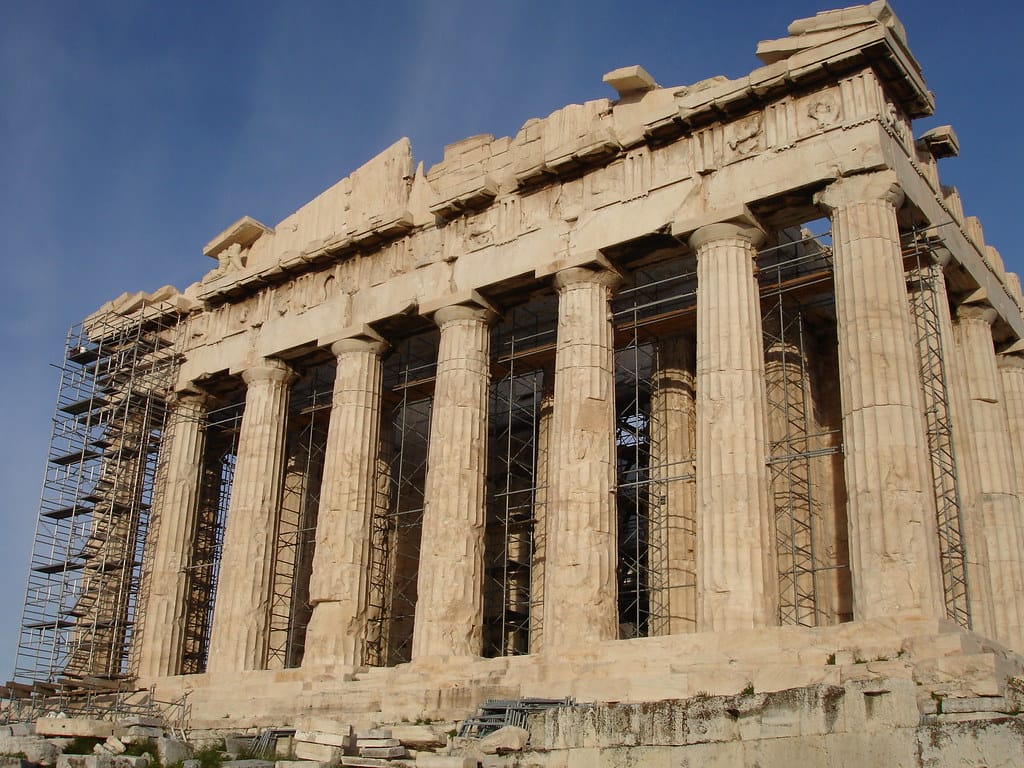
Sneed cites Simon, who calls Hephaistos "one of the main deities of Athens". By Sneed's account he had an altar in the Temple of Athena Polias on the Acropolis and a temple in the Athenian Agora with cult statues of both him and Athena, and he was worshipped at festivals including the Chalkeia and the Hephaisteia. She adds that on the Ionic frieze of the Parthenon he has pride of place next to Athena.
Sneed also ties him to Athenian origins: citing Aeschylus' Eumenides, she says the autochthonous Athenians were, quite literally, children of Hephaistos. She adds that Erichthonios, whose parents were Hephaistos and Ge, became a king of Athens and instituted the Panathenaia festival.
What the vase adds
Sneed concludes that the vase deepens our picture of Hephaistos without collapsing his identity into his disability or trying to erase it. In her words, "this vase proclaims that Hephaistos has returned and is beautiful". Her stated aim is not a definitive analysis but to make the vase more readily available as evidence to scholars.
Sources
Sneed, D. (2026) 'BEAUTIFUL HEPHAISTOS: A RE-PRESENTATION OF A KALOS-INSCRIPTION', Cambridge Core, 10 March 2026, available at: https://www.cambridge.org/core/journals/greece-and-rome/article/beautiful-hephaistos-a-representation-of-a-kalosinscription/F242B241B1A62BD5C7D53FAF1C37A3D0 (Accessed: 17 November 2026).