
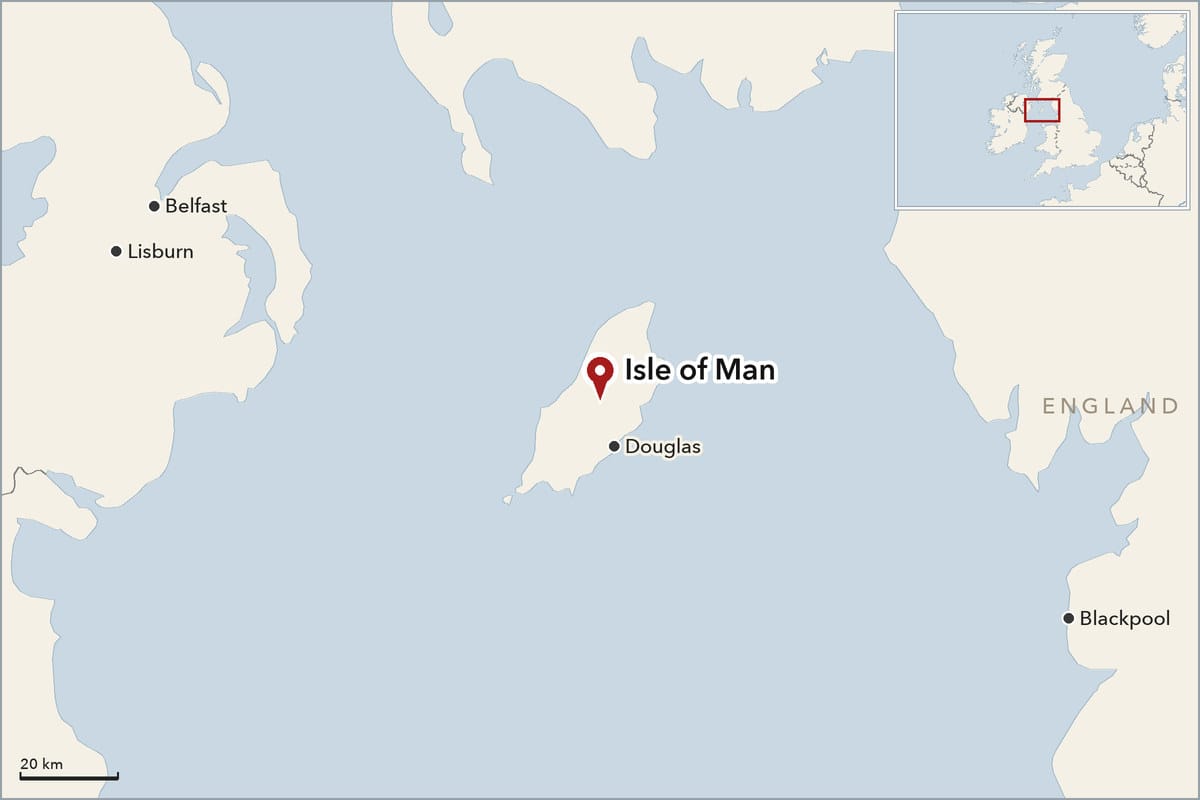
Metal detectorists on the Isle of Man uncovered a group of Viking Age objects in February 2026, and the group was declared Treasure at Douglas Courthouse on 9 November 2026. The items, found by Daniel Crowe and Rhett Britton, include an elaborately decorated sword, three bronze brooches, trading weights and scales, a bronze ladle and the head of an axe. BBC News reported that Coroner James Brooks said the artwork on some of the items would be of "exceptional quality today, let alone when they were made".
Brooches that may mark the island's earliest known female Viking burial
Medievalists.net counts among the most significant finds a pair of oval bronze brooches covered in interlocking animal designs, which it calls a distinctive feature of Viking art. Such brooches were typically worn by women. BBC News reported that they were found alongside a third brooch, and that the pair is only the second of its kind to be found on the Isle of Man. The first pair was found by Daniel Crowe's father, John Crowe, along with Craig Evans in 2018, before going on display after conservation in 2021.
According to Medievalists.net, the newly discovered brooches could be around 50 years older than the earlier pair, potentially making them evidence of the earliest known female Viking Age burial on the island. Allison Fox, Curator for Archaeology at Manx National Heritage, said: "The brooches are especially important because they appear to represent our earliest known female Viking Age burial." The third brooch, which was originally gilded and has spiral decoration around a glass centre, is the first of its kind found on the island, BBC News reported. BBC News said the brooches have turned green over the centuries through oxidation.
A sword that was broken
Medievalists.net and IOM Today both describe the richly decorated sword as the 13th Viking sword found on the Isle of Man. The part that survives, around two-thirds of the sword, includes parts of the hilt. According to Medievalists.net, X-rays showed the hilt is decorated with fine inlaid silver and twisted silver wire. BBC News reported that the sword had been deliberately broken in line with Viking burial practices. IOM Today put it more cautiously: the sword appears to have been deliberately broken, possibly as part of the burial ritual, although some damage occurred after it was buried. BBC News, IOM Today and Medievalists.net all put the sword among only three Manx Viking swords with similar silver decoration. A later BBC News report gave a different count of similarly decorated swords: it reported Fox as saying that while 12 swords had been found on the island, only three others showed similar inlaid silver wire decoration.
One burial or two?
BBC News reported that the items are thought to be the grave goods of a man and a woman, who were either buried side-by-side in the same grave or in two separate ones near to each other. Medievalists.net reported that the original burial site was disturbed at some point over the past thousand years, making it difficult to establish the precise circumstances. BBC News said the items were thought to have been disturbed over many years of the land being worked, and were found scattered over an area of up to 328ft (100m). Fox said: "Although the original burial site has been disturbed, further research may reveal much more about these objects and the people who owned them."
Trade goods and a ladle
The group also contains decorated lead weights and pieces of bronze balance scales, used in trade to weigh precious metals and coins. Medievalists.net says the weights are the first of their type found on the island, and the most intricately decorated Viking trading weights found there so far. Medievalists.net reported that one weight incorporates a decorative bronze fitting, possibly taken from a small chest or religious object, in an artistic style typical of Britain and Ireland at the time. The bronze ladle, which may have been used at feasts or ceremonies, is also a type of object not recorded on the Isle of Man before, Medievalists.net said. BBC News also lists fragments of a cauldron among the other items found.
The finders
Crowe deliberately left the objects uncleaned after finding them, so they could be examined professionally in their original condition, Medievalists.net reported. Britton, also a metal detectorist, helped with the search and found the axehead, part of the balance scales and other iron objects. British Heritage, citing IOM Today, reported that Crowe is keeping the exact location under wraps out of respect for the farmer who owns the land. Medievalists.net quotes Fox as saying Manx National Heritage is extremely grateful to Crowe and Britton for their assistance, and to the landowner for their patience and cooperation.
Medievalists.net also quotes Fox thanking the Radiology Team at Manx Care, and saying specialist scans before conservation allowed a look beneath layers of compacted soil.
Treasure law and the Viking Isle of Man
British Heritage notes that the Isle of Man is a Crown Dependency, not part of the United Kingdom, with its own parliament and its own treasure law. Citing Manx National Heritage, it says finds are reported to Manx National Heritage, and if they fall under the Treasure Act 2017 they are also reported to the Coroner of Inquests, who decides whether an artefact is Treasure. Medievalists.net says the Vikings first arrived on the Isle of Man during the ninth century, establishing trading links before settling on the island. It adds that the island's parliament, Tynwald, traces its origins to the Viking Age and is recognised as one of the world's oldest continuous parliaments.
Where to see it
A selection of the newly declared Treasure has gone on public display in the Viking Gallery at the Manx Museum in Douglas, from Wednesday 11 November 2026. British Heritage, citing Manx Radio, gave the opening time on 11 November as 9.30am.
Medievalists.net reported that further conservation and research could reveal more about the people who owned the objects and the early Scandinavian communities in which they lived.
Sources
British Heritage (2026) 'Father found the Isle of Man’s only pair of Viking women’s brooches in 2018. Now his son has found the second, with a 1,100-year-old sword probably broken in a burial rite, in what may be the island’s earliest known female Viking grave', British Heritage, 11 November 2026, available at: https://britishheritage.com/history/father-found-the-isle-of-mans-only-pair-of-viking-womens-brooches/ (Accessed: 16 November 2026).
Curphey, T. (2026) 'Extraordinary Viking treasure discovered on Isle of Man reveals secrets of 1,100-year-old burial', Isle of Man, 9 November 2026, available at: https://www.iomtoday.co.im/news/extraordinary-viking-treasure-discovered-on-isle-of-man-reveals-secrets-of-1100-year-old-burial-971148 (Accessed: 16 November 2026).
Medievalists.net (2026) '1,100-Year-Old Viking Treasures Discovered on the Isle of Man', Medievalists.net, 15 November 2026, available at: https://www.medievalists.net/2026/11/1100-year-old-viking-treasures-discovered-on-the-isle-of-man/ (Accessed: 16 November 2026).
Nicoll, C. (2026) ''Extraordinary' Viking items declared as treasure', BBC News, 9 November 2026, available at: https://www.bbc.com/news/articles/cx4g1gr99rr9o (Accessed: 16 November 2026).
Nicoll, C. (2026) 'Viking jewellery sheds new light on island's history', BBC News, 15 November 2026, available at: https://www.bbc.com/news/articles/cm894lk2xlljo (Accessed: 16 November 2026).
Picture credits
- Top picture: The Manx Museum in Douglas, where a selection of the finds is on display. Image: Otter, via Wikimedia Commons (CC BY-SA 4.0)
- Map: drawn from Natural Earth (public domain) and Wikidata.
