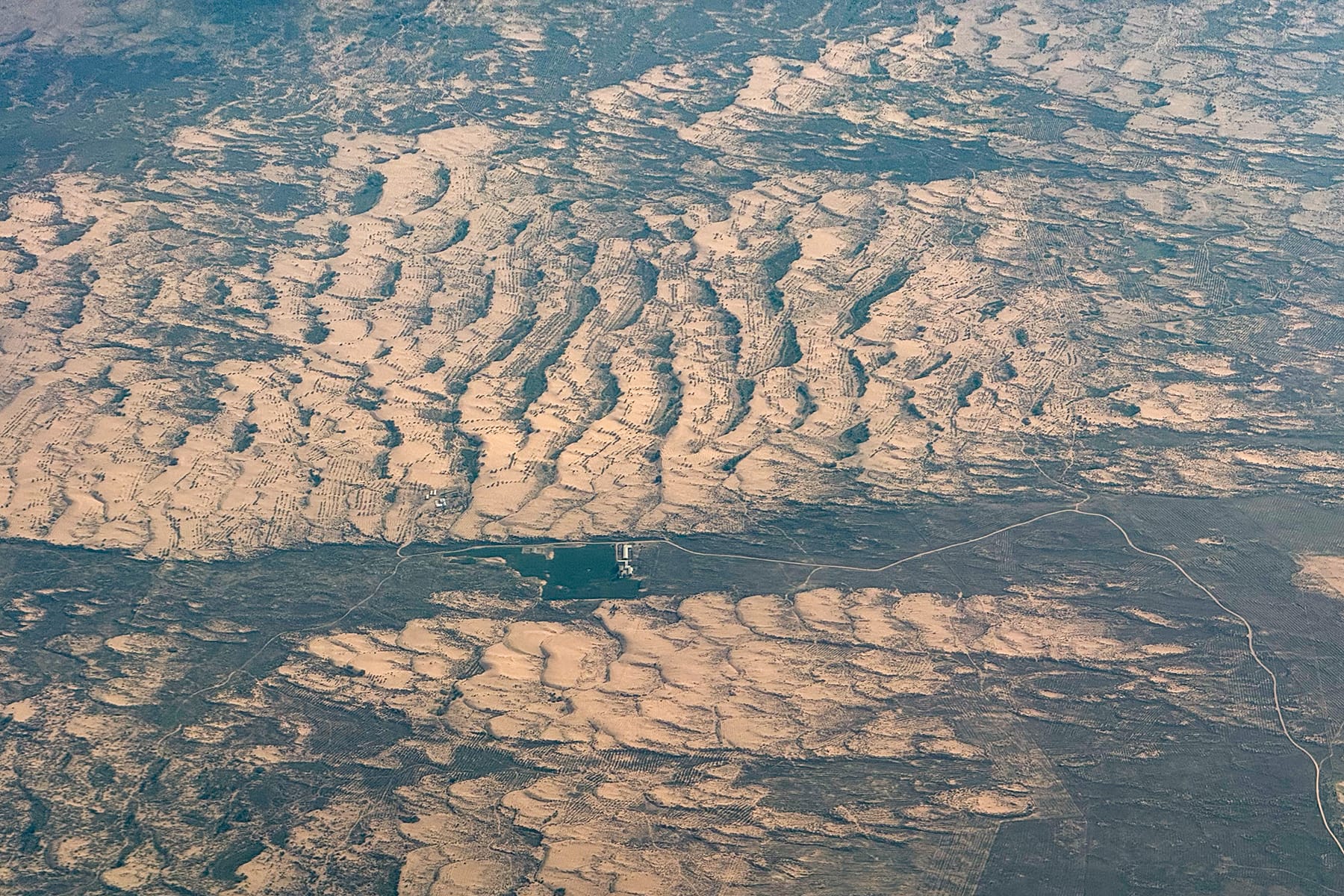
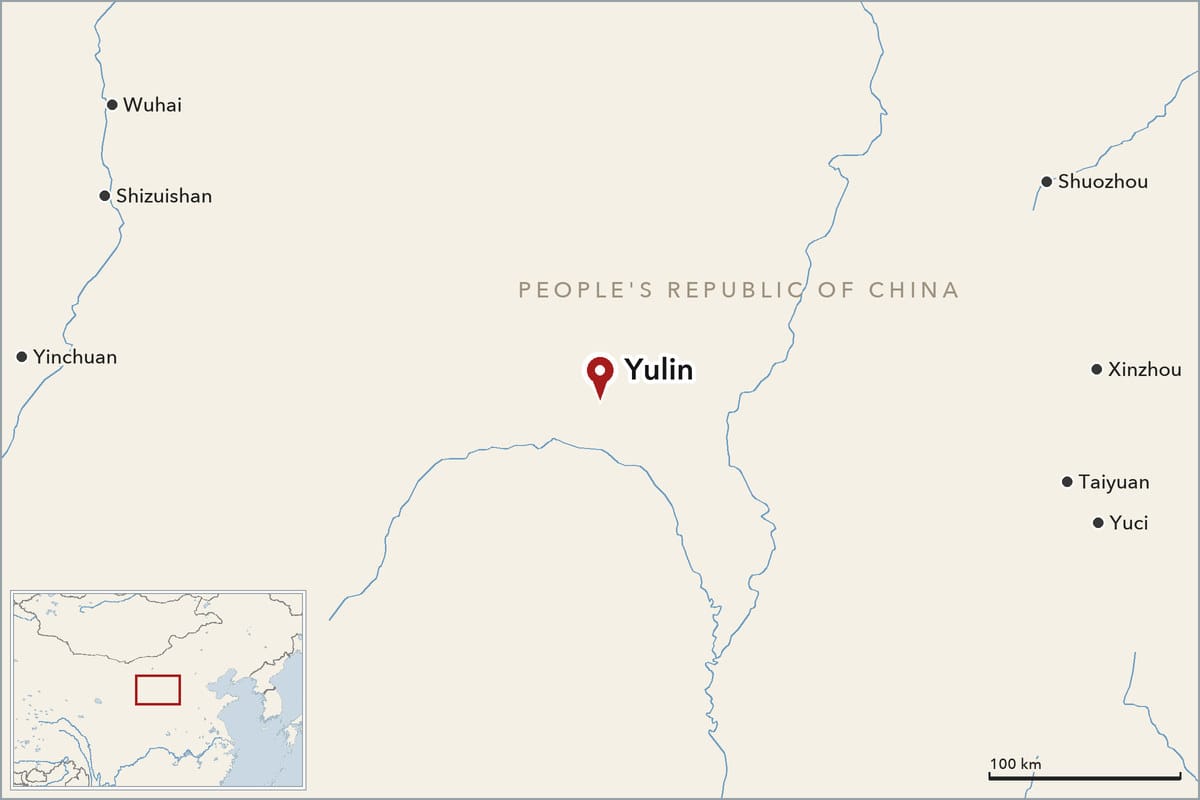
On 9 November, the Yulin Municipal Institute of Cultural Relics and Archaeology announced what it called its latest results. Since August 2026, the institute had been working out the course of the Qin Straight Road across the Mu Us sandy land and surveying along it. During that work, archaeologists newly identified a Qin-era site at Huangtuliang village in Balasu township, Yuyang district, Yulin, and preliminarily judged it to be an ancillary lodging palace along the road. People's Daily Online reported this on 10 November, citing the Shaanxi Provincial Cultural Heritage Administration.
A Han site that turned out to be Qin
Huangtuliang was first logged during a cultural heritage survey and classed as a Han Dynasty site. It sits on the southeastern edge of the Mu Us sandy land, where farmland meets the dunes, near the headwaters of a tributary of the Wuding River. Sand now covers it, and a small temple and courtyard occupy most of the summit, so the original form is hard to make out.
The core area covers nearly 10,000 square metres, and finds are scattered over about 150,000 square metres. The surface is strewn with building material, including hollow and square bricks, cord-marked cylindrical and flat roof tiles and cloud-pattern eave tiles, but only a very small amount of pottery. Three roughly worked circular and square column base stones lie within the site.
Why the archaeologists call it a palace
The institute's archaeologists point first to fragments of large eave tiles with a kui-dragon pattern, which they say have so far been found only in the highest-ranking Qin buildings. China News Service reported that such tiles have come only from Qin palaces, lodging palaces and buildings of the First Emperor's mausoleum. Interviews and brief drilling indicate a rammed-earth platform under the sand at the top of the site, and earlier soil-digging turned up drainage works and well remains, the drainage made with ceramic round water pipes and right-angled elbows. The archaeologists say the platform, the water supply and drainage, the geometric-patterned bricks and the many eave tiles show a high-grade building.
The scarcity of pottery matters to their case too. The archaeologists say little surface pottery and little sign of everyday life indicate the site was not a military fort, a county town or a village, and that it was used briefly for a special function. From documents and the architecture, they infer it was built between the 32nd year of Qin Shi Huang (215 BC) and the end of the Qin. They also say the types and decoration of its building materials are similar to those of known lodging-palace sites along the road, at Chengliang in Dongsheng district, Honghuayuan in Ansai district and Renyaozi in Zhidan county. The other lodging-palace sites confirmed along the road hug the road itself and were mostly built on high ground to its east.
China News Service reported that the core area is small, which it linked to the building's rank and to how hard it was to bring soil to the spot. Around the site, loess is exposed only about 3 kilometres to the southwest.
The road itself is the open question
About 80 metres north of the small temple, a dune section nearly 60 metres wide exposes a level layer of brown clay fill, about 0.3 metres thick. Another trace turned up about 7.5 kilometres southwest, near Baichengtai village: an intermittent line of large-scale fill, mostly loess and red clay, running for nearly 800 metres. The archaeologists say both lie on the predicted line of the road, with similar structure and scale. They tentatively suggest the fill may be surviving traces of the road itself.
They also say the dunes make searching for the road very difficult and that a fuller understanding of this stretch depends on more archaeological work. On 17 November, Arkeonews reported that researchers had not yet confirmed that the route is definitely the Straight Road. The palace identification is likewise labelled preliminary, so it is best read as the institute's working judgement rather than a settled finding.
Sources
Altuntaş, L. (2026) 'Possible 2,200-Year-Old Imperial Palace Discovered Along China's Desert Road', Arkeonews, 17 November 2026, available at: https://arkeonews.net/possible-2200-year-old-imperial-palace-discovered-along-chinas-desert-road/ (Accessed: 18 November 2026).
Amiri, A. (2026) 'Buried Under Desert Sand, Archaeologists Found a Palace on the 2,200-Year-Old 'Highway' Built for China's First Emperor', The Daily Galaxy --Great Discoveries Channel, 11 November 2026, available at: https://dailygalaxy.com/2026/11/qin-dynasty-imperial-palace-qin-shi-huang/ (Accessed: 18 November 2026).
白鸽 (2026) '陕西榆林新发现秦代行宫遗址', 人民网-陕西频道 (People's Daily Online), 10 November 2026, available at: http://sn.people.com.cn/n2/2026/1110/c226647-41746861.html (Accessed: 18 November 2026).
赵茁轶 (2026) '陕西新发现秦代行宫遗址', 陕西日报 (Shaanxi Daily), via shaanxi.china.com, 10 November 2026, available at: https://shaanxi.china.com/news/20000876/20261110/26026197.html (Accessed: 18 November 2026).
阿琳娜 (2026) '陕西榆林新发现秦代行宫遗址', 中国新闻网 (China News Service), via sohu.com, 10 November 2026, available at: https://www.sohu.com/a/1099719487_123753 (Accessed: 18 November 2026).
Picture credits
- Top picture: The Mu Us Desert in Ordos. This is not the Huangtuliang site, which lies in Yulin, Shaanxi. Photo: Windmemories, CC BY-SA 4.0, via Wikimedia Commons
- Map: drawn from Natural Earth (public domain) and Wikidata.
