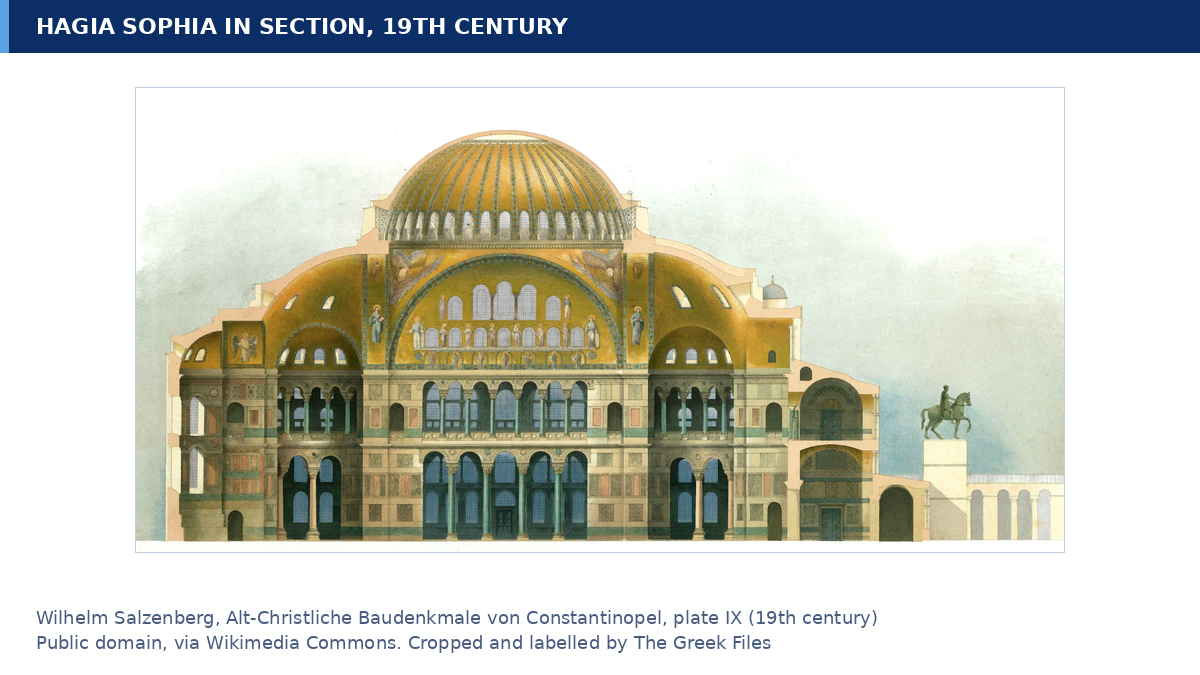
Headlines say Turkey has confirmed a 9 km tunnel network beneath Hagia Sophia. The minister said nine kilometres is being "spoken of". The length surveyed so far is about a kilometre. This is the full file.
CASE FILE: THE TUNNELS UNDER HAGIA SOPHIA
CLAIM:    A 9 km network of ancient tunnels and water
          channels beneath Hagia Sophia, some 1,600 years
          old, newly mapped in 3D
SOURCE:   Culture and Tourism Minister Mehmet Nuri
          Ersoy, 17 September 2026
FILED:    20 September 2026
STATUS:   PARTLY SUPPORTED. The tunnels are real and
          documented. The 9 km figure is not a survey
          result.
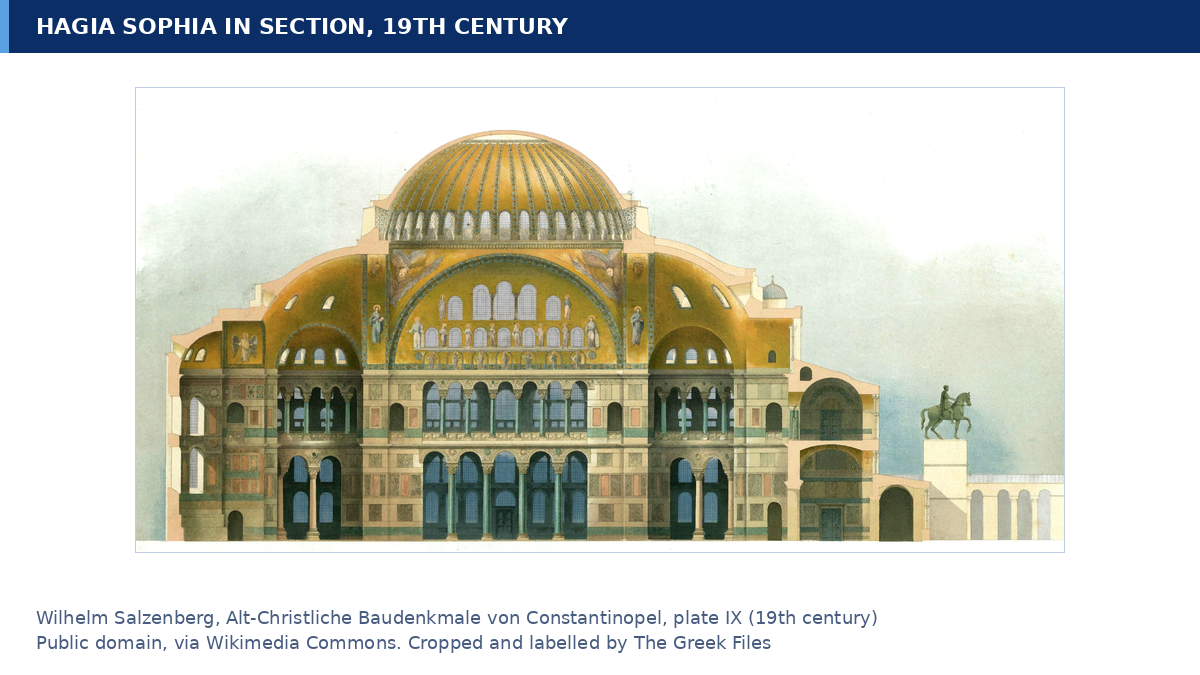
The short version
Tunnels and water channels do run beneath and around Hagia Sophia, and a team publishing in peer-reviewed journals has been documenting them since 2020. That part is solid. Three other parts of the story are not.
- "Confirms 9 km." The minister said sections extending up to about nine kilometres are being spoken of. He did not say anyone had surveyed them, and he added that collapses block the way beyond a certain point. The most recent total I could find from Diker, the researcher leading the documentation, is a combined length above 1 km, given in June 2025.
- "Newly mapped." The network-wide 3D laser survey was done in 2020. A cleaning and excavation programme began in 2025, and the sections it opens are being laser-scanned as it goes. Nothing published maps 9 km.
- "1,600 years old." Diker, the researcher leading the documentation, told the press that seven tunnel lines are about that old. His own paper dates most of the spaces it describes to Justinian's church or later, and only the earliest structure and one water line to before it.
Nothing published supports the old legend of secret escape tunnels. Diker says the tunnels carried water and air, though his 2026 paper suggests the longest one may run well beyond the building.
What the minister actually said
Ersoy spoke at a meeting in Kahramanmaraş on Thursday 17 September 2026, mostly about earthquake-zone restoration. On Hagia Sophia, Turkish outlets including CNN Türk and Sabah report that he described a very extensive system of underground passages and tunnels beneath the building. Yeni Şafak quotes him directly: "Yaklaşık 9 kilometreye kadar uzanan bölümlerden söz ediliyor." In plain English: sections extending up to about 9 kilometres are being spoken of.
The passive matters. He didn't say the tunnels measure 9 km. He went on to say that beyond a certain point there are collapses and blocked areas, that cleaning and restoration continue in the sections that can be reached, and that safe sections might be opened to visitors once the work is done.
The English-language headlines are not equal. Greek Reporter's, "Could Stretch Up to 9 Kilometers", tracks what he said. Greek City Times said Turkey "confirms 9km of tunnels", and Orthodox Times and ProtoThema reported that the "urban legend" had been confirmed. The minister confirmed that tunnels exist. He did not confirm the legend of secret passages, which Diker has called unsupported since 2022. The stretching wasn't only in English: Haber TR's headline said 9 km of tunnels had been "found", and Halk TV said the tunnels were not an urban legend after all.
In the same press conversation Ersoy said radar and laser scans would be carried out once the dome is opened up in a controlled way. That concerns the dome's structure, not the tunnels, and may be where "newly mapped with 3D surveys" crept into the headlines.
How the number grew
The length of Hagia Sophia's underground network has been reported several ways. None of the earlier figures is 9 km.
| Date | What was reported | Source |
|---|---|---|
| 1935 to 1939 | Schneider's German Archaeological Institute excavations (published 1941) document the substructure of the atrium | Diker, Open Archaeology 2026 |
| 1943 | Emerson and van Nice publish a plan of wells and passages below the floor | Diker 2026 |
| From 2005 | Özkan-Aygün's Istanbul Technical University survey, with divers and cavers, documents wells, tunnels and water systems | Gounari, Anatolian Studies 2023; Özkan Aygün 2010 |
| Feb to Jul 2020 | Laser-scan survey: 936 m of underground structures, of which 668 m scanned and 268 m measured by hand where debris blocked the way | Diker; Anadolu Agency (Turkish), 2022; Türkiye Today, Jan 2025 |
| Aug 2022 | About 1 km of tunnels and culverts, mapped in 3D | Anadolu Agency |
| Jun 2025 | Diker: hard to quantify precisely, but the combined length exceeds 1 km | Hürriyet Daily News |
| 27 Feb 2026 | Ministry: seven tunnel lines, hundreds of metres long, in the West Garden; 1,068 tonnes of fill removed | Türkiye Today; Popular Mechanics |
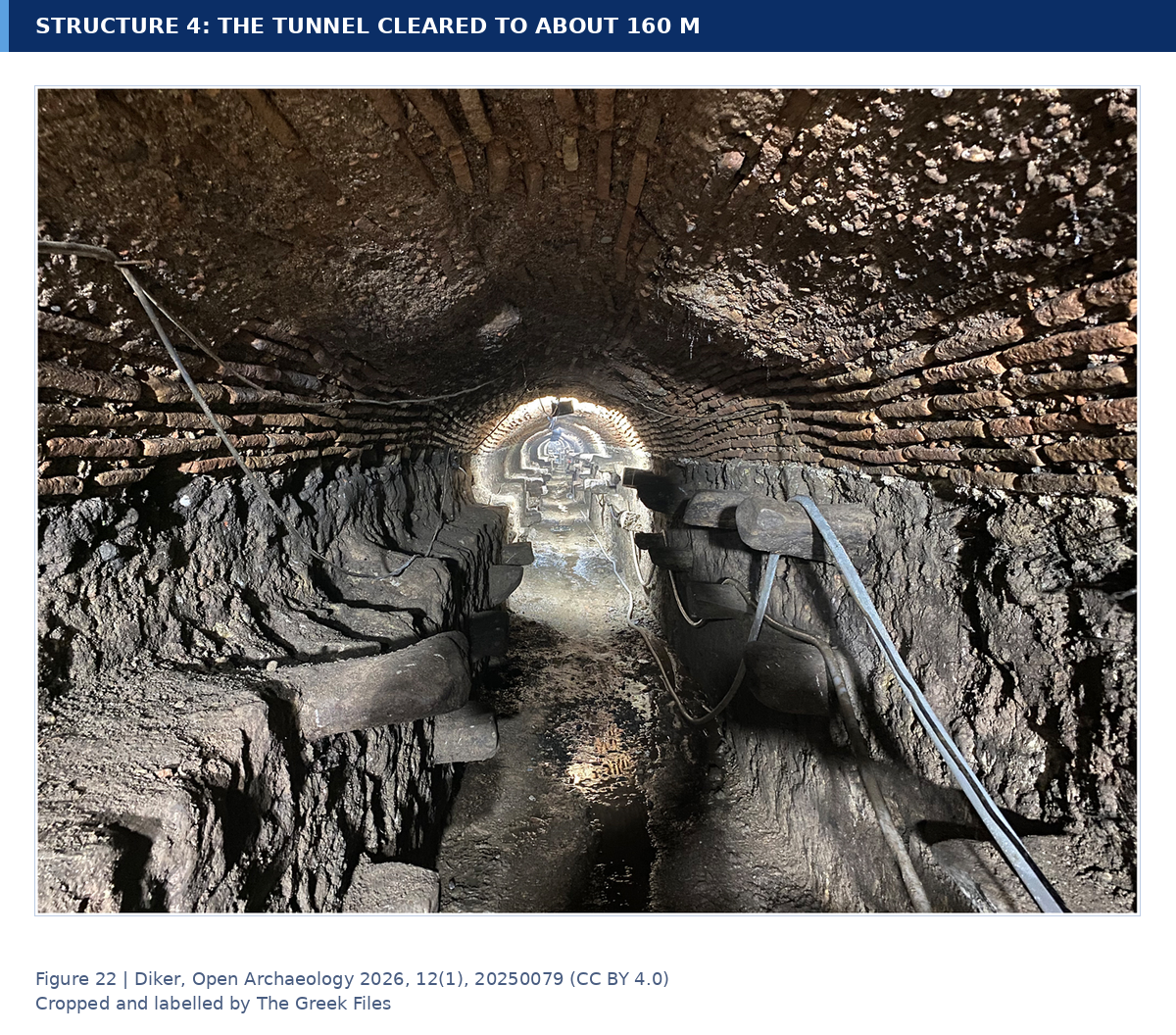
| 16 Mar 2026 | Diker's paper: one tunnel, Structure 4, cleared to about 160 m by September 2025 | Diker 2026 |
| 17 Sep 2026 | Minister: sections extending up to about 9 km are being spoken of | Yeni Şafak; CNN Türk; Sabah |
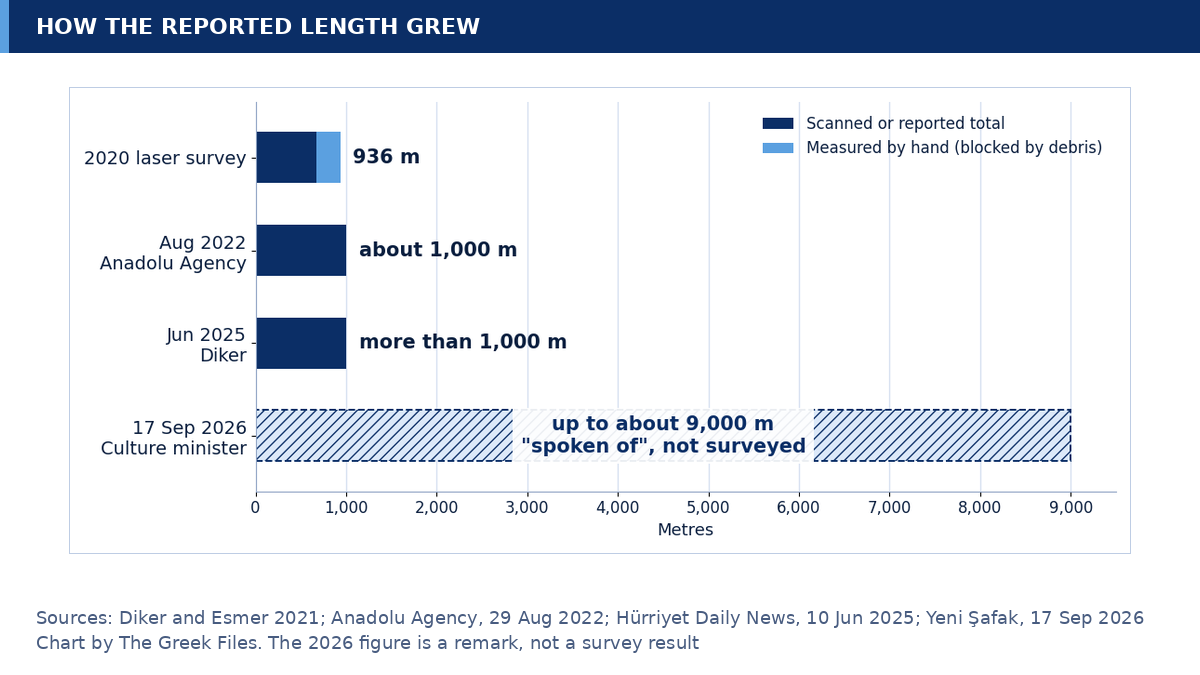
The jump from about a kilometre to nine has no published survey behind it. It may be an estimate, an extrapolation or a projection of how far blocked passages might run. I couldn't find the source of the figure, and I found no comment from Diker on it.
What has actually been found
The best account is Diker's paper, published in March 2026 in the open-access journal Open Archaeology, covering cleaning up to mid-2025. Diker is an architecture professor at Fatih Sultan Mehmet Vakıf University and a member of Hagia Sophia's scientific committee.
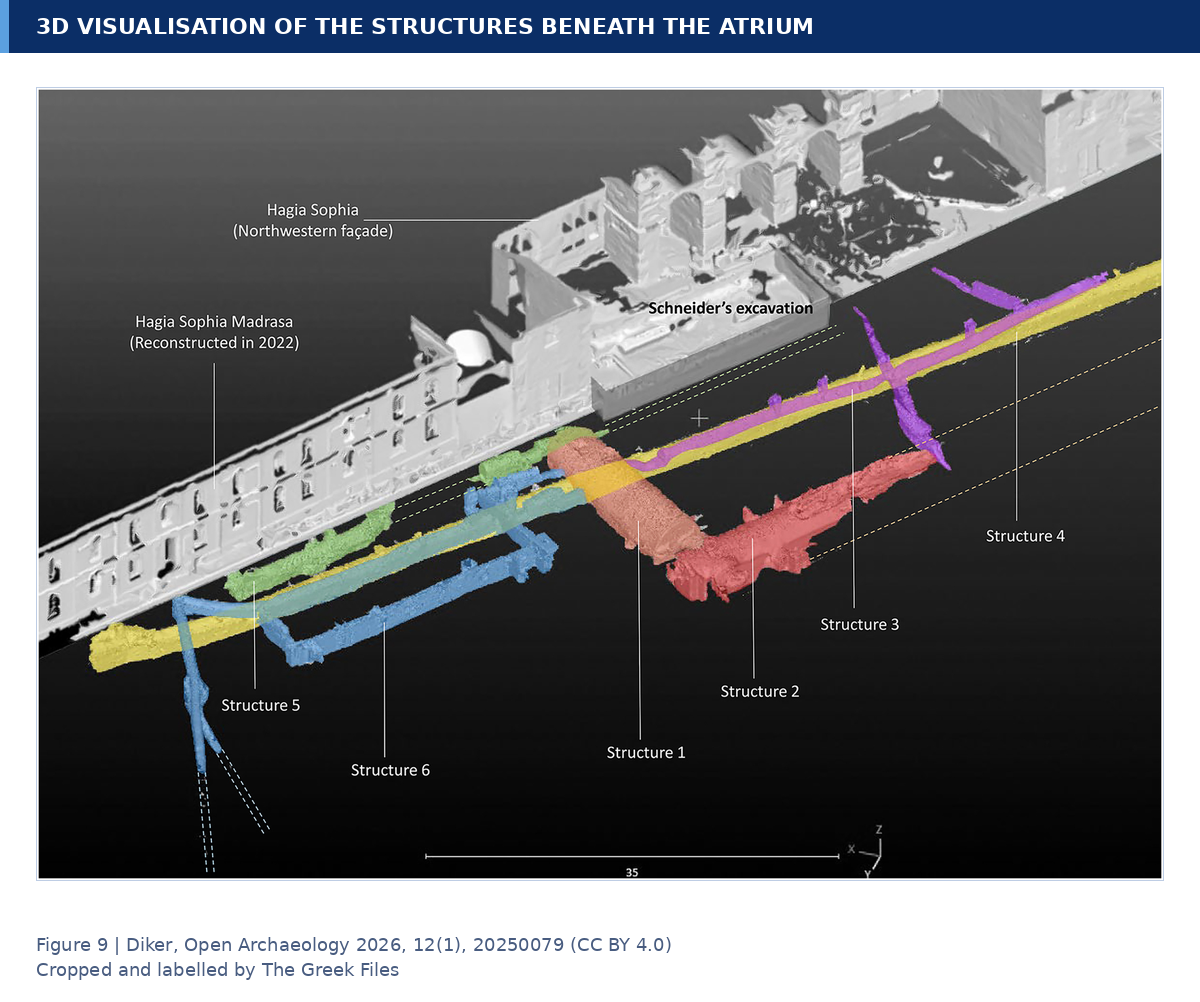
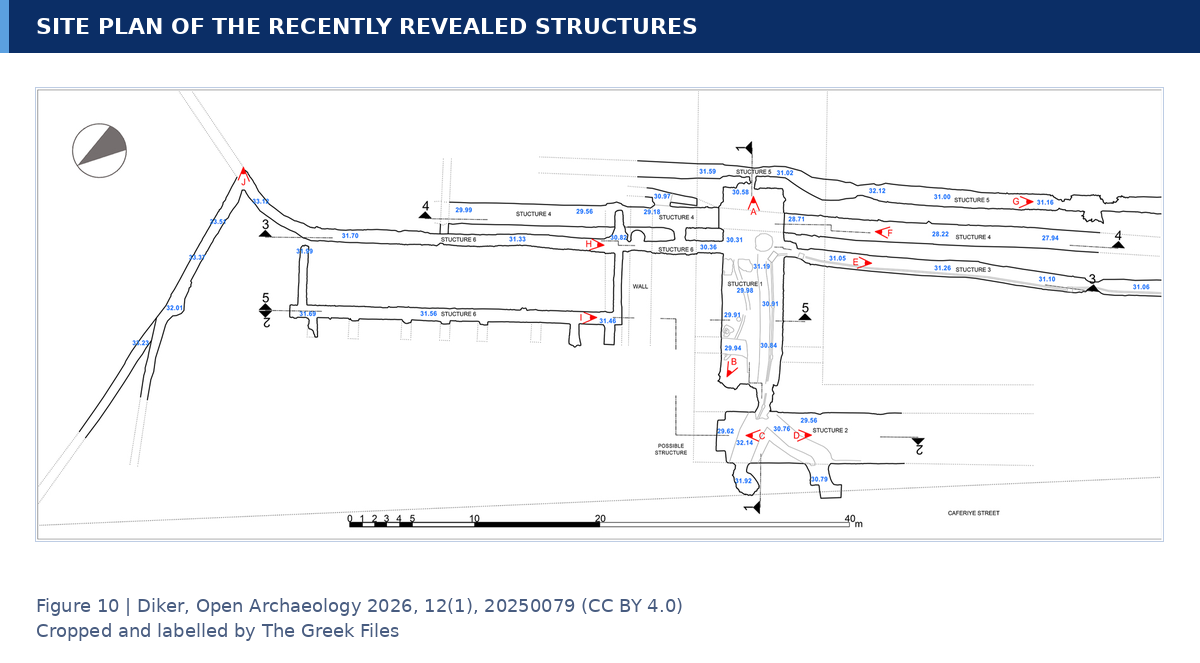
The work began in February 2025 in the vaulted cellars under the vanished atrium, the courtyard that once stood in front of the church. Archaeologists supervised it, and the spoil was sifted above ground. Cleaning was documented with laser scanning. The paper describes six numbered structures:
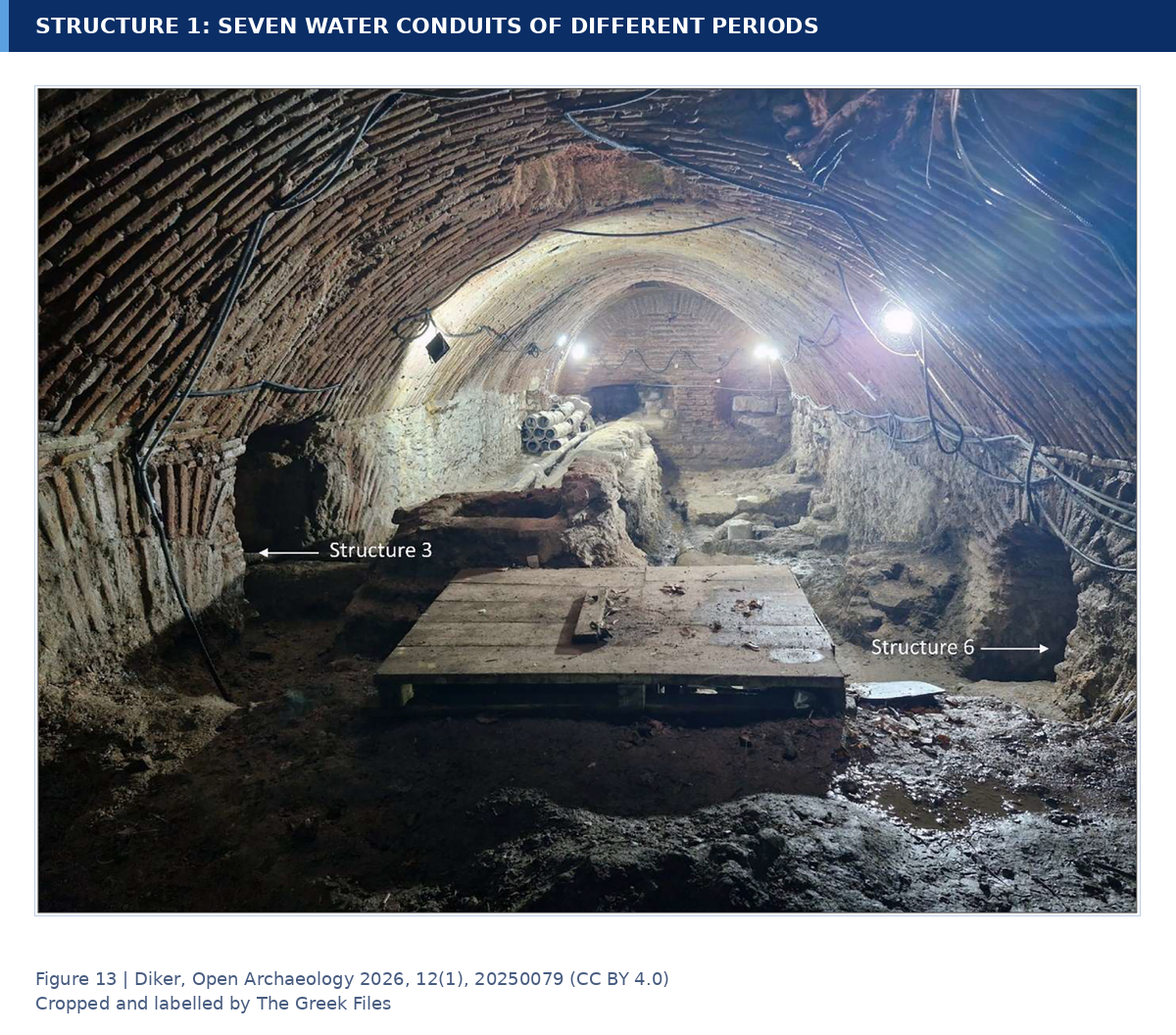
- Structure 1, a vault about 5 m by 15.5 m under the north-east wing of the atrium, holds seven distinct water conduits running in different directions and dating from different periods. They include terracotta pipes and, from the 19th or 20th century, cast-iron ones.
- Structure 4 is the headline find. It is a tunnel about 1.5 m wide and 2 m high, with a floor of levelled bedrock and a gentle fall of about 2 degrees. By September 2025 about 160 m had been cleared, and both ends were blocked by collapses. It lies under the line of a buried street that Schneider partly exposed, and Diker reads it as the drainage substructure of that street. The street's route comes from a hypothetical plan of the city by Berger (2000), so that reading is a proposal, not a proof.
- Structure 3 is a narrow tunnel, 1.2 m wide and 1.2 to 1.7 m high. Diker suggests that, beyond carrying water, it may have been part of the church's climate control.
Diker and the ministry both describe the system as infrastructure. Diker told the Hürriyet Daily News that the passages carried water, ventilated the building and drained rain. Many are so narrow that you have to crawl, and they were built for specialists to inspect and maintain the channels, not for general passage. In 2022 he told Anadolu that, apart from water supply, rain drainage, ventilation and storage, no other use of these spaces is known.
The finds are modest. The paper says the fill was mostly brick and ceramic fragments with a few small objects of metal, bone and stone, and that the finds will be the subject of a separate study. It calls them less striking than the architecture itself.
Newly discovered? Not quite
Schneider documented the atrium's substructure after Hagia Sophia became a museum in 1935, and his plans remained the only record of it until 2020, Diker writes. Emerson and van Nice mapped wells and passages under the floor in 1943, and the Istanbul Technical University team began surveying the underground system in 2005. Diker notes that the later ITU surveys overlooked the atrium's basement, which Schneider had already recorded.
The 2020 survey used laser scanners and traditional measurement to produce a 3D point-cloud model. The current cleaning has since corrected it. The 2020 documentation had taken a pile of debris for the south-west boundary of one space, and cleaning showed the space continued. The paper overlays the new findings on the 2020 model.
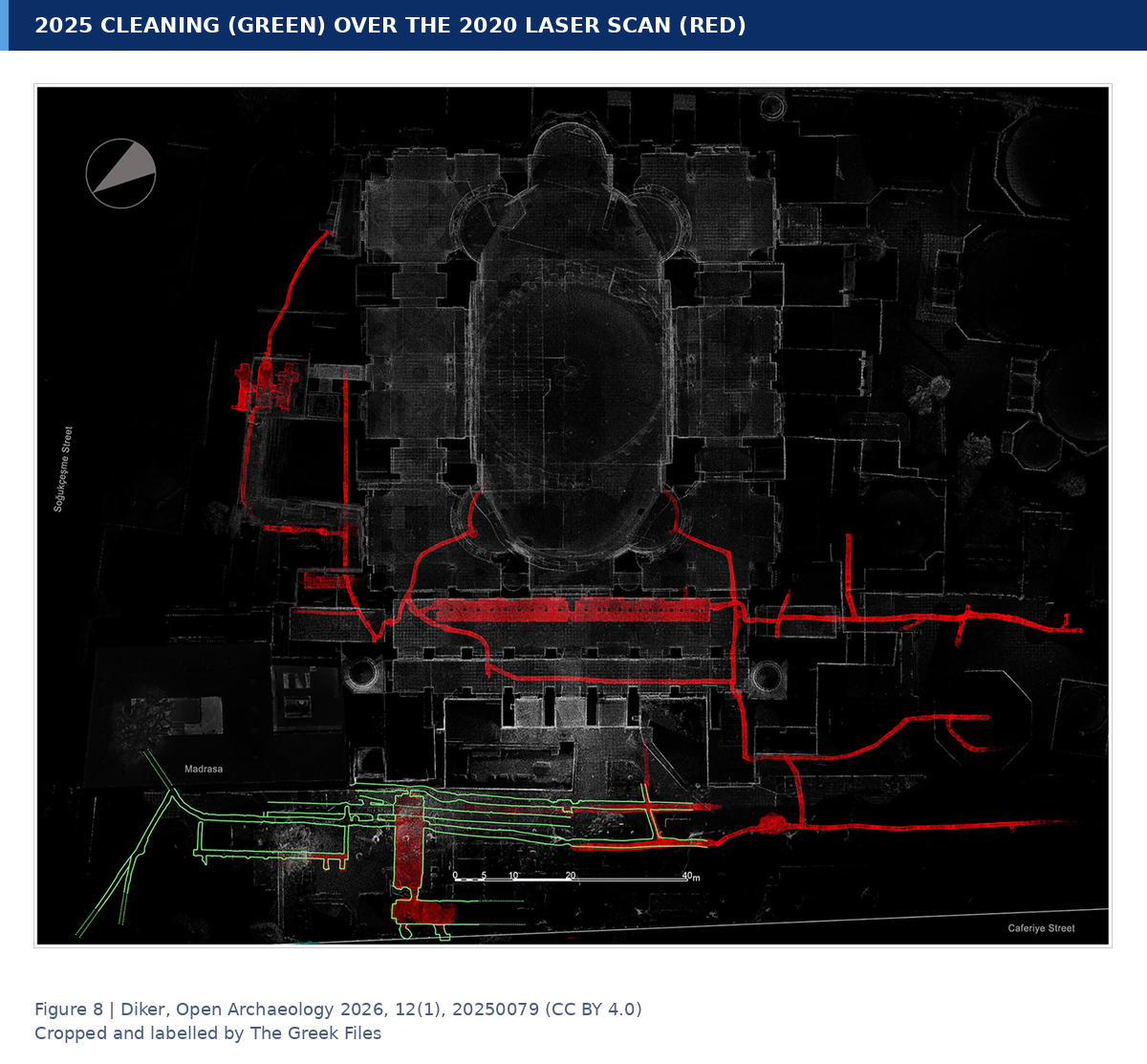
"Newly revealed" is fair for parts of the system: some tunnels had been clogged with mud and rubble for centuries and hadn't been mapped in full. "Newly mapped in 3D" is half right. The sections cleared since 2025 have been laser-scanned as they were opened, but the network-wide 3D survey dates from 2020.
The "1,600 years" claim
Diker told Türkiye Today in February 2026 that the seven documented tunnel lines are about 1,600 years old, in the early Byzantine period. Counting back from 2026 lands in the 420s AD, around the time of Theodosius II's church, which was dedicated in 415. Justinian's present building was raised in 532 to 537, after the Nika riots burned Theodosius's, which makes it about 1,490 years old.
Diker's own published dating is less generous than the press figure.
- In 2022 he told Anadolu that the spaces under the atrium, which form the basement of the lost courtyard, date to the 6th century, the same time as the present church, and that a burial vault (hypogeum) beside the church dates to the 4th century.
- His 2026 paper reasons that Structures 1, 2 and 6 were probably built with Justinian's church, that Structures 3 and 5 were added later, and that Structure 4 is the earliest, dated to before Justinian by Schneider because it lies lower than the others. One of the seven water lines predates the present church. The rest run up to the 19th and 20th centuries.
- The dating is relative: depth, masonry, brick sizes and vault type. I found no radiocarbon or other absolute dates. The paper says finds from the fill will be studied separately.
- Anadolu's English text in 2022 called the tunnels 1,500 years old. Its Turkish original gives 1,485 years as the age of the building. That is the church's age, not a date for the tunnels.
So "about 1,600 years" holds, at most, for the earliest parts. It is an informed estimate from a leading researcher, not a laboratory date for the network.
Secret passages: what the evidence says
The stories say the tunnels lead to Topkapı Palace, the Basilica Cistern, Maiden's Tower or the Princes' Islands. Diker said in 2022 that claims the tunnels reach Maiden's Tower and the Islands are an urban legend with no scientific basis and no way of being proved. What he has documented is water and air infrastructure close to the building's foundations and gardens.
His 2026 paper is more open than that. It says Structure 4 appears likely to extend far beyond Hagia Sophia, and it calls for investigating its continuation north-east toward Topkapı Palace and south-west toward Sultanahmet Square. That is a proposal about a drain beneath a street, not a claim of a secret passage, but the paper adds that it may bring the city's underground legends "closer to reality than ever before". If any longer total is being counted, a projection like this is one place it could come from. I found no one saying so.
A different legend attaches to the fabric of the building. When Constantinople fell in 1453, a priest at the liturgy is said to have walked into the sanctuary wall as the Ottomans entered, to return when the church is again Christian. Versions vary; one has a patriarch slipping out a side door. It is folklore and has no connection to the tunnels.
Who is speaking, and what is missing
This is not a fringe claim. The documentation is by a named academic, in peer-reviewed journals, under a state-run conservation programme. The problem is the headline number.
- One source chain. The ministry's Directorate General of Foundations runs the work and the ministry announces it, and the researcher leading the documentation sits on the scientific committee overseeing the conservation. The paper's acknowledgements add that the cleaning is carried out by a contractor, ADAMAK Restoration, whose staff supplied the raw digital data, and it thanks the Director General of Foundations for supporting the project and the publication. Diker declares no funding and no conflict of interest. That is normal for a heritage project, but I found no independent expert comment on the 9 km. The story is three days old.
- No survey behind the 9 km. No published plan, segment lengths or scan data support it.
- Blocked ground. Collapses stop the work at both ends of the best-documented tunnel and, by the minister's account, at other points, so any total is a projection.
- Slow timetable. Ersoy said exterior work should largely finish before the end of 2027, and that work in the lower, less visible parts may continue after that.
What would settle it
- A published plan with measured lengths per tunnel, and how much of the 9 km is surveyed, cleared or inferred.
- Release of the laser-scan data so others can check it.
- Diker's confirmation of where the figure came from.
- Absolute dating of the tunnels.
- Clearance of the blocked ends of Structure 4, and of the unexcavated north-west and possible south-west parts of the atrium substructure that the paper flags.
Where it stands
The tunnels are real and carefully documented, and some of them may be older than the church above. About a kilometre has been surveyed. The figure of nine is a number being spoken of, and the headline that Turkey has confirmed it is ahead of the evidence.
Sources
- Culture Minister's 17 September 2026 remarks, Yeni Şafak: https://www.yenisafak.com/hayat/ayasofyanin-altindaki-9-kilometrelik-gizemli-tunel-agi-ziyarete-aciliyor-bakan-ersoy-mujdeyi-verdi-4856687
- CNN Türk: https://www.cnnturk.com/turkiye/bakan-ersoy-acikladi-ayasofyanin-altinda-9-kmlik-tunelden-soz-ediliyor-bu-alanlar-ziyarete-acilabilir-3467718
- İktibas Dergisi, full quotation of the minister, 17 September 2026: https://iktibasdergisi.com/2026/09/17/ayasofyanin-altinda-9-kilometrelik-tunel-agi/
- Haber TR ("found" headline): https://www.haber.tr/ayasofya-camiinin-altinda-9-kilometrelik-yeralti-tunelleri-bulundu
- Halk TV ("not an urban legend" headline): https://halktv.com.tr/turkiye/ayasofyanin-altindaki-tuneller-sehir-efsanesi-degil-gercekmis-bakan-acikladi-1055458h
- Sabah: https://www.sabah.com.tr/gundem/2026/09/17/bakan-ersoy-duyurdu-ayasofyanin-altinda-9-kmlik-tunelden-soz-ediliyor-bu-bolgeler-ziyarete-acilabilir
- Greek Reporter, 18 September 2026: https://greekreporter.com/2026/09/18/hagia-sophia-tunnels/
- Greek City Times, 18 September 2026: https://greekcitytimes.com/2026/09/18/hagia-sophia-1600-year-old-underground-tunnels
- Orthodox Times: https://orthodoxtimes.com/9-kilometer-long-underground-tunnels-revealed-beneath-hagia-sophia/
- ProtoThema English, 17 September 2026: https://en.protothema.gr/2026/09/17/turkish-culture-minister-confirms-the-existence-of-a-9-km-tunnel-beneath-hagia-sophia/
- Diker, H. F. (2026), "Newly Revealed Subterranean Structures Beneath Hagia Sophia's Atrium", Open Archaeology 12(1), 20250079: https://doi.org/10.1515/opar-2025-0079
- Türkiye Today, 28 February 2026: https://www.turkiyetoday.com/culture/1600-year-old-underground-tunnels-discovered-under-hagia-sophia-during-restoration-3215271
- Popular Mechanics, February 2026 (minister's statement of 1,068 tonnes): https://www.aol.com/crew-found-hidden-tunnels-beneath-130000180.html
- Türkiye Today, 5 January 2025 (936 m survey): https://www.turkiyetoday.com/culture/what-lies-beneath-hagia-sophia-secrets-of-underground-tunnels-vaults-tombs-opens-for-visitors-101435/
- Hürriyet Daily News, 10 June 2025 (Diker interview): https://www.hurriyetdailynews.com/into-the-depths-of-hagia-sophia-tunnels-and-hidden-legacy-210109
- Anadolu Agency, 29 August 2022: https://www.aa.com.tr/en/culture/anadolu-agency-team-enters-largest-underground-structures-of-hagia-sophia/2671672
- Anadolu Agency (Turkish) on Diker and the legends: https://www.aa.com.tr/tr/kultur/ayasofyanin-en-buyuk-yer-alti-yapilari-goruntulendi/2671496
- Diker, H. F. (2023), digital documentation of the three largest subterranean structures, Technical Annals 1(3): https://doi.org/10.12681/ta.36068
- Diker, H. F., "Discovery and documentation of the underground structures of Hagia Sophia" (the 2020 survey, 936 m): https://www.academia.edu/109127302/Discovery_and_documentation_of_the_Underground_structures_of_Hagia_Sophia
- Diker, H. F. and Esmer, M. (2021), "Preliminary Evaluation of the Terrestrial Laser Scanning Survey of the Subterranean Structures at Hagia Sophia", PDT&C 50(2), 65 to 84
- Özkan Aygün, Ç., "The Wells, Subterranean Passage, Tunnels and Water Systems of Hagia Sophia in Istanbul": https://www.researchgate.net/publication/265361554_The_Wells_Subterranean_Passage_Tunnels_and_Water_Systems_of_Hagia_Sophia_in_Istanbul
- Gounari, E., "Interpreting the subterranean building (the crypt) in the northern courtyard of Hagia Sophia", Anatolian Studies 73 (2023)
- The Metropolitan Museum of Art, Hagia Sophia, 532 to 37: https://www.metmuseum.org/essays/hagia-sophia-532-37
- First Things, "Hagia Sophia: Past and Future": https://firstthings.com/hagia-sophia-past-and-future/
- Neos Kosmos, "Hagia Sophia's secrets, superstitions and lore": https://neoskosmos.com/en/2020/07/13/life/hagia-sophias-secrets-superstitions-and-lore/
Image credits
Image 1 is a plate by Wilhelm Salzenberg (19th century), in the public domain, via Wikimedia Commons; it is cropped and labelled. Image 2 is a chart made by The Greek Files from the sources above. Images 3 to 7 are figures from Hasan Fırat Diker, "Newly Revealed Subterranean Structures Beneath Hagia Sophia's Atrium", Open Archaeology 12(1), 2026, © the author, published by De Gruyter under a Creative Commons Attribution 4.0 licence. They are cropped and labelled for this article.