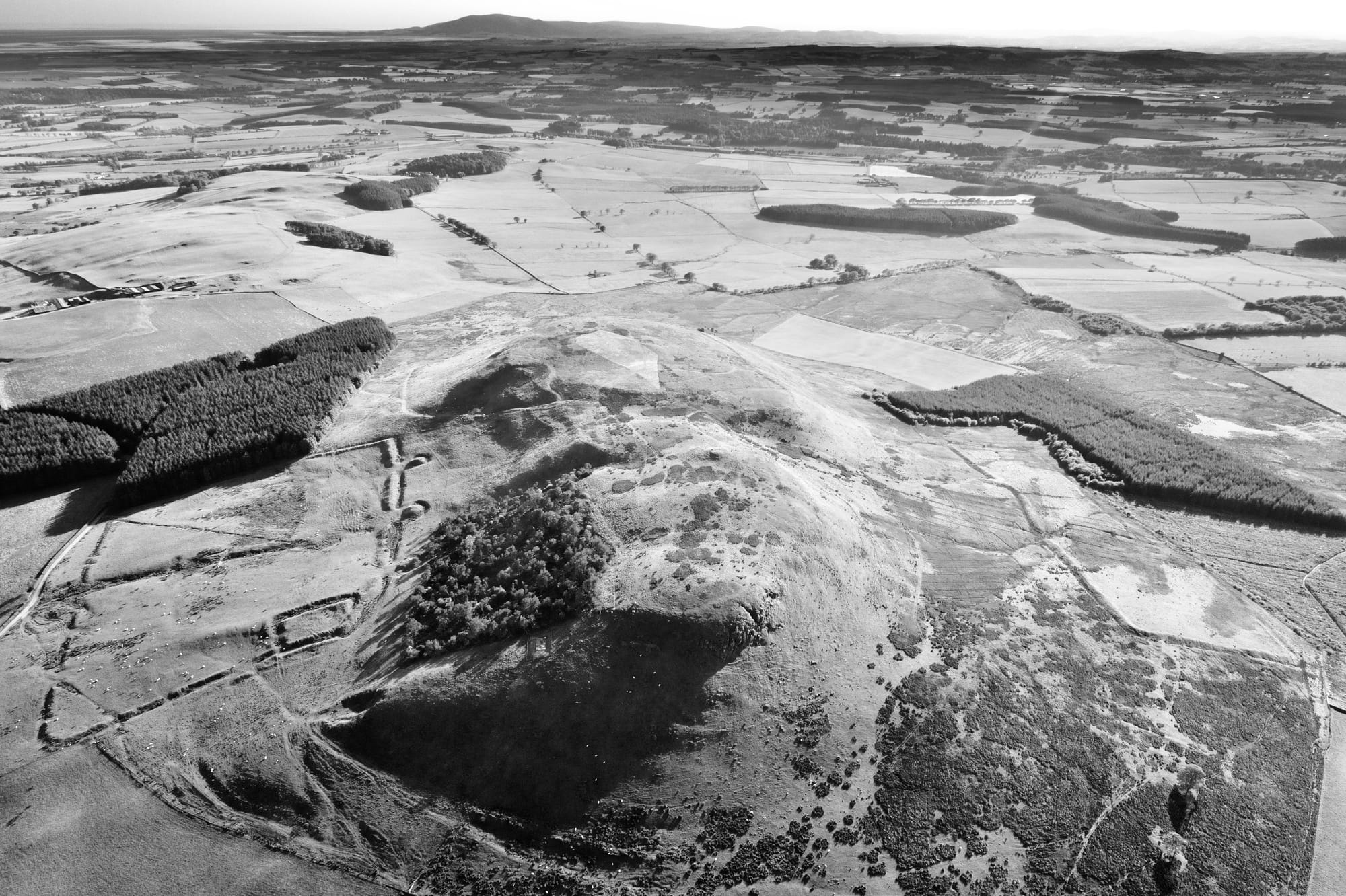
A hillfort in Dumfriesshire with a Roman camp on either side has been argued over for roughly half a century. The question is whether the Romans trained there or fought there. A recent talk in Appleby put the case for a real fight, and the evidence behind it is worth setting out.
The Westmorland Gazette reported that Andrew Nicholson, an archaeologist from Dumfriesshire, spoke to members and visitors of Appleby Archaeology about Burnswark Hill. The group's lecture programme lists his talk for Thursday 8 October 2026, under a title that asks whether Burnswark was an Iron Age settlement and/or a Roman training camp.
The question
The Trimontium Trust, which has worked at Burnswark for over a decade, describes the site as two Roman camps flanking an 18-acre native hillfort on the hilltop. Its account of the debate runs in three stages:
- Early investigators suggested a siege complex.
- In the 1960s that view was set aside in favour of a non-conflict explanation.
- After excavations in the late 1960s and early 1970s, this hardened into a full Roman training-camp hypothesis.
The Trust adds that the training idea was not universally accepted, and that the Scottish Archaeological Research Framework recommended more work.
A 2019 paper in the Journal of Roman Archaeology by John H. Reid and Andrew Nicholson says the training model was first proposed in 1964. It also notes that, as the arguments stood in 2011, most of them were evenly balanced. When D. J. Breeze reviewed the arguments in 2011, the paper says, he noted that balance but opted for the practice scenario.
What the talk covered
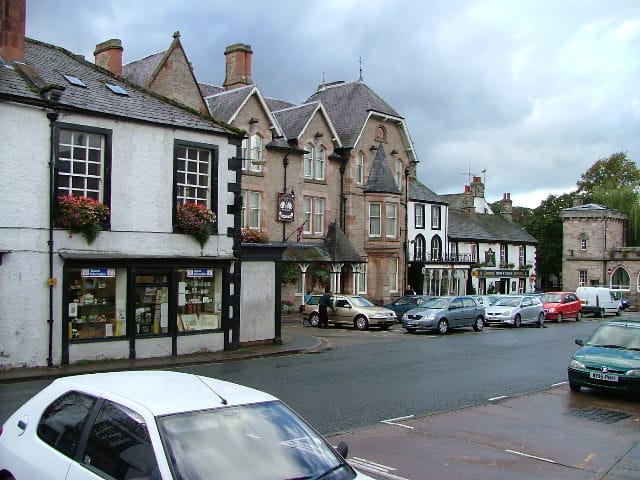
According to the Gazette, the talk was held in the Supper Room above Appleby's Market Hall and explored the ongoing Burnswark Project. The paper describes the project as using battlefield archaeology, the plotting of metal-detected missiles across the site. The Gazette reports that Nicholson said growing evidence supports the traditional view that Burnswark was the scene of a real conflict rather than a military practice ground.
The Gazette's account of the evidence is brief:
- Projectiles. Roman lead sling bullets, stone ballista shot and iron bolt heads have been found at the site.
- Finds near the entrances. Some of the projectiles were found near the hillfort's entrances, which the Gazette says suggests targeted attacks on defended positions.
- Artillery platforms. The Gazette says evidence also points to the use of artillery platforms associated with the southern Roman camp.
- Occupation. The Gazette reports that Nicholson noted the hillfort remained occupied during the Roman period and may have housed between 1,000 and 1,500 people during any confrontation.
- Collaboration. The Gazette says the talk also covered recent research with the University of Glasgow and the University of Manchester.
What the published paper says
The 2019 paper, which Nicholson co-wrote, calls itself an interim report of the Burnswark Project. Its authors argue that the distribution, characteristics and dating of the missiles support their use in a dramatic episode of "exemplary force" by the Roman army.
The paper's evidence goes further than the Gazette's summary:
- Survey and excavation. The authors surveyed the site by metal detector over three seasons and dug five trenches by hand to check what the detectors had found. In the trenches and the permitted detecting areas they excavated 588 pieces of lead sling shot.
- A buried cache. One trench behind the North Camp rampart produced 375 sling bullets, lying in layers in a band of dark soil. The authors read the soil as the trace of an organic container, perhaps a leather bag. They say the excavated sample is the largest single group of Roman lead sling bullets recovered in Britain.
- Where the bullets fell. The densest scatter is a swathe across the south face of the hillfort's rampart, not concentrated at the gateways. The authors say this is compatible with suppressive fire and that the older idea of bullets aimed at targets in the gateways is no longer tenable. They also report that in their experiments the bullets could not be tracked by eye beyond 30 metres, and say that the invisibility of small lead bullets beyond that range makes 'target' shooting at the distance of the hillfort's ramparts impossible.
- A single episode. Initial lead isotope results showed the main group of bullets clustering strikingly, with the type II bullets forming a second, adjacent group. The authors say this is compatible with bullets made and used in a single episode.
- Dating. They found that the rare type II bullets match three type II bullets from Birrens, 4 km to the south-east, in form and isotope signature, and suggest a late Hadrianic or early Antonine date. They offer the Antonine reconquest of Scotland as a hypothesis and write that the assault "may have been the first blow in that war."
The Trimontium Trust's Burnswark page says it returned to the site in the summer of 2025 to continue the work.
Where that leaves the case
The Gazette report and the paper agree on the direction of the argument. They differ in emphasis, since the paper puts the weight on the rampart rather than the entrances. The paper says most of the arguments were closely matched as they stood in 2011, before its new ballistic data. The Gazette account is a secondary report of a single talk, and the paper is an interim report.
My reading is that the training-camp theory is under real pressure. Calling the case closed would still go beyond what the published work says, because the authors present the Antonine link as a hypothesis. For a site this well documented, the open question is a good reason to keep the file out on the table.
Sources
Appleby Archaeology Group (2026) 'Appleby Archaeology Newsletter, Volume 28/2 Summer 2026', Appleby Archaeology Group, Summer 2026, available at: https://storage.googleapis.com/apparchlive.appspot.com/newsletters/2026-2.pdf (Accessed: 4 November 2026).
Reid, J.H. and Nicholson, A. (2019) 'Burnswark Hill: the opening shot of the Antonine reconquest of Scotland?', Journal of Roman Archaeology, 32, available at: https://journalofromanarchaeology.com/wp-content/uploads/2020/05/JRA32_20_Reid_v6.pdf (Accessed: 4 November 2026).
Trimontium Trust (2026) 'Burnswark — Archaeology case study', Trimontium Museum, 24 July, available at: https://www.trimontium.co.uk/about/our-work/burnswark/ (Accessed: 4 November 2026).
Veneziani-Rocha, S. (2026) 'New evidence suggests Burnswark Hill saw Roman assault', The Westmorland Gazette, 4 November, available at: https://www.thewestmorlandgazette.co.uk/news/26697318.new-evidence-suggests-burnswark-hill-saw-roman-assault/ (Accessed: 4 November 2026).
Picture credits
- Top picture: Burnswark Hill, Dumfriesshire: an Iron Age hillfort with a Roman camp on each side. Image: Aerial view of Burnswark Hill, Trimontium Museum, CC BY-SA 4.0 (source)
- Appleby's Market Square. The talk was held in the Supper Room above Appleby's Market Hall. Image: Appleby Market Square, photo Carl Bendelow (CC BY-SA 2.0) (source)
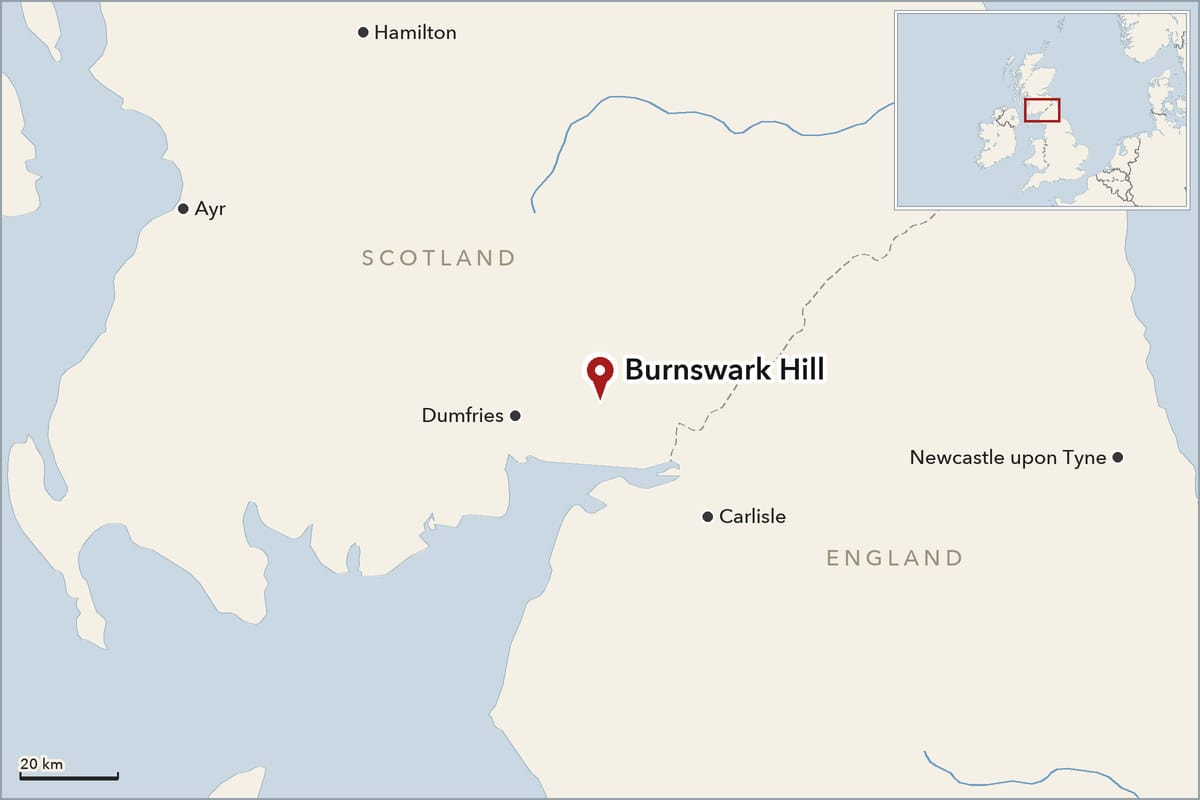
- Map: drawn from Natural Earth (public domain) and Wikidata.

