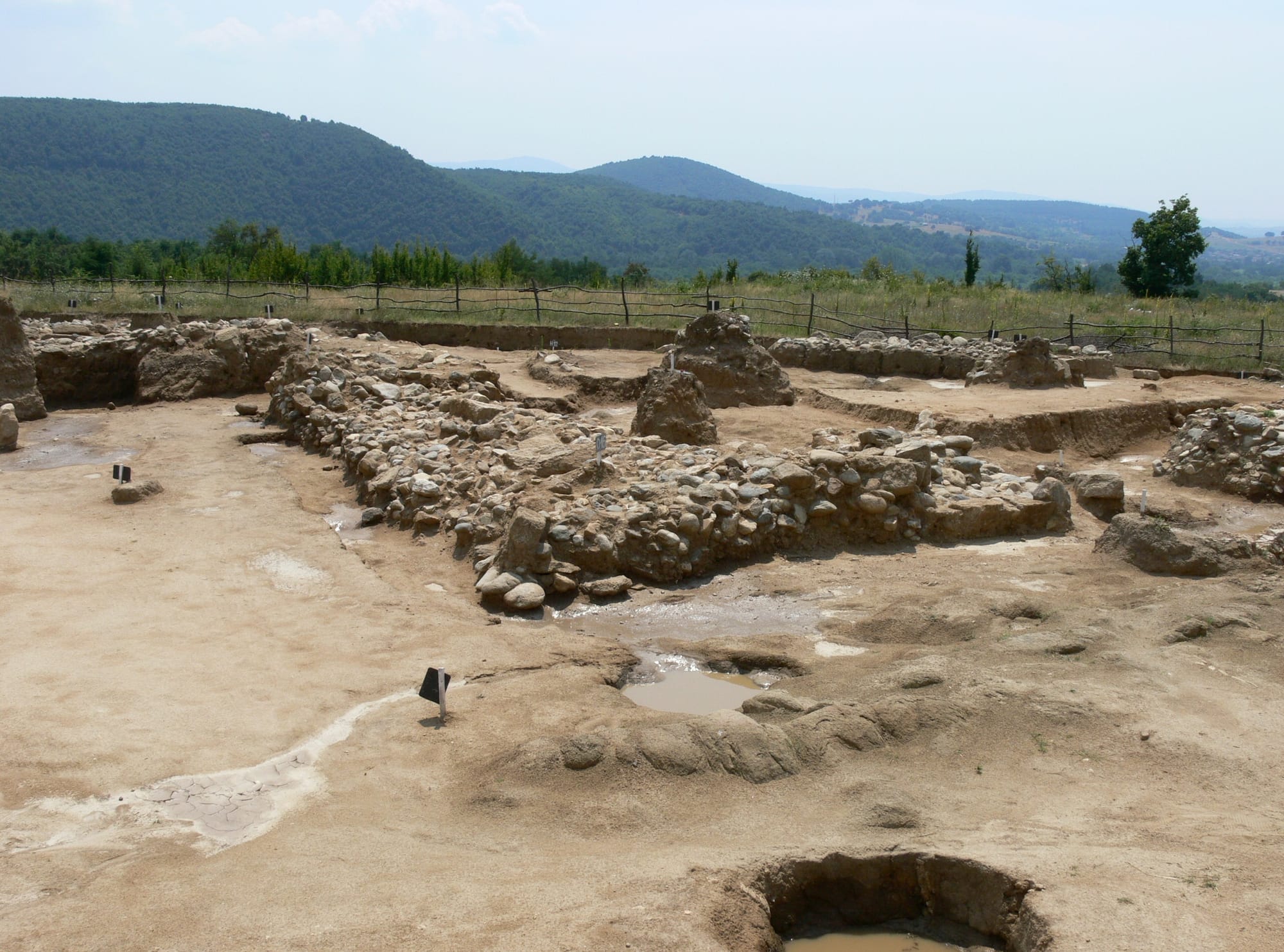
Archaeologists digging an ancient Thracian settlement in southern Bulgaria have found a bronze object that its excavator says he cannot match with anything from the period: a ring carrying four hooks, found at the entrance of a temple. The team has put forward two ideas about what it was. In its report on the find on 18 October 2026, Arkeonews said neither had been confirmed and that the object's original function remained unknown.
What was found
The object was found in the pronaos, the entrance chamber, of a temple, according to Arkeonews. It describes a ring supporting four hooks whose barbs point backwards, like those of fishing hooks. In the report on Bulgaria's bTV, which Trafficnews.bg and Informiran.net republished, Associate Professor Kostadin Kisyov, director of the Regional Archaeological Museum in Plovdiv, calls it a unique find. From what is known of the period, he says, such a mechanism has not turned up before. The bTV report adds that every element is bronze and that the workmanship is extremely precise.
Two explanations, neither settled
The first idea is a lamp holder. In the bTV report Kisyov describes it as a mechanism for hanging lamps, whether clay, bronze or glass. Lamps hung from the hooks would need a chain, he says, and as of that report, which Trafficnews.bg republished on 11 October 2026, the team had not found one at that stage.
The second idea is fishing. What troubles Kisyov, he tells bTV, is that the barbs are there at all: the hooks end like fish hooks, with very well-preserved, pronounced barbs, which points him towards fishing. But if it was fishing, he says, this is large equipment, suited to sea fishing or to very large rivers such as the Maritsa and the Danube. He tells bTV that the site sits on a mountain terrace flanked on both sides by deep, full-flowing ravines, and Arkeonews adds that the size makes the fishing reading harder to square with small waterways.
Arkeonews also cautions that finding the object inside a temple does not by itself mean it had a ritual function, and that further examination would be needed to say whether it was part of the building's furnishings or something else. That is a sensible warning.
The site around it
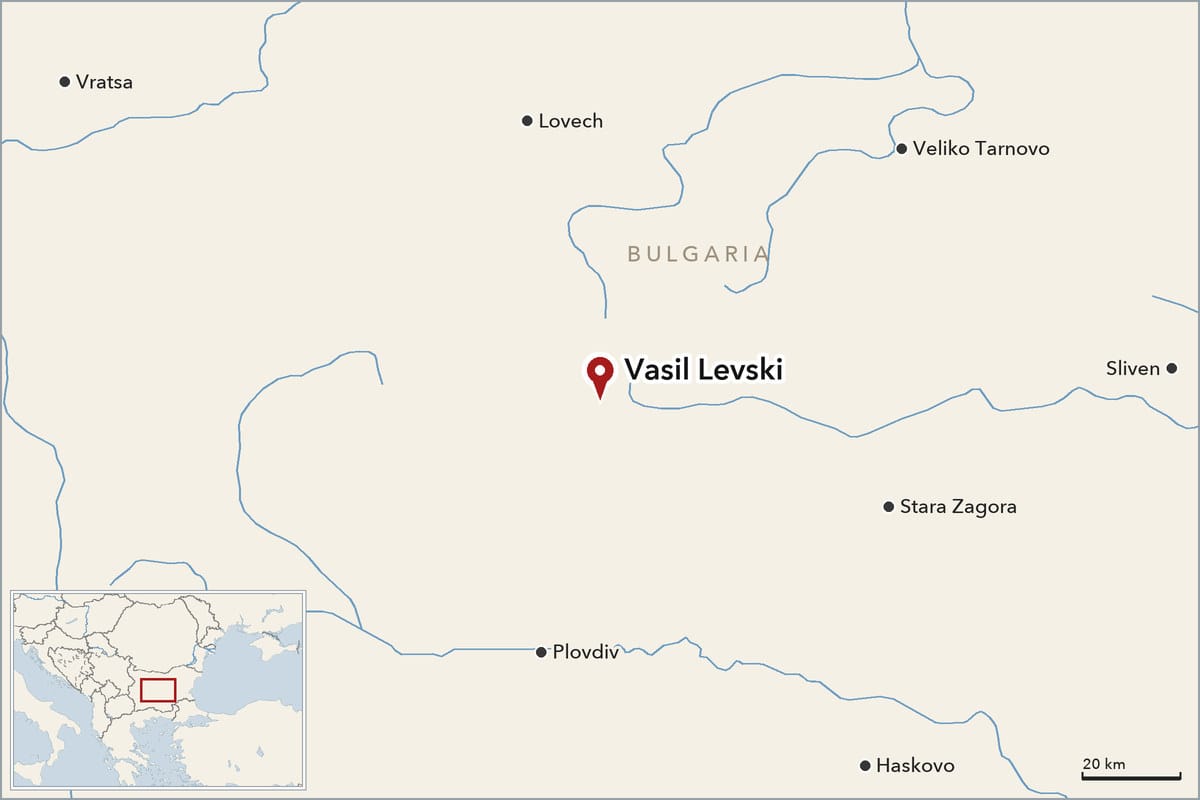
The settlement stands several kilometres from the Karlovo village of Vasil Levski, in terrain that bTV describes as hard to reach in an ordinary car. According to bTV, Kisyov came across ruins unknown to science there 30 years ago, in an old vineyard. bTV says locals destroyed many of them in the early 20th century to build houses, and Kisyov says around 15 houses were built from stone blocks taken from the site. Work then went on with many interruptions for lack of money. Arkeonews gives the dating as mainly the sixth and fifth centuries BC.
bTV reports a large settlement with massive architecture, a citadel and a temple complex. Only part of the citadel, which covers 5 decares, had been excavated at the time of the report. KarlovoPress, a local outlet, puts the whole site at over 30 decares (3 hectares), as does Arkeonews, citing Karlovo Municipality. KarlovoPress also reports evidence of a Thracian sanctuary on the spot as early as the ninth century BC, and says the citadel has yielded the earliest known Thracian temple building to date.
Kisyov points to several details that set the place apart:
- Roof tiles. The temple buildings were roofed with large tiles, which he describes as three-layered: a red coating at the base, black stripes of varnish, and a golden surface made with scattered mineral pigment. He says they were fired above 900 degrees and have survived almost unaffected by weather. Arkeonews notes that the site is sometimes called the "Golden City of the Thracians", a modern designation tied to these tiles.
- Walls. The fortress wall has stone blocks on both faces with a river-stone fill between them. bTV says this technique was unusual for the sixth century BC and characteristic of ancient Greece.
- Imports. He reports transport amphorae for olive oil and wine from Chios, Samos and Thasos, and several women's glass-paste bead ornaments that he says came from the Baltic region.
Was this the first Odrysian capital?
In the bTV report Kisyov says the place may be the first capital of the Odrysian Kingdom, because its monumental building is characteristic only of Thracian rulers. bTV also says the settlement was abandoned suddenly but in an orderly way, with no traces of catastrophe or military destruction, and that it is presumed to have been the capital of the Odrysian ruler Teres I. Arkeonews, on 18 October 2026, said the city's ancient name remained unknown and that its identification as the kingdom's first capital had not been conclusively established.
My own reading is that the hooks make a better puzzle than a headline. Kisyov himself calls the find unique, and the two readings he offers pull in different directions, one towards temple furnishing and one towards the water. Until more of the building is excavated, or a chain turns up, the ring stays a mystery.
Sources
Buyukyildirim, O. (2026) 'Mysterious Bronze Mechanism Discovered in 2,500-Year-Old Thracian Temple', Arkeonews, 18 October 2026, available at: https://arkeonews.net/mysterious-bronze-mechanism-discovered-in-2500-year-old-thracian-temple-in-bulgaria/ (Accessed: 18 October 2026).
Informiran.net (2026) 'Загадъчен бронзов механизъм откриха при разкопки археолози', Informiran.net, 12 October 2026, available at: https://informiran.net/index.php/lyubopitno/zagadachen-bronzov-mehanizam-otkriha-pri-razkopki-arheolozi (Accessed: 18 October 2026).
KarlovoPress (2026) 'Златният град на траките“ край Васил Левски пази древни тайни', KarlovoPress, 16 October 2026, available at: https://www.karlovopress.com/%D0%B7%D0%BB%D0%B0%D1%82%D0%BD%D0%B8%D1%8F%D1%82-%D0%B3%D1%80%D0%B0%D0%B4-%D0%BD%D0%B0-%D1%82%D1%80%D0%B0%D0%BA%D0%B8%D1%82%D0%B5-%D0%BA%D1%80%D0%B0%D0%B9-%D0%B2%D0%B0%D1%81%D0%B8%D0%BB-2026-10-16 (Accessed: 18 October 2026).
Trafficnews.bg (2026) 'Непознати за археологията руини: Откриха загадъчен бронзов механизъм в Пловдивско', Trafficnews.bg, 11 October 2026, available at: https://trafficnews.bg/kultura/nepoznati-arheologiiata-ruini-otkriha-zagadachen-bronzov-391683/ (Accessed: 18 October 2026).
Picture credits
- Top picture: A part of the archeological excavations of the Thracian town near village Vasil Levski, Plovdiv District, Bulgaria. Photo: Nenko Lazarov (CC BY 2.5), Wikimedia Commons
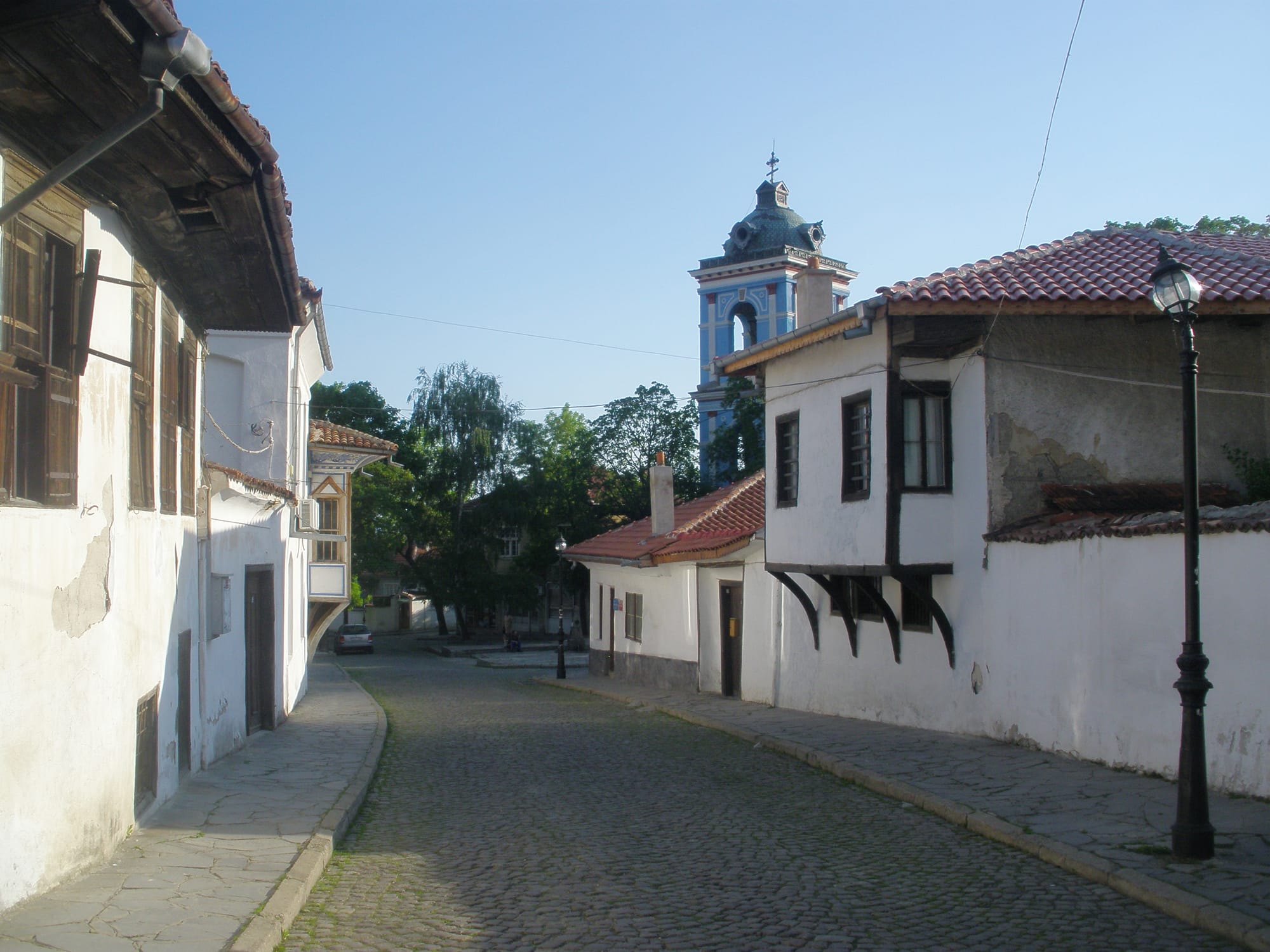
- Karlovo, Bulgaria. A location photo, not an image of the find or the site. Photo: TodorBelomorski (CC BY-SA 4.0), Wikimedia Commons
- Map: drawn from Natural Earth (public domain) and Wikidata.
