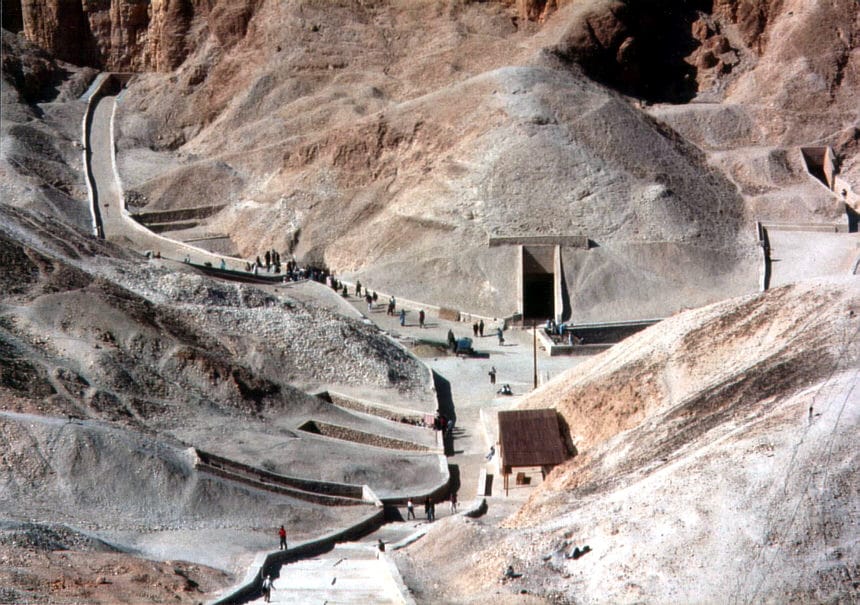
On 4 October 2025, Egypt's Minister of Tourism and Antiquities, Sherif Fathy, opened the tomb of Amenhotep III to visitors, after a restoration project that the ministry says ran for more than 20 years.
Who was involved
The ministry's announcement says the project, titled in Arabic as the conservation of the wall paintings of the tomb of King Amenhotep III, was a collaboration between Egypt's Supreme Council of Antiquities and two Japanese universities, Waseda and Higashi Nippon, under the auspices of UNESCO's Japanese Trust Fund. Fathy opened the tomb alongside Dr Mohamed Ismail Khaled, Secretary-General of the Supreme Council of Antiquities, and Dr Nuria Sanz, director of UNESCO's regional office in Cairo.
The ministry says the international team included Egyptian, Italian and Japanese conservators, with specialists in stone conservation, wall-painting conservation, architecture and civil engineering, rock monitoring, 3D scanning and Egyptology.
The ministry also singled out one man. Egyptian restorer Mohamed Mahmoud, who had worked on the tomb since the project began and happened to be in the area, was called up to the platform by the minister. According to the ministry's account, Mahmoud said that although he had reached retirement age, he had insisted on attending so he could see the dream he had devoted more than twenty years of his career to come true.
Three phases of work
According to the ministry, the work came in three consecutive phases: 2001 to 2004, 2010 to 2012, and 2023 to 2024.
The ministry says the first two phases covered conservation of the wall paintings on the walls, pillars and ceilings of chambers E, I and J, and significant progress on the king's red granite sarcophagus lid. More than 200 pieces of the lid were reassembled, its surface cleaned, and it was mounted on a metal base. Work also improved the stairs leading into the tomb and its lighting. The entrance now carries information and explanatory panels, including a general plan of the tomb's interior.
The tomb and its history
The ministry describes the tomb as one of the largest royal tombs on Luxor's West Bank and a reflection of the artistic and cultural flowering of the New Kingdom. Its ceiling is decorated with yellow stars on a dark blue background representing the sky, and the burial chamber walls carry texts from the Amduat. Ancient Origins gives a 36-metre passage and a 14-metre descent leading to three chambers: one for the king and two for his wives, Tiye and Sitamun.
The ministry's account of the tomb's history runs as follows:
- Archaeological evidence suggests work began under Thutmose IV, whose name was found in the foundation deposits, and that his son Amenhotep III completed the construction and decoration.
- French engineers Prosper Jollois and Édouard de Villiers du Terrage found the tomb in 1799 during the French campaign in Egypt, though, the ministry notes, the tomb was already known, having been mentioned in the memoirs of a British traveller it names as William George Brown.
- Howard Carter later revealed the tomb's contents in full, in 1915.
- During the 19th century, salt build-up damaged the wall paintings and cracks in the pillars grew, affecting the tomb's structural and decorative integrity.
- In the reign of Smendes of the 21st Dynasty, the king's mummy was moved with other royal mummies to the royal cache later found in the tomb of Amenhotep II (KV35), after the original tomb had been robbed during times of unrest.
Egypt's National Museum of Egyptian Civilization (NMEC) agrees on the burial and the later move: Amenhotep III was buried in the western arm of the Valley of the Kings, in KV 22, his tomb was robbed in antiquity and his mummy moved to the tomb of his grandfather, Amenhotep II. NMEC says he ascended the throne as a teenager and ruled for 37 or 38 years, and that his memorial temple was fronted by the statues now known as the Colossi of Memnon.
Why the reopening matters
Khaled framed the reopening as a boost to Egyptian cultural tourism: he said the tomb was among the most important in the Valley of the Kings and that the reopening was a distinguished addition to the valley's tombs and to Egypt as a tourist destination, particularly cultural tourism. UNESCO's Sanz, for her part, said the day celebrated several achievements, among them the partnership between UNESCO, the ministry and the Japanese side, and the research on the tomb and its inscriptions.
Ancient Origins noted that the reopening came weeks before the Grand Egyptian Museum's opening, which it said was scheduled for 1 November 2025. Futura-Sciences reports that the museum near the Giza pyramids held its grand opening on 1 November 2025.
That the tomb is open again after two decades of conservation work is good news for anyone who wants to see it, and the detailed phase-by-phase account the ministry gives is the kind of record such projects should leave.
Sources
Ancient Origins (Manners, G.) (2025) 'Amenhotep III Tomb Reopens After Two Decades of Meticulous Restoration', Ancient Origins, 7 October 2025, available at: https://www.ancient-origins.net/news-history-archaeology/amenhotep-iii-tomb-00102192 (Accessed: 26 October 2026).
Egyptian Ministry of Tourism and Antiquities (2025) 'After two decades of restoration, the Minister of Tourism and Antiquities opens the tomb of King Amenhotep III in the Valley of the Kings on the West Bank' (Arabic), Ministry of Tourism and Antiquities, 4 October 2025, available at: https://mota.gov.eg/ar/%D8%A7%D9%84%D8%A3%D8%AE%D8%A8%D8%A7%D8%B1-2-1-1/%D8%A8%D8%B9%D8%AF-%D8%B9%D9%82%D8%AF%D9%8A%D9%86-%D9%85%D9%86-%D8%AA%D8%B1%D9%85%D9%8A%D9%85%D9%87%D8%A7-%D9%88%D8%B2%D9%8A%D8%B1-%D8%A7%D9%84%D8%B3%D9%8A%D8%A7%D8%AD%D8%A9-%D9%88%D8%A7%D9%84%D8%A2%D8%AB%D8%A7%D8%B1-%D9%8A%D9%81%D8%AA%D8%AA%D8%AD-%D9%85%D9%82%D8%A8%D8%B1%D8%A9-%D8%A7%D9%84%D9%85%D9%84%D9%83-%D8%A3%D9%85%D9%86%D8%AD%D8%AA%D8%A8-%D8%A7%D9%84%D8%AB%D8%A7%D9%84%D8%AB-%D8%A8%D9%85%D9%86%D8%B7%D9%82%D8%A9-%D9%88%D8%A7%D8%AF%D9%8A-%D8%A7%D9%84%D9%85%D9%84%D9%88%D9%83-%D8%A8%D8%A7%D9%84%D8%A8%D8%B1-%D8%A7%D9%84%D8%BA%D8%B1%D8%A8%D9%8A-%D8%A8%D8%A7%D9%84%D8%A3%D9%82%D8%B5%D8%B1 (Accessed: 26 October 2026).
Futura-Sciences (Futura Team / Pia Gray) (2026) 'Egypt reopens the 3,400-year-old tomb of one of its greatest pharaohs after 20 years', Futura-Sciences, 25 October 2026, available at: https://www.futura-sciences.com/en/egypt-reopens-the-3400-year-old-tomb-of-one-of-its-greatest-pharaohs-after-20-years-a1_35232/ (Accessed: 26 October 2026).
National Museum of Egyptian Civilization (2021) 'Amenhotep III', NMEC, 13 April 2021, available at: https://nmec.gov.eg/mummies-hall/amenhotep-iii/ (Accessed: 26 October 2026).
Picture credits
- Top picture: Luxor (Egypt): Valley of the Kings. Image: Peter J. Bubenik / Wikimedia Commons (CC BY-SA 2.0)
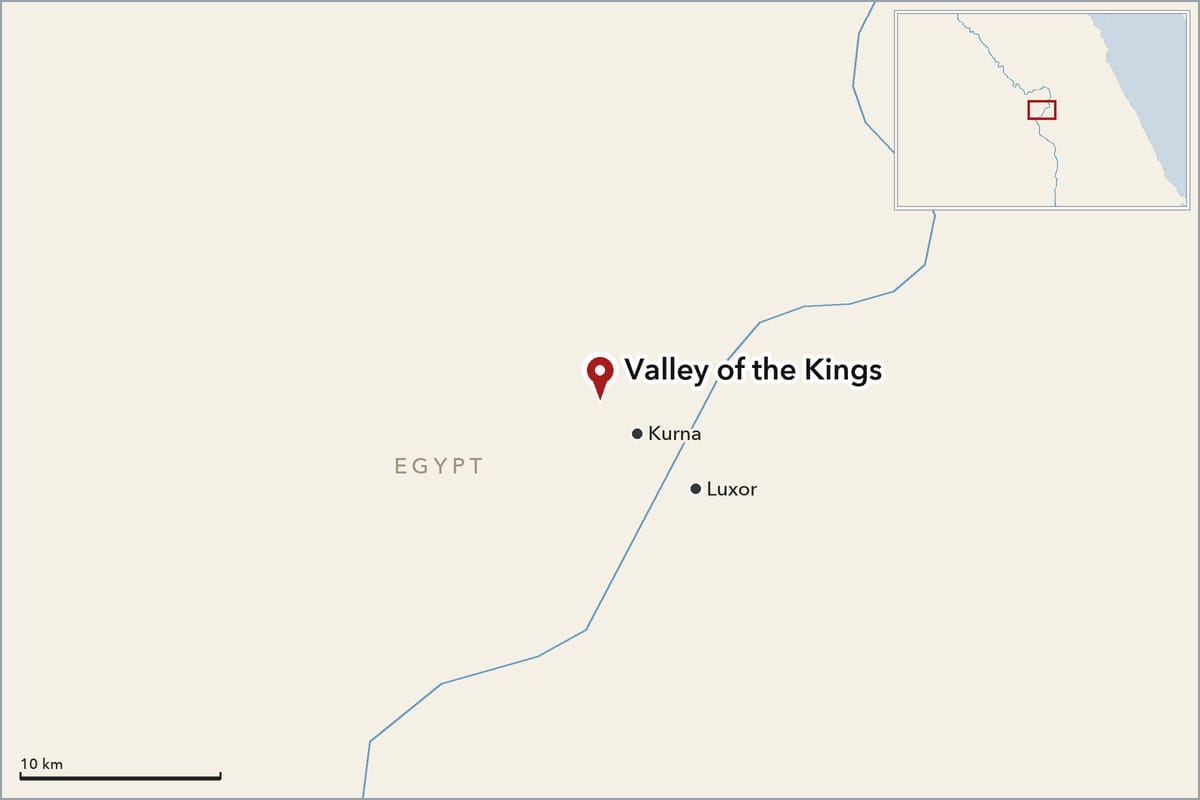
- Map: drawn from Natural Earth (public domain) and Wikidata.
