A team led by Kelly Graf of the University of Kansas has published a detailed account of Shég' Xdaltth'í', a site in interior Alaska that was occupied about 13,800 years ago. The paper appeared in Science Advances on 14 October 2026. It describes a camp with what the authors read as a possible shelter, a large earth oven and a sewing kit. Several of its finds resemble material from the Russian side of the Bering Land Bridge.
A ridge above the Tanana
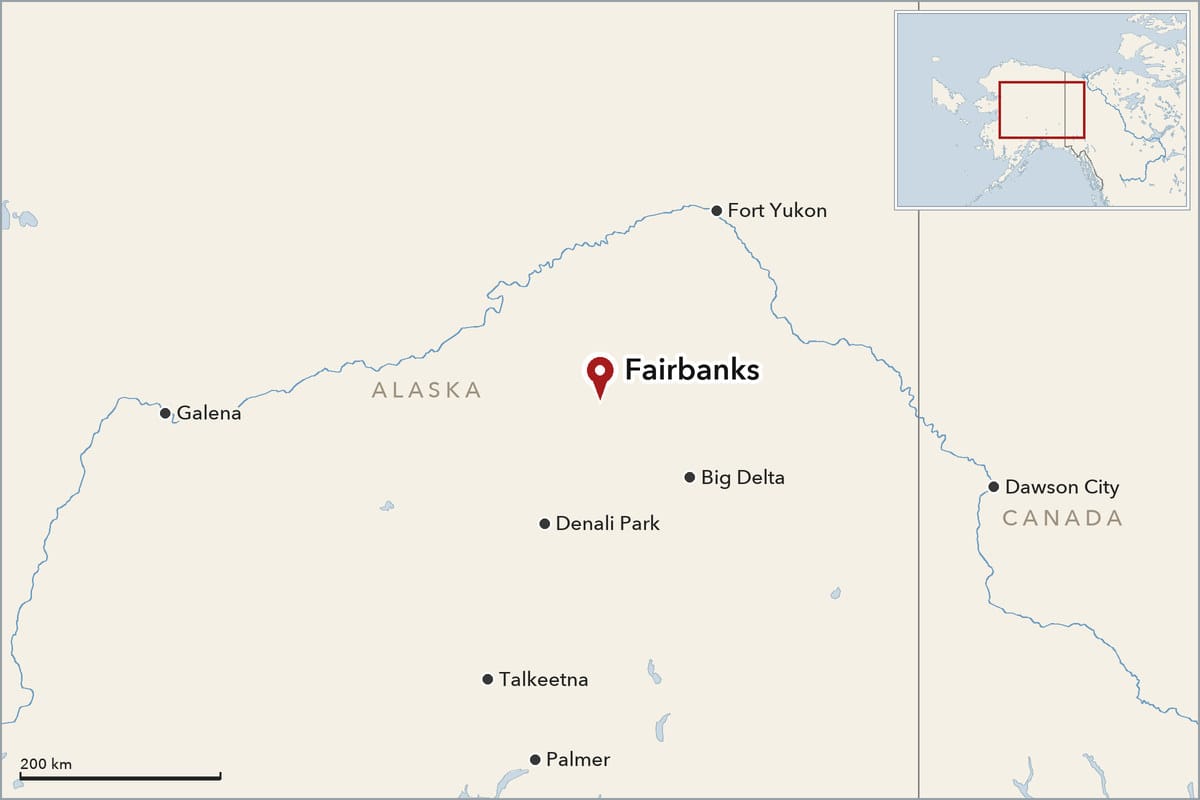
The site lies 55 km south-southeast of Fairbanks, on a bluff overlooking the Tanana River. The paper gives its name as meaning "They were there" in Alaska Native Athabascan, and says it was formerly called McDonald Creek. In their acknowledgements the authors thank the elders of Healy Lake Village, who named the site.
The site was found in 2010 during a cultural resources survey. Graf's team has worked there since 2013, and a 25 m² block excavation began in 2016. The paper describes three Late Pleistocene components, dated to 13.8, 13 and 12.7 thousand years ago. The authors concentrate on the oldest, which they say yielded more than 80,000 specimens. Their Bayesian radiocarbon model dates it to 13,850 to 13,500 calendar years ago. They add that the model may have narrowed the range too far, and that the evidence could point to several occupations between about 14,050 and 13,120 years ago.
The authors say plainly that the site is not the oldest in Beringia. They point to Swan Point, about 14,200 years old, in the same Tanana region.
The possible dwelling
The authors identify a charcoal-stained oval area at least 3 m across. It contains a hearth about 70 cm wide, a pit about 80 cm wide and 17 cm deep, and a possible postmold nearby. Their discussion interprets this as an artificial shelter, most likely a partly covered lean-to opening to the south.
Inside the possible dwelling, about 50 cm south of its hearth, lay a possible stone anvil, which Graf et al. suggest was used for marrow extraction or bone-grease preparation; Graf told the KU News Service it was surrounded by bashed-up bison bones, and that the team thinks they were broken to extract marrow and likely to render grease. South of the dwelling was an outdoor hearth. About 2.5 to 3 metres west of that lay a pile of discarded bones, surrounded by a wider scatter of bones; beneath the western edge of that scatter lay a large burn feature packed with fire-affected rock. The authors suggest this was an earth oven, and Live Science reports it was likely used to slow-cook meat for a large family group.
The paper's own wording is hedged: the complex feature "represents the earliest potential case of a habitation structure in North America." Live Science's headline calls it "the oldest dwelling in the Western Hemisphere", which goes a step beyond the word "potential". The excavation is also unfinished. Parts of these features run into the walls of the dig and have not been fully uncovered.
Needles, tools and a wolf jaw
The authors report 18 worked bone, antler and ivory pieces, among them eight needle fragments and an antler pendant with a drilled hole. Live Science reported, citing the study, that the needles are the oldest found in the Western Hemisphere.
The stone tools include bipointed, diamond-shaped bifaces, several with ground stems that suggest they were mounted in handles or shafts. The authors call them hafted bifaces and decline to say whether they were projectile points or knives until microscopic wear studies are done. In the paper's account this diamond shape is new to central Alaska but matches pieces from Nikita Lake and Berelekh in western Beringia. All 25 obsidian artifacts came from the Batza Téna source, 370 km to the northwest.
Graf said in a KU News Service release: "It's the only site in Alaska that features this clear diamond shape." She also said, "It suggests people traveled across the Bering Land Bridge to and possibly from this location."
The team also analysed a wolf jaw from among at least 15 wolf specimens. Its shape did not match dire wolves, Pleistocene Beringian wolves or modern wolves of the northern US, which the authors take to suggest a distinct population. From there they suggest the inhabitants may have been dog owners, writing that "like humans, potentially, the canids of Shég' Xdaltth'í' and other early Alaskan sites were recent immigrants from Asian Beringia." They add that wolves and the earliest dogs can be indistinguishable in the archaeological record, and that further comparison and genetic tests may eventually resolve the question.
What it adds
The authors call the site the earliest known Nenana Complex occupation east of the land bridge. They argue it supports a cultural difference between microblade and non-microblade industries on both sides of the land bridge. Whether the site's people were Ancient Beringians or a separate population, they write, will require ancient genomes to resolve.
Live Science also quoted Spencer Pelton of the University of Wyoming, who was not involved in the research. In an accompanying perspective he wrote that the site is "remarkable because it is the oldest site in the Americas containing a large and rich assemblage of features, artifacts, and faunal refuse indicative of prolonged residential occupation".
Graf told Live Science the find was unexpected: "It was a total surprise!" She also said that two of the paper's co-authors are elders from Alaska Native corporations nearest the site, and that she hopes to bring younger Alaska Native people to future digs. Among the paper's co-authors are Evelynn Combs, of the Healy Lake Tribal Council, and Donald Charlie, of the Nenana Native Association.
Sources
Graf, K.E., Goebel, T., Henry, A., Hockett, B., Shelley, N., Antonosyan, M., Meachen, J., Sewing, M., Harbort, M., Esdale, J.A., Allaun, S.A., Gore, A.K., Rasic, J.T., Roberts, P., Combs, E. and Charlie, D. (2026) 'Highlights from an early base camp in Beringia 13,800 years ago: Shég' Xdaltth'í' and the Late Pleistocene peopling of Alaska', Science Advances, 12(42), eaeh0802, published 14 October 2026, doi:10.1126/sciadv.aeh0802, available at: https://pmc.ncbi.nlm.nih.gov/articles/PMC13666009/ (Accessed: 26 October 2026).
Killgrove, K. (2026) 'Archaeologists discover the oldest dwelling in the Western Hemisphere at a 13,800-year-old site in Alaska', Live Science, 16 October 2026, available at: https://www.livescience.com/archaeology/americas/archaeologists-discover-the-oldest-dwelling-in-the-western-hemisphere-at-a-13-800-year-old-site-in-alaska (Accessed: 26 October 2026).
Niccum, J. (2026) 'Bering Land Bridge base camp reveals what life was like nearly 14,000 years ago', KU News Service, University of Kansas, 14 October 2026, available at: https://news.ku.edu/news/article/bering-land-bridge-base-camp-reveals-what-life-was-like-nearly-14000-years-ago (Accessed: 26 October 2026).
Picture credits
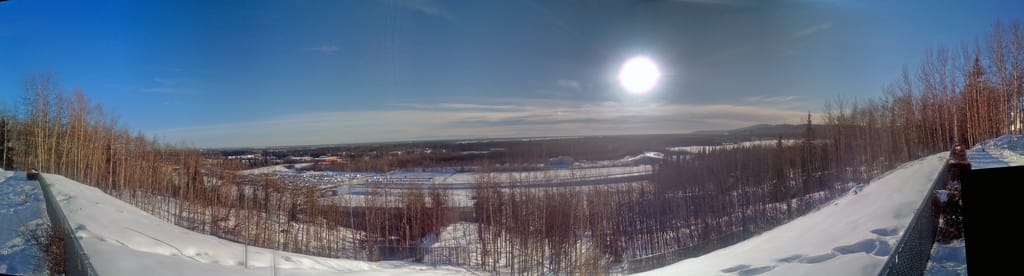
- Top picture: This is the valley in which Fairbanks and the surrounding area lies. Image: Tanana Valley Panorama by jkbrooks85, CC BY 2.0, via Wikimedia Commons
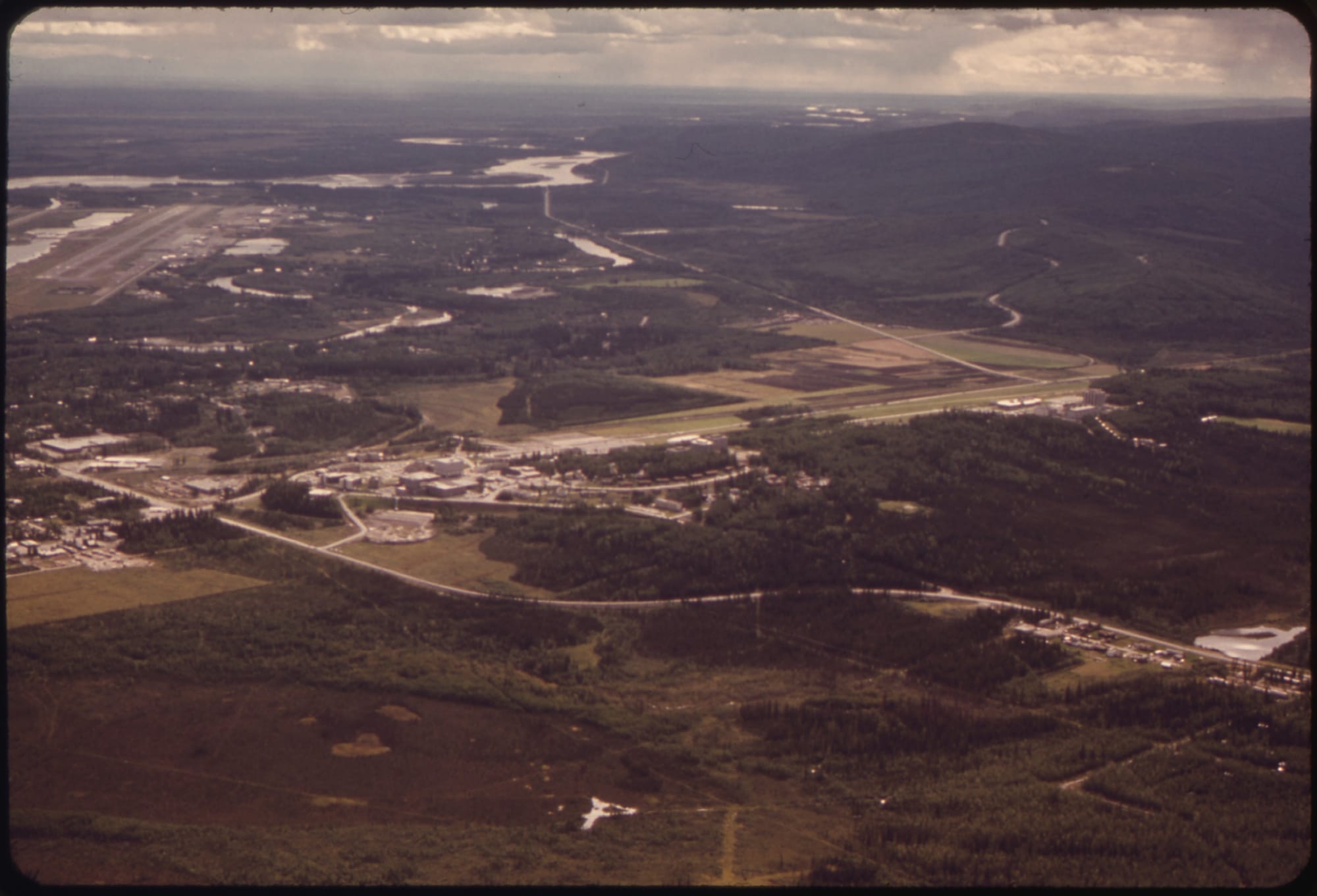
- Fairbanks. The site lies 55 km south-southeast of the city. Image: View of Fairbanks, Southwest, Including the Main Campus of the University of Alaska, Fairbanks International Airport and the Tanana River, by Dennis Cowals, EPA Documerica, via NARA (source)
- Map: drawn from Natural Earth (public domain) and Wikidata.

